Nose in a book

Reviews and other ramblings

  • Home
  • Reviews archive
    • Book reviews
    • TV reviews
    • Theatre reviews
  • TBR
  • Challenges
    • The Classics Club
    • 2014 Popular-Science Reading Challenge
    • Cookery challenge
    • The Gilmore Girls Reading Challenge
    • 2013 TBR Pile Challenge
    • 2013 Translation Challenge
    • Crime and Punishment read-a-long
  • About
    • Cookie legal stuff
  • Home
  • Reviews archive
    • Book reviews
    • TV reviews
    • Theatre reviews
  • TBR
  • Challenges
    • The Classics Club
    • 2014 Popular-Science Reading Challenge
    • Cookery challenge
    • The Gilmore Girls Reading Challenge
    • 2013 TBR Pile Challenge
    • 2013 Translation Challenge
    • Crime and Punishment read-a-long
  • About
    • Cookie legal stuff

Free speech is unthinkable

March 29, 2017

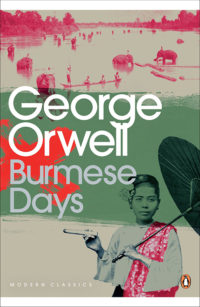
Burmese Days
by George Orwell

I’m always nervous of contemporary books about colonialism but I figured I’d be in safe hands with Orwell. Like A Passage to India, the major theme is the racism inherent to colonialism, but Orwell does a better job than Forster of clearly separating his characters’ racism from his own opinions on the subject.

The first character we meet is U Po Kyin, a middle-ranking Burmese official who has plotted and bribed his way to where he is and continues to plot his way further up. The next step in his plan is to destroy the reputation of Dr Veraswami, the local doctor. The biggest hurdle he faces is that the doctor is friends with Mr Flory – a white British man, in a country where the ruling British are unassailable.

For the most part the rest of the novel follows Flory as he tries to keep a grip on his awkward position in society. They’re in a small town in northern Burma and the Europeans-only Clubhouse has just eight members, most of whom are, like Flory, timber merchants who spend most of their time in the jungle. Aside from Flory they keep themselves apart from the native population and refer to them with racial epithets that are shocking to modern ears, and I suspect even at the time would have been frowned on “back home”. Flory makes clear by his friendship with the doctor that he doesn’t agree with the prevailing opinion, but he rarely opens his mouth to object when racist things are said.

“[Flory said,] ‘I don’t want the Burmans to drive us out of the country. God forbid! I’m here to make money, like everyone else. All I object to is the slimy white man’s burden humbug. The pukka sahib pose. It’s so boring. Even those bloody fools at the Club might be better company if we weren’t all of us living a lie the whole time.’
‘But, my dear friend, what lie are you living?’
‘Why, of course, the lie that we’re here to uplift our poor black brothers instead of to rob them. I suppose it’s a natural enough lie. But it corrupts us, it corrupts us in ways you can’t imagine. There’s an everlasting sense of being a sneak and a liar that torments us and drives us to justify ourselves night and day. It’s at the bottom of half our beastliness to the natives.’ ”

Continue reading “Free speech is unthinkable”

Kate Gardner Reviews

Sunday Salon: Weekending in Devon

March 26, 2017 2 Comments

The Sunday SalonDespite losing an hour, we packed in a lot of fun this weekend. Yesterday we took the steam train and ferry from Paignton to Dartmouth with some friends. The weather was perfect, with blue skies and some real warmth from the sun for one of the first times this year. We ate local crab sandwiches, took a cruise around the estuary and (after some searching) found a place for cream tea with delicious scones and terrible wait staff.

We weren’t in Devon for a literary break, but it so happens that one of the stops on the steam train line is Greenway Halt, which exists solely for visitors to Greenway, the estate of one Agatha Christie. I haven’t read her books since I was a teenager but back then I was a big fan. I couldn’t resist picking up one of her titles in the railway shop. Maybe I’ll rekindle my fandom and next time we’re in Devon I can drag Tim round another author’s home!

Braveheart

Continue reading “Sunday Salon: Weekending in Devon”

Kate Gardner Blog

The hands of loss keep touching the memory

March 19, 2017

All the Rivers
by Dorit Rabinyan
translated from Hebrew by Jessica Cohen

I remember spotting this book in the Serpent’s Tail catalogue last year and immediately liking the sound of it. It had potential to be brilliant or awful, to deal with complex matters sensitively or insensitively. Thankfully, to my mind, Rabinyan got it just right.

Liat is a translation student spending the academic year in New York City. She is practical and idealistic. Hilmi is a painter struggling for his artistic break. He is passionate and pessimistic. When they meet one day in a coffee shop there is instant attraction, but it also immediately clear that theirs won’t be a straightforward courtship. Besides the fact that Liat has only six months left on her visa, there’s the question of where she will be moving back to. Because she is from Israel and he is from Palestine.

The narrative isn’t quite linear, dealing with different aspects of the relationship in turn. First there’s getting to know each other. Then there’s Hilmi’s burgeoning art career. Then how they act around their friends. And so on. The day of Liat’s departure keeps getting close, only for the story to jump back a few months to fill in fresh detail. It feels very much like the way someone remembering events might structure their thoughts.

Continue reading “The hands of loss keep touching the memory”

Kate Gardner Reviews

In our house money was a god. But it was an angry, careful god

March 17, 2017

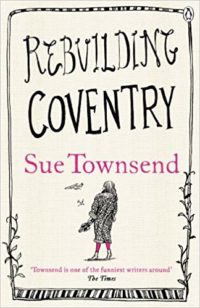
Rebuilding Coventry
by Sue Townsend

Sue Townsend was reliably both funny and socially relevant, and she doesn’t disappoint here. The title doesn’t refer to the Midlands town’s destruction in World War Two – it is, rather, about a woman called Coventry.

Coventry Dakin introduces herself with two facts: she’s beautiful and she killed a man. Specifically, her neighbour Gerald Fox. And now she’s on the run in London, without her handbag.

Killing Gerald was a spur of the moment decision, hence Coventry’s less-than-perfect running-away outfit. We learn the story behind the murder and the fallout for Coventry’s husband and children, interspersed between Coventry’s survival on the streets of the capital.

This being a comedy, there is an element of the ridiculous to much of the action. The murder weapon is an Action Man doll. She had been in the middle of cleaning her chimney, so she’s wearing old clothes and covered in soot. Her husband Derek is really only interested in his tortoises.

Continue reading “In our house money was a god. But it was an angry, careful god”

Kate Gardner Reviews

There is a silent ripeness to the air

March 10, 2017

Harvest
by Jim Crace

This is an unusual book, primarily because of its historical setting and premise. While there are plenty of historical novels, there are few that remain so determinedly non-specific about the time and place in which they are set and even fewer where the action revolves around the forced enclosure of common land.

England (which is presumably the setting, though even that isn’t stated outright) had a series of Enclosure Acts from the 12th century to the 19th, but they became especially common in the 17th and 18th centuries. Effectively, this allowed landowners to seize common land – land that their tenants, which often meant whole villages, farmed for their own use – and enclose it, controlling what was farmed there. This might mean charging rent to local people or it might mean switching to a type of farming that employed far fewer people, such as sheep farming.

It doesn’t sound like the most auspicious basis for a book, but actually that part of it really worked for me. It felt very relevant to be reading about social injustice, the rich getting richer while the poor lose what little they have. There is some action too – arson, violence, death – which the landowner turns to his advantage, though the villagers don’t realise it.

Continue reading “There is a silent ripeness to the air”

Kate Gardner Reviews

I am swing-swing between worlds, people, things

March 5, 2017February 9, 2020

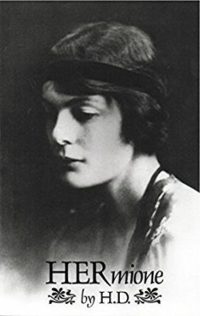
HERmione
by Hilda “HD” Doolittle

I’ve delayed writing this review because I really didn’t know how to describe this book. It’s a strange, repeating, myth-referencing auto-fiction about a young woman. The strangeness and repetition point to the main character’s emotional fragility, but they also reflect her wider character – an intelligent woman well-versed in arts and sciences who can quickly get lost in thoughts and dreams.

It’s the fictionalised memoir of a year in Hilda Doolittle’s youth, 1907–08, when she was 21. She wrote this in 1927 and at the time of her death in 1961 was preparing it for publication, but it then got packed away with all her literary estate and didn’t finally see publication until 1981. This may or may not be related to the bisexual nature of both the author and her fictionalised counterpart.

The story takes a bit of teasing out from the abstract prose, and it helps to learn about HD’s own life to fully follow it (in my copy there is an introduction by HD’s daughter that fills in some gaps), but the actual events aren’t really what’s important here. HD has done an incredible job of finding the words to depict fragile mental health.

Continue reading “I am swing-swing between worlds, people, things”

Kate Gardner Reviews

February 2017 reading round-up

February 28, 2017May 19, 2017 2 Comments

girl reading

Does every month fly by when you get older? I can’t remember the last time it didn’t feel that way. Time passes too fast. Then again, it’s been another reasonably busy month. I’ve kept up the running, on track to run my first 10k in British Science Week as part of Run the Solar System. Once I have the virtual race under my belt, I’ll be all set for the real thing in early May.

On the cultural front, I went to see Othello at the Tobacco Factory Theatre, which I thoroughly enjoyed. And I went to Bletchley Park, which has left me itching to learn more about life there in World War II, if I can only choose between the hundreds of books written about it over the past 20 years or so since it became public knowledge.

Speaking of science and engineering history that had been relatively hidden, tonight I watched the film Hidden Figures about black women who worked as computers at NASA in the 1960s. It’s a remarkable film, a stark reminder of how recently widespread discrimination not only existed but was the norm, and what a fight it was for talented women such as Katherine Johnson, Dorothy Vaughan and Mary Jackson to do their work every day. I now really want to read the book behind the film, Hidden Figures by Margot Lee Shetterly, though I understand it’s rather different, taking a wider look at the historical context and less of a personal story of those three women.

Continue reading “February 2017 reading round-up”

Kate Gardner Blog

Relationships are about stories, not truth

February 27, 2017

Apple Tree Yard
by Louise Doughty

This got lots of great reviews when it came out, which is how it came to be on my shelves but it wasn’t until my Twitter stream was full of responses to the recent BBC adaptation that I decided to read it.

I remember the reviews gave me a sense that this was different from the standard crime novel in some way, and they were right, but even now I struggle a little to put my finger on the exact difference. It wasn’t quite what I expected.

For starters, the actual crime is held back until late in the story. The first half of the book builds up tension while filling in the back story. Biologist Dr Yvonne Carmichael has just given evidence to a Select Committee in the Houses of Parliament when she bumps into an attractive stranger who offers to show her the private chapel. Thus begins their affair. But while they are both married, it isn’t clear for a long time exactly what crime this leads to, or why the book’s prologue has Yvonne being questioned in a criminal court.

Continue reading “Relationships are about stories, not truth”

Kate Gardner Reviews

Sunday Salon: Catching up

February 26, 2017February 26, 2017 2 Comments

The Sunday SalonThis is the blog post I intended to write last Sunday night, but I was exhausted from having such a full weekend so I curled up on the sofa with a book and fell asleep. It’s not a bad way to end the week!

And what exactly did I fill last weekend with? Well, I’m going to start with Friday morning because that way I get to mention something I’m super proud of: I ran 8 km before going to work last Friday. That is the furthest I have run yet, and marks the first time I felt actually confident that I will be able to run 10 km by early May, when the Bristol race that I’ve entered comes around. (I tried to repeat the achievement this week and managed 7.5 km, which is not to be sniffed at, but slightly disappointing when I now know I can beat it!)

Last Friday night, we went with my Mum and brother to the theatre to watch the Shakespeare at the Tobacco Factory production of Othello. I really enjoyed it and thought the acting excellent. The local press have been a bit sniffy, and I do agree that some of the modern touches were a misstep. But I thought the central relationships – between Othello and Desdemona, between Othello and Iago, and between Othello and Cassio – were really well portrayed.

Continue reading “Sunday Salon: Catching up”

Kate Gardner Blog

I still find “Negro” a word of wonders, glorious and terrible

February 23, 2017

Negroland: a Memoir
by Margo Jefferson

This is an unusual memoir. It’s heavily stylised, experimental even, but it’s also rather scholarly in its approach to the historical context of Jefferson’s own life.

Margo Jefferson was born in 1947 and raised in a well-to-do black family in Chicago, part of a black elite society with its own specific rules, norms and challenges. And this is what she documents. It’s an unusual subject for a memoir, and in keeping with that, often doesn’t feel like a memoir at all. Jefferson doesn’t bare her soul, or reveal any shocking family secrets. She doesn’t even stick to first person, slipping in and out of referring to herself in the third person.

There is a lot of background information provided about the formation of America’s black elite, which at first felt a little excessive and/or dry until I realised how recent it all was, and in fact most of the people she refers to turn out to be family friends. There is also a lot about physical appearance – how people with different types of hair handled it, how nuances of skin colour and facial shape could affect your place in society. Usually I could not be less interested in hair and make-up, but of course its relevance to this story is rather different. Because even though Jefferson was and is rich, educated and well-connected, she and her friends and family cannot get away from the fact that they are black and therefore different.

Continue reading “I still find “Negro” a word of wonders, glorious and terrible”

Kate Gardner Reviews

Posts pagination

1 … 42 43 44 … 124

Archives

RSS Nose in a book

  • Book review: We Have Always Lived in the Castle by Shirley Jackson
  • Book review: Ripe by Sarah Rose Etter
  • February 2026 reading round-up

Me on the internets

  • @kate_in_a_book@mas.to (Mastodon)
  • Flickr/noseinabook
  • Instagram/kate_in_a_book
  • StoryGraph/kate_in_a_book

Categories

  • Blog
  • Reviews
  • Uncategorized
Proudly powered by WordPress | Theme: Dream by vsFish.