Nose in a book

Reviews and other ramblings

  • Home
  • Reviews archive
    • Book reviews
    • TV reviews
    • Theatre reviews
  • TBR
  • Challenges
    • The Classics Club
    • 2014 Popular-Science Reading Challenge
    • Cookery challenge
    • The Gilmore Girls Reading Challenge
    • 2013 TBR Pile Challenge
    • 2013 Translation Challenge
    • Crime and Punishment read-a-long
  • About
    • Cookie legal stuff
  • Home
  • Reviews archive
    • Book reviews
    • TV reviews
    • Theatre reviews
  • TBR
  • Challenges
    • The Classics Club
    • 2014 Popular-Science Reading Challenge
    • Cookery challenge
    • The Gilmore Girls Reading Challenge
    • 2013 TBR Pile Challenge
    • 2013 Translation Challenge
    • Crime and Punishment read-a-long
  • About
    • Cookie legal stuff

Triumph and tragedy

December 12, 2010

T-Minus: the Race to the Moon
by Jim Ottaviani (author), Zander Cannon and Kevin Cannon (artwork)

I think this comic book is strictly aimed at children but that didn’t stop me from thoroughly enjoying it and learning all sorts of new facts about the space race. And I live with Tim and have been to Kennedy Space Center, so I consider myself reasonably well versed in this stuff.

The story begins in 1957 with the text “T-minus 12 years” and ends (except for a short postscript) in 1969 at “T-minus zero”, the moment when Neil Armstrong set foot on the Moon. The story inbetween shows both the Russian and the American teams of scientists, engineers and pilots, not to mention the politicians who had their own ideas about going into space. There’s more detail about the Americans, possibly because much more information about them is available to an American author, and not every question I had was answered, but overall this was an impressive and entertaining summary of historical events.

Most of the missions get their own panel with a list of pertinent details: rocket used, launch date, flight duration, etc. Deaths and other disasters were not lingered on, which I actually found a little difficult, but there were enough of them to make it clear how immensely daring the astronauts and cosmonauts were. These men and women (the first woman in space was Russian Valentina Tereshkova in 1963 – I didn’t know that before today) really were braving the unknown, human guinea pigs essentially. Early flights went up before having figured out urine disposal or temperature control. There’s a scene where cosmonauts discuss not taking much food on a 2-day flight because the smell in the capsule made them feel too queasy to eat.

There are a couple of jumps back in time to show the development of the science behind space travel, though I’m sure another book this long could have been written/drawn on that subject. The story is reverent without painting everyone involved as perfect. NASA engineer Caldwell C Johnson is picked out as being a workaholic who rarely saw his family, lost track of days of the week and didn’t stop to celebrate each victory on the way because he was already immersed in the next challenge (or indeed the one after that). Russians are shown mocking American failures and achievements, not to mention covering up the cause of Laika’s death and keeping many other details secret. Interestingly, the book does mention that the American and Russian teams met up every so often to discuss their work and that these meetings were friendly affairs, but no detail is given. I don’t know if this is because it’s all classified or if there were no details important enough to pick out for this abbreviated history.

The full-page bibliography reveals that most of the authors’ sources came from NASA, including mission transcripts, but they also spoke to astronauts Buzz Aldrin, Neil Armstrong and Alan Bean. They also say that they didn’t read one particular book they found because it was only available in Russian, which sounds like a bit of a rubbish excuse when researching Russian history. Surely they could have found a Russian speaker to help out? However, they did do a lot of research (they provide a web address for the full list, described as a stack of books “more than ten feet tall”) and it shows.

I heartily recommend this to any adult or child interested in the space race, but I would also be interested in learning more about the Russian side of things.

Published 2009 by Simon & Schuster. Available from GT Labs.

Kate Gardner Reviews

The Great Grocery Bag Exchange #2

December 10, 2010 4 Comments

My second parcel of goodies is here (after a delay while it sat forlornly at the sorting office until Tim kindly cycled over there and fetched it for me). In case anyone missed my last post about this, I took part in the Great Grocery Bag Exchange, organised by Carin of A Little Bookish. Go here to find out more.

This second parcel came from Lydia of The Lost Entwife, another book blog that was new to me and I am now enjoying. Which was what this was all about, after all. Thank you Lydia for my lovely lovely parcel. Here they are:

More goodies in the post

Yes I have eaten three of those rather chunky cookies already and yes they are very tasty. Yum yum. Thanks again Lydia!

Kate Gardner Blog

Boys will be boys

December 9, 2010March 11, 2012 1 Comment

Slam
by Nick Hornby

I’ve read Nick Hornby books before and I’m reasonably certain that I liked them. So I was a bit disappointed to find that I was so, well, disappointed with this one.

The story is narrated by Sam, a teenage boy, which was the first thing that grated. Not that it was done badly. In fact it was probably the realism of the narrative voiced that made it so irritating. This is not a smart or interesting kid. It’s a slightly dumb, largely boring, typical teenage boy. I don’t usually mind disliking a main character but I think I still need to be interested in them. This kid skateboards, talks to his Tony Hawk poster, is a little clueless about girls but still somehow pulls the first pretty girl he tells us about, rarely sees the couple of friends he names and doesn’t have a lot to say about school, except that he likes art and is apparently good enough to stand a chance of going to art college. So he’s either dull or not very well fleshed out. I suspect it’s mostly the former but a little bit of the latter too.

I know that sounds harsh. And maybe if you’re a young guy you’ll totally relate to Sam. But even if I don’t relate to a character I usually feel that I have learned something by being in their shoes for the length of a book. I didn’t learn anything here. I mean, who couldn’t figure out for themselves that teen pregnancy is hard?

Yup, that’s the subject matter. It’s hinted at for a while before it’s said outright but I don’t think it’s much of a spoiler to say it here. And I suspect this is a realistic portrayal in many respects, but it doesn’t get into many of the issues surrounding the subject, really. Mostly it’s a boy whining about how shit it is that he got his girlfriend pregnant even though they used a condom. And if it had been written differently I might have sympathised, but I really didn’t. The writing was easygoing enough that I read on but the entire book was predictable and the end was irritatingly nicey nice.

But the worst bit was the time travel. Yes, you read that right. Possibly in a bid to make the book actually interesting, Hornby has his main character travel into the future randomly, without warning. The first time it happens, you can maybe write it off as a dream, or rather a nightmare of the “oh my god I have an exam and I haven’t revised at all and I may have forgotten how to write my name” variety. But no, we’re supposed to accept that this actually happens, with no explanation or scientificness of any nature. It’s just weird and out of place and made me dislike a book I was already dubious about.

First published 2007 by Penguin.

Kate Gardner Reviews

Fun with guns

December 7, 2010March 11, 2012 1 Comment

Out of Sight
by Elmore Leonard

I’m reasonably certain I saw the film of this shortly after it came out and I remember absolutely nothing about it, which isn’t generally a sign of quality. I can’t be sure until some time has passed but I think the book was better.

I’ve been meaning to read some Elmore Leonard for years. He’s often called the king of crime fiction and has won numerous awards. I would have liked to start with something from earlier in his career but this was what the library had. He’s been writing novels and screenplays since 1953 and is still going strong. That’s one long career. This is one of his more famous titles and even spawned a short-lived TV series so it probably wasn’t a bad start point.

The story arch is basically a love story, that of serial bankrobber Jack Foley, just escaped from his third spell in prison, and beautiful, hard-nut federal marshal Karen Cisco, who managed to be in the wrong place at the wrong time when Foley was making his escape. In their brief time together an odd bond is established that neither can shake, even though next time they meet they may have to accept that they’re on opposite sides.

It’s not the best writing in the world. And the copy editing was atrocious. There were often words missing, making sentences nonsensical. Leonard’s much-lauded dialogue was very Pulp Fiction, which no doubt I should be saying the other way round, with discussions between characters jumping from how to avoid the cops to a funny news story they just read, or obsessing about clothes. It makes a big difference to the readability of what could otherwise be a very gritty story. There’s some serious crimes going down here, with some not very nice people involved, but Foley and his sidekick – the appropriately named Buddy – are classic loveable rogues and it’s hard, reading this, not to wish that there were some way that Foley and Cisco could believably end up together.

This was an enjoyable, quick read. I wasn’t on the edge of my seat wondering what would happen next, I felt that was fairly predictable (though maybe I did have a vague memory of the film after all) but I definitely did care about the characters. At some point I will definitely come back to Leonard’s rather large back catalogue.

First published in the US in 1996 by Dell Publishing.

Kate Gardner Reviews

The Great Grocery Bag Exchange #1

December 5, 2010 6 Comments

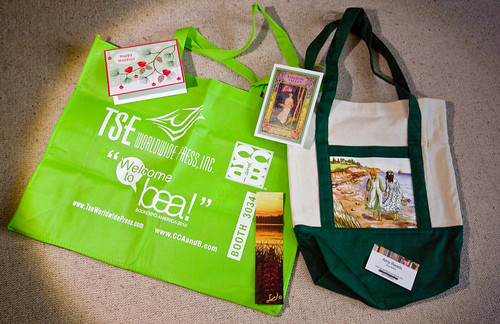
I have received the first of my two parcels in the Great Grocery Bag Exchange, a fantastic idea dreamed up by Carin of A Little Bookish where book bloggers get to know each other by sending a parcel of goodies, including at least one reusable shopping bag, to their exchange partner(s). What fun! Goodies from another country, another blog to read, another blogger to get to know and perhaps the best bit – fun post!

My first parcel is from Amy of Amy Reads, a Canadian blogger whose reading taste has, I think, quite a lot of crossover with mine. At least, I have starred a lot of her reviews in my Google Reader, which is my totally hi-tech system for marking out books I think I might like to read. Amy sent me these good-looking goodies:

For me!!!

The postcard and one of the bags were designed on Prince Edward Island by descendants of LM Montgomery, which gives me a book-nerd thrill. Oh how I loved the Anne of Green Gables books when I was younger. Also, I like how the greeting card has a non-denominational “Happy Holidays” message. Very Canadian, I believe. It’s hard to even get a birthday card in the UK right now, everywhere’s so Christmas-obsessed!

Thank you Amy for my great parcel of fun stuff. I will definitely take your advice and bump Adichie up the TBR pile 🙂

Kate Gardner Blog

Words on women of the world

December 4, 2010March 11, 2012 1 Comment

Feminine Gospels
by Carol Ann Duffy

A lot of the poems in this collection by our esteemed Poet Laureate read like little short stories, which made them pleasingly accessible for someone like me who doesn’t read a whole lot of poetry.

The subject matter, as you might guess from the title, is women – the women of myth, of urban legend, of old wives tales – and womanhood, what that means. The tone ranges from meditations on love, beauty, identity to everyday rhythms and humour.

There’s “The Map-Woman” about a woman whose skin is a map of the town, from head to toe. There’s “Work” about a woman taking on increasingly tough jobs as she has more children to support, until she has a billion children and can no longer cope. There’s “Beautiful”, about some of history’s most famous women, from Helen of Troy to Princess Diana, drawing the parallels between their lives and the way they were treated.

I usually like love poems best and there are some of those here, but I think my favourite in this collection is “A Dreaming Week”, which uses repetition and clearer rhythm and rhyme than most of Duffy’s poems to create something that sounds really good spoken aloud. Its story, if it can be said to have one, is quite simply a person daydreaming/dreaming a week away. There’s idle playing with words, there’s evocative descriptions of bed and night-time.

I think I prefer Duffy’s most recent book, Rapture, but this is an excellent window into multiple characters/perspectives/ideas about femininity.

Published 2002 by Picador.

Kate Gardner Reviews

Undecided about mornings

December 1, 2010 4 Comments

One of the joys of having lupus is the many blood tests I have to have. Okay, that was sarcastic but the regular trips to the GP surgery are actually quite fun. Maybe not fun. Diversions from the normal routine that aren’t too unpleasant. That’s closer.

I always book my blood tests for first thing in the morning on a work day. I stroll up the hill against the flow of people heading to work or school, spend about two minutes with a nurse and then amble on my way to work. I’ve warned my manager that I’ll be a little late in, so I’m in no hurry. I sometimes need a pick-me-up after having blood drawn so I treat myself to a sugary breakfast. I get to see a slightly different view of my neighbourhood, like the lollipop man outside the local primary school who makes crossing the road so much easier. And it’s morning, which is a time I think I like. Probably.

The blood test itself isn’t too bad these days. I’m inured to the whole thing. I’m lucky that the two practice nurses are great (that’s nurses at the medical practice, not nurses who are practising on me, obviously, though I did have a student nurse draw my blood once – it wasn’t pleasant, I had to lie down for a while). You might think all nurses are equally capable of taking blood but believe me, you’re wrong. I show them which vein looks good and we chat a little about holidays, family, weather, whatever. Before I know it the tourniquet’s off, the plaster’s on and I’m saying goodbye. While my health is steady as it has been all year (I’m not superstitious but I feel I should touch wood or something here) I only have to have one sample taken, which is a whole lot better than the armful I used to give every month.

But regardless I’m always a little nervous beforehand and a little relieved afterward. As I was today. It was particularly cold, with a biting wind and I was worried I’d chosen a bad outfit for getting at my inner arm easily. But it all went fine and I was feeling cheerful as I bought my cappuccino and brownie from A Cappella, then strolled down the road sipping at my drink, having a nose at a shop that’s opening soon and someone’s house covered in scaffold. Now maybe I wasn’t paying enough attention to where I was going or maybe I wasn’t fully awake still but personally I blame the police siren and the car that looked like it was about to mount the pavement and head straight for me. Either way I walked into a wall and spilled my coffee all down me. Perfect.

My day wasn’t ruined but I’m still uncertain about this morning thing. It might just be the lupus, but another hour of sleep sounds a whole lot better than an early morning walk to me.

Kate Gardner Blog

A different normality

November 28, 2010March 11, 2012 5 Comments

Non-fiction
by Chuck Palahniuk

A few years back I considered myself a big fan of Palahniuk’s novels. Then either they got worse or my reading tastes changed. Either way, this collection of his essays, many of them previously published in newspapers and magazines, lay around unread until I had an urge to read more non-fiction and this seemed to fit the description well!

While I may have gone off his fiction, I still love Palahniuk’s writing style. His short punchy sentences, repetition and colloquial phrasing break all sorts of rules about writing and grammar but they work. He can be very critical of the world but he can also be very sweet in his genuine interest in people, often people no-one else is interested in. He’s led an odd life, some of which he talks about in these essays, and that has no doubt coloured his view of the world. I don’t admire him for doing strange, sometimes dangerous things, but I do admire him for working with dying people, for telling stories that deserve to be told, for openly analysing his reasons for writing what he does.

If you’ve read any of Palahniuk’s fiction these essays will make sense to you. He collects facts and stories about real people and files them away for later use in a novel. Literally, it turns out. He has a wall of filing cabinets full of this stuff. The essays range from moments in his own life, to people he’s met casually, to people he has deliberately researched. There’s the crew of a US navy submarine, three men who built their own castles, a woman who trained her dog in search and rescue, professional wrestlers. There’s Palahniuk’s experiences of having his novel turned into a Hollywood film, of having an annoying faux psychic woman genuinely unearth a troubling childhood memory, of dealing with his father’s murder.

My favourite pieces were the more positive ones, which were mostly about writing. Palahniuk’s career took off when he attended a creative writing class and he writes movingly about the greatness of his mentors and some of his favourite writers. His cynicism is still there but it’s aimed at himself and not the subject.

I didn’t enjoy every essay. Palahniuk does his research thoroughly and in some cases that meant trawling through paragraph after paragraph on a subject I don’t care about, like wrestling or demolition derbies, but the essay as a whole is always worth reading because somewhere in there will be a gem of a portrait or observation, a really real person saying or doing something that makes you stop and think.

These essays don’t get as dark as his novels do, possibly because they’re mostly written for the wider audiences of magazines with editors who don’t want to publish Palahniuk’s darkest thoughts. But they’re clearly written from the perspective of a person who has dark thoughts, who questions the acceptance of any “normality”, who has frankly been through some shit. It’s interesting stuff.

Published 2004 by Jonathan Cape.

Kate Gardner Reviews

Not as sweet as it sounds

November 25, 2010March 11, 2012 3 Comments

The Heart of a Dog
by Mikhail Bulgakov
translated from Russian by Michael Glenny

This book was selected for our local book group, partly because most of us had never read any of “the Russians”. Including me, unless Nabokov counts (I’ve only read Lolita, which he wrote in English, and he left Russia when he was 18 so it’s a bit tenuous).

I’ve always wanted to explore this group of authors but didn’t know where to start. The Heart of a Dog was probably a good choice in that it’s short and easy to read, but it’s crammed full of analogies to history and politics that I suspect I’m not familiar enough with to get the most out of it. I did study the Russian Revolution as part of A-level history but that was a few years ago now and I had rubbish teachers.

The story is a combination of the real setting of Moscow in 1924–25 and the surreal. Rich, successful Professor Preobrazhensky appears to be protected from the ravages of the Party by his specialism – STDs and “sexual rejuvenation” – and when he first picks up a scarred, mistreated stray dog and takes him back to a plush apartment it seems like a sweet friendship is developing. But the professor has more sinister reasons for adding to his household and the Party sees an opportunity to hold the rich man to account for continuing to have more rooms and more money than anyone else in the building.

A lot of the book is narrated by the dog, which sounds bizarre but is actually very well done. Bulgakov uses humour and empathy to create a novel viewpoint of the poorest of the poor. I liked the logic given for the dog being able to understand most of what is said around him and the way he loyally repeated his master’s political views without understanding them. When the surreal part of the story takes over and switches to a conventional third-person narrative, I found it harder to connect with the characters I had previously liked immensely. I began questioning my previous judgement and was uncertain I liked where the plot was going. But although the undercurrent is one of fear, this book doesn’t get too dark or scary.

I liked how, as the book went on, the descriptions of the professor’s assistant, Dr Bormenthal, get increasingly canine, referring to him as loyal and faithful and having been rescued from poverty by the professor, just like the dog. I also found the book genuinely funny, much of it mocking the Party, so I was not surprised to learn that the manuscript was confiscated from Bulgakov and not published until after his death.

For such a short book, this book was able to generate a reasonable amount of discussion in our group. We talked about whether you can enjoy this as a story without worrying about analogies and historical context, what that professor character was really up to, where Bulgakov’s sympathies lay, the development of the dog character and particular moments and phrases that stood out for us. It was postulated that the distancing of the narration was a deliberate ploy to make the reader look more analytically at the characters. That made a lot of sense to me.

I’m not sure I would ever had read this book without the book club so thanks Bedminster Bugbear for choosing it!

First published (in this translation) in Great Britain in 1968 by The Harvill Press.

Kate Gardner Reviews

Flabby round the edges

November 23, 2010March 11, 2012

Arthur & George
by Julian Barnes

The only other Barnes book I’ve read was Flaubert’s Parrot, which is about 100 pages long, so this great heavy thing is a bit of a change and yet in many ways the same. It’s based on actual historical events, drawn heavily from police records, diaries, letters, newspapers etc, relating to some very famous people at the turn of the twentieth century. It was shortlisted for the 2005 Man Booker prize and for a while it seemed to be everywhere and yet I somehow picked this up without having a clue what it was about, which I’m glad of.

My reaction to this book fluctuated a lot while reading. I borrowed it from the library (my first library loan since leaving university, and I only went there to try out the cafe, which turned out to be closed) and at several points I found myself wishing I’d bought it because I was enjoying it so much, only to change my mind a chapter or two later and be relieved that I’d not spent any money on it.

Why the variation? It’s a well written book, with some brilliant turns of phrase and some of the best characterisation I’ve encountered in a while but the same excruciatingly slow build-up that results in those thoroughly fleshed out, believable characters also means that the storyline drags. A lot. Although there are events that are the intended focal point of the story, they get a little lost among everything else that is detailed, often minutely. And that could be deliberate. The George of the title is a very detail-oriented person, for one thing. But this is also, to some extent, a detective story and every detail could turn out to be vital. Or to be a red herring.

The story follows the two title characters in turn, with occasional joint chapters when their paths cross, which is an effective way of pointing out the similarities and differences between their lives, but the timeline was not entirely linear and it became clear that it was carefully constructed so that information was revealed in a specific order, deliberately leading the reader to react one way and then another.

Partly because I came to this book so free from spoilers, partly because I believe it’s written in a way that suggests certain details are intended as clever twists that shouldn’t be given away by reviewers, I can’t mention some of the things that I most want to talk about without a big fat ** spoiler alert **, so here it is: DO NOT READ ANY FURTHER if you haven’t read this book and think you might want to. Okay?

So, this may in fact be widely known by everyone except me (me about two weeks ago, that is) but the Arthur of the title is Arthur Conan Doyle and this book is a sort-of novelised biography of him, from birth to death, concentrating in particular on a criminal case that he got involved in when he decided that there had been a miscarriage of justice. It was big news at the time, with headlines screaming “Sherlock Holmes investigates” and led to the creation of the Court of Appeal. It’s quite amazing that the story isn’t better known, really. Anyway, I’m a big Sherlock Holmes fan and fascinated by anything related, so I was saddened to discover that I didn’t like the depiction of Doyle presented here. I liked the story of his childhood, told concurrently with that of George, despite it later being revealed that George was actually almost 20 years his junior, and I empathised with some of the events in Arthur’s life, but he comes across as a self-absorbed, brash person with some rather backward misogynist ideas, even for the time.

George is a cold, and yet curiously sympathetic character. He of course suffers from a great miscarriage of justice, so there’s that in his favour, but I felt that for much of the book the possibility that he might in fact be guilty was kept alive and there were a few occasions when I wondered if that was why these events have been forgotten. The fact that George’s surname is Edalji, inherited from his Indian-born father, is saved until a long way into the book. By this point George has spent his childhood and early adulthood suffering from various forms of bullying and with hindsight it seems likely that the colour of his skin was at least a factor, but by not being aware of that fact at the time the reader is led to be curious about why George is continually picked on and called “not quite right”. Maybe Barnes chose this route because George himself states later on that he doesn’t think race was a factor, or at least not the main factor, in his victimisation, and he considers himself as much an Englishman as any other man born in England. Is he being generous to his torturers with this statement or is he in fact more astute than others who jump to the “it’s racism” conclusion just because he’s not white?

In all, this was certainly absorbing, as the tagline on the cover promised, but it did suffer a little from including too much beyond the end of the Edalji case. There’s a long section at the end set after Arthur’s death that I felt was entirely extraneous. I lost the sense of pleasure I had built up and closed the book for the last time feeling mostly bored. It’s a real shame because for long sections of this book I loved it.

Published 2005 by Jonathan Cape.

Kate Gardner Reviews

Posts pagination

1 … 115 116 117 … 124

Archives

RSS Nose in a book

  • Book review: Christopher and His Kind 1929–1939 by Christopher Isherwood
  • March 2026 reading round-up
  • Book review: We Have Always Lived in the Castle by Shirley Jackson

Me on the internets

  • @kate_in_a_book@mas.to (Mastodon)
  • Flickr/noseinabook
  • Instagram/kate_in_a_book
  • StoryGraph/kate_in_a_book

Categories

  • Blog
  • Reviews
  • Uncategorized
Proudly powered by WordPress | Theme: Dream by vsFish.