Nose in a book

Reviews and other ramblings

  • Home
  • Reviews archive
    • Book reviews
    • TV reviews
    • Theatre reviews
  • TBR
  • Challenges
    • The Classics Club
    • 2014 Popular-Science Reading Challenge
    • Cookery challenge
    • The Gilmore Girls Reading Challenge
    • 2013 TBR Pile Challenge
    • 2013 Translation Challenge
    • Crime and Punishment read-a-long
  • About
    • Cookie legal stuff
  • Home
  • Reviews archive
    • Book reviews
    • TV reviews
    • Theatre reviews
  • TBR
  • Challenges
    • The Classics Club
    • 2014 Popular-Science Reading Challenge
    • Cookery challenge
    • The Gilmore Girls Reading Challenge
    • 2013 TBR Pile Challenge
    • 2013 Translation Challenge
    • Crime and Punishment read-a-long
  • About
    • Cookie legal stuff

The murky depths

April 8, 2011March 11, 2012 3 Comments

Death in Venice
by Thomas Mann
translated from the German by David Luke

This is really closer to a short story than a novel so I shouldn’t have waited so long to read it, but a few recent outpourings of praise for it made me finally take it down from the shelf. Yet for such a short piece, it was a very slow starter.

This is your classic flowery literary prose, with endless allusions to Greek myth and a gradual, thoughtful story. It’s about a successful ageing writer, Aschenbach, who feels a sudden urge to take a break and travel. While in Venice he falls heavily and hopelessly in love with a beautiful young man, Tadzio, who is staying at the same hotel. In the meantime, a cholera outbreak is gradually spreading across Venice and both Aschenbach and Tadzio have delicate health…

The story isn’t really about homosexuality as such, it’s about an old man falling helplessly for the beauty of youth. He never expects anything from Tadzio, he just wants to see him every day and gets a thrill when the boy smiles in his direction. It’s almost heartbreakingly sad, this cultured respected man reduced to stalking a stranger and his family. It is also a little creepy. Aschenbach is fully aware of how out of character he is acting, but presses on even when his poor health means he really should leave the city.

Having a writer for the main character is an old trope that both familiarises and distances the hero. We think we know what a writer is like but at the same time recognise that he could be anyone. It allows the first-person narration to be highly stylised and fanciful while being believable. “Do you see now perhaps why we writers can be neither wise nor dignified…The magisterial poise of our style is a lie and a farce…the public’s faith in us is altogether ridiculous…how can one be fit to be an educator when one has been born with an incorrigible and natural tendency toward the abyss?”

There are some truly beautiful passages and I can see how Mann ended up winning the Nobel Prize for Literature, but I did struggle a bit with the myth interludes, which I found tedious.

First published by Hyperionverlag Hans von Weber in 1912.
This translation first published by Bantam Books in 1988.

Kate Gardner Reviews

What a character

April 5, 2011March 11, 2012 2 Comments

The Book of Other People
edited by Zadie Smith

This book caught my eye on a recent trip to one of Tim’s favourite shops, Forbidden Planet. It’s a collection of short stories written by some pretty big names in the literary world, including Jonathan Safran Foer, Miranda July, Toby Litt, David Mitchell, Vendela Vida and ZZ Packer. They were all commissioned to “make somebody up”, in aid of homelessness charity 826 New York. It’s interesting just to see the many ways that can be interpreted, but it has also resulted in a genuinely very good collection.

The 23 contributions cover a range of ages, characters, backgrounds, storytelling methods (first person, second person, third person, illustrated, comic strip, reliable narration, unreliable narration, linear, nonlinear, etc etc) and even venture beyond humanity in a few cases (“Theo” by Dave Eggers is a very touching story about a giant). There is a certain tendency to white, western, middle-class-ness, which reflects the authors involved, but beyond that the only link is the high-quality of the writing.

Not all of the characters are likeable, in fact those that stuck with me most are decidedly unlikeable. David Mitchell’s “Judith Castle” is first a snob, then increasingly unreliable until I felt so cold toward her that only Mitchell’s wonderful humour could make me want to read about her. AM Homes’s “Cindy Stubenstock” is vomit-inducingly rich, taking a private jet with her equally rich friends to Miami and gossiping about other people, art, how less rich people live. It’s darkly ironically comic.

There are also some very sad stories. “Puppy” by George Saunders was tough for me (Note to Tim: Do Not Read It, trust me.) – the story of a mother taking her children to buy a puppy from a less well-off neighbourhood than their own. The title is a little misleading because it’s not told from the dog’s perspective, but the dog is key.

For me, this book acts as a little snapshot of the writing styles of all sorts of names that I have heard great things about but not yet sampled (I mean, not all of them, I have read novels by six of the contributors, I think, and some of the names were entirely new to me). Though, Zadie Smith does mention in her introduction that she felt the brief gave writers a chance to break free from their usual style or method, if they wanted to, so maybe it’s not the best way to decide if I want to read more by any of them.

I don’t think there were any stories here that I outright disliked and I am having a little trouble choosing a favourite, but I think it has to be “Judge Gladys Parks-Schultz” by Heidi Julavits, about an old woman sat in her study with a book that she isn’t enjoying, reminiscing about her life recent and long past. Julavits uses the language of the mystery novel (good ones, that is) to make this simple evening into a fascinating tale.

Published 2007 by Penguin Books.

Kate Gardner Reviews

Hobbyist

April 2, 2011April 2, 2011 4 Comments

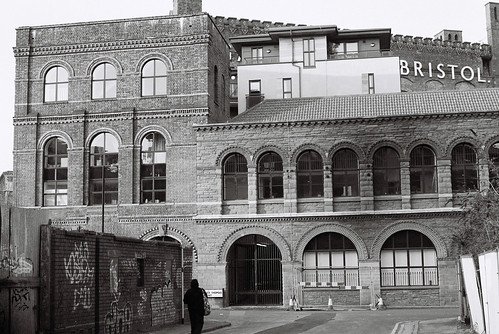
Bristol

When we moved to Bristol we didn’t really know anyone here, I had a mysterious as-yet undiagnosed illness that was sapping all my energy (and a fair wedge of my confidence) and we were leaving the comfort zone of our university town, with its familiar faces and watering holes. I like to think we’re friendly types but it took us a while to make friends and we had rather a lot of “just the two of us” time. One thing that helped us both continue to enjoy each other’s company without getting bored and meet new people was joining Flickr.

We had been toying with digital photography for a little while already but wanted to move on to a digital SLR and improve our skills. The examples, experience and advice on Flickr were immensely valuable but the big step was when we joined the Bristol Flickr Group (affectionately known as the BFG) and, after a few months of conversing with increasingly familiar avatars, braved a real-life meet-up. And I do mean “braved” because it was a little scary, but what we found was a wonderfully friendly group, with a range of different ages, careers and backgrounds and a slightly higher than average tendency to geekery, which suited us down to the ground.

We have made some great friends through the BFG and improved our photography skills immeasurably. The biggest step, I think, has been our rediscovery of film. Obviously, we grew up with film cameras and our parents had SLRs, but neither of us had owned a film SLR before. Thanks to charity shops, eBay and friends/family we now (mostly Tim) have several, plus a heap of film stored in the fridge. I have stepped into this world very tentatively, but this week I got my first black and white film processed and I am so so pleased with the results.

There’s more on my Flickr photostream.

Kate Gardner Blog

Quietly getting on with being human

March 31, 2011March 11, 2012

Ladder of Years
by Anne Tyler

Until a few months ago I hadn’t really heard of Anne Tyler. While we were visiting Tim’s parents his mum recommended this book to me and since then I keep seeing her everywhere. This week she was nominated for the Man Booker International Prize for her lifetime body of work. This is an intriguing book, a study of human character, and I suspect that the way a reader reacts to it is very telling. In some ways it’s a very sad story, and it definitely got me thinking.

“Baltimore woman disappears during family vacation” begins the book, or more accurately the newspaper article that precedes chapter one. The description of the missing woman, 40-year-old Cordelia Grinstead, is so vague, so comical that I thought this was some kind of ironic take on the actual news story, a character’s bitter retelling – “Her eyes are blue or gray or perhaps green”, she “avoided swimming wherever possible and…may have been a cat in her most recent incarnation”. It’s a slightly bizarre introduction to a not-at-all comic novel about the Grinstead family, with all its quirks and pecularities.

I had assumed, from that beginning and the brief description I’d been given by Tim’s mum, that that would be where the story began – with the woman walking away from her family – and that the bulk of the novel would alternate between them looking for her and whatever she was doing, in a slightly detached, psychological study type of way.

Instead, the book begins weeks before the family holiday, with Cordelia, or Delia as she’s known to everyone, getting into a bizarre situation while at the supermarket – a younger man spots his estranged wife with another man and begs Delia, a complete stranger, to pose as his lover. It’s a brilliant opening – the comedy of the dichotomy between what Delia wants to buy for her family and what the young man throws into the basket, what he hisses at her not to buy because it will reveal that she has children or simply isn’t glamorous enough – and gives lots of room for Delia’s thoughts to reflect on her life, on how exciting this situation is compared with the humdrum of her usual existence, on what type of person she must be to go along with this, to drive away without half of the things she needs just to please a complete stranger.

Delia isn’t unhappy, but the more she reflects on that scene at the supermarket and other circumstances that come up in the run-up to the annual family holiday (Delia, her husband Sam, their three mostly grown-up children, both Delia’s sisters and her two nieces) she becomes, not exactly dissatisfied, but aware of herself and how other people see her and how little she appears to matter in anyone else’s life.

The book follows Delia all along, revealing every thought, every indecision, every awareness, every doubt. It is fascinating to watch as she walks away from her family aimlessly, catches a lift with no particular destination in mind, and creates a whole new life for herself. She dresses differently, interacts differently with people, reads a different type of book and, importantly, is delighted whenever anyone comments on her independence. From then on the question is: will she stay here? Will she take this new Delia back home to her family? Will she move on again when this new life becomes humdrum?

I wasn’t altogether satisfied by the ending, but then I don’t think I ever quite empathised with Delia. I understand the need for a change, to search herself for a while, but it seems such a cold, cruel way of going about it. And she does spend a lot of the book seeming a little empty, distracted, not quite there, so when she is moved by events toward the end of the book it is clear that she has finally figured out where she belongs, what and who she cares about. But again she goes about it in such a cold way.

Despite my difficulty with Delia, I really enjoyed this book. I may not empathise, but hers is still a fascinating head to get inside. It really did get me thinking about that common complaint of being unappreciated, trapped in a marriage that has lost all the spark and with the children about to leave home – what’s left? Everybody wants to feel needed, right?

First published in 1982.

Kate Gardner Reviews

This is the way the world ends

March 28, 2011March 11, 2012

Southland Tales books I–III
written by Richard Kelly
illustrated by Brett Weldele

These graphic novels are a bit of an oddity. After the belated success of the brilliant but odd Donnie Darko, writer and director Kelly went even more cerebral and complex for his next project, Southland Tales. Parts I–III are in graphic novel format, while parts IV–VI form the film Southland Tales starring The Rock, Seann William Scott, Sarah Michelle Gellar and Justin Timberlake. Confused? Wait ’til you hear the synopsis!

I’m not sure if this was intended to be the project’s format all along (as a marketing ploy) or if Kelly couldn’t fit all of his ideas for this film into a sensible length but didn’t want to just discard some on the editing room floor, instead putting the overflow into these books. To be honest, the latter is how it comes across.

Kelly’s grand idea is an end of days tale, borrowing ideas from the Book of Revelation, as well as science fiction and the politics of paranoia. The story is set in an alternative reality where the US appears to be rumbling toward disaster following a nuclear attack three years ago and the all-pervasive USIdent controls security – from software regulating internet access to the committee deciding who can cross state lines.

World-famous actor Boxer Santaros wakes up alone in the Nevada desert with no memory. He is rescued by a drifter who takes him to porn star/wannabe serious actress/psychic Krysta Now who convinces him that they are in love and were about to make a film she has written prophesying the end of the world: The Power. As Boxer begins to research his role, reality and the screenplay merge together.

Then there’s liquid karma, a mysterious substance mined from deep inside the Earth that can be used to create a wireless electricity field – the answer to the world’s energy problem. But the creators are jealously guarding their secret, and in particular their discovery that liquid karma has some very troubling effects on humans, especially when injected directly into “volunteers”.

Sound like there’s a lot going on? I’ve barely scratched the surface. Which is a problem when these are pretty slim volumes. As it happens, I watched the film Southland Tales before reading the books and I really liked it. Either film is a better medium for such a complex story and large cast or the editing process clarified the film in a manner the books could have done with. They really do look and read like a storyboard and maybe Kelly should have seriously considered making this a mini-series. Maybe he tried but with only one sleeper hit under his belt and a story that touched on a lot of the paranoia of post-911 America it wouldn’t have been easy.

There is a black sense of humour in the dialogue and characterisation that prevents this from being as heavy as it sounds. Krysta acts dumber than she is, with such lines as “Teen horniness is not a crime” but then she recites haiku on stage at the strip club where she works and explains concisely to the manager how the performance is within the terms of her contract. There are also plenty of quotations from the Bible and T S Eliot’s “The hollow men”, if that appeals.

If you liked Donnie Darko and are intrigued by a retelling of the Book of Revelation with a lot of complex ideas thrown in, then I can recommend the film. Sadly I cannot recommend these books.

Published by Graphitti Designs Inc and View Askew Productions 2006

Kate Gardner Reviews

Lupus fashion

March 25, 2011 4 Comments

So maybe today was just a freak, and tomorrow we’ll be plunged back into wintry greyness, but it’s getting to be that time of year when I have to start covering up when I go outside to prevent all that UV from triggering a flare of my lupus symptoms.

“Covering up” entails wearing high-factor suncream and covering my head and shoulders (at this time of year, at least; in midsummer I try to hide as much skin as possible). I have an array of hats and scarves with which to achieve this and I have mostly gotten over the embarrassment of looking like a twat, or at least standing out from the crowd. What I have not yet perfected is how to wear headscarves properly. Why don’t they teach us this stuff at school?

I can do your basic piratical tied round the head with ends trailing at the back look. When I haven’t had all my hair chopped off recently I can do a decent hair in a bun with scarf tied round in a sort-of cottage loaf thing. What I can’t do is anything remotely elegant. I want to look like a 1950s film star when I put a headscarf on. Or a mysterious Arab beauty (except showing my face so not all that mysterious).

Is there anyone out there who can provide me with some much-needed guidance?

Headcover

Kate Gardner Blog

Comedy is soul

March 23, 2011March 11, 2012 1 Comment

The Commitments
by Roddy Doyle

This was another book club read and I was excited when I was told it had been chosen. It promises a lot – great author, raucous humour, snapshot of an interesting time and place – and I definitely got the humour but I’m sad to say that I wasn’t bowled over on the whole.

I think that was the general feeling of everyone in book club. It’s definitely funny – we all had a favourite joke to recite – and it’s stylistically interesting, but it didn’t stun anyone or inspire deep thoughts.

In brief, it’s the story of a soul band in a working-class suburb of 1980s Dublin, a band which is formed at the start of the book and falls apart by the end. Most of the characters have either never played an instrument before or are amateurs at best and it’s unclear if they ever become good, but they certainly enjoy a brief spell of success. And that’s roughly it. There’s no dark undercurrent, no distracting sub-plots, there’s just the band.

The book is almost all dialogue, written in dialect, which is occasionally confusing as a non-Dubliner but it adds a lot to the characters to really hear how they speak. The songs are also written as dialogue, with stress and accent picked out, making the music a character itself.

There’s a certain amount of casual sexism and racism – the girls are often referred to as a unit, expected to be pretty and ego-free, there solely to look good; and the characters’ views of black musicians are hideously stereotyped – but I think this is a reflection of the setting rather than actual bigotry.

None of the characters is particularly fleshed out. The book is very short, with a song often taking up a few pages, which doesn’t give much room for stuff like character development or personal histories, so we learn very little about these people, only what they say and do while they’re in the band. There’s a lot of fun to be had guessing at when a character is lying or embellishing, which we got the feeling was a lot.

Quick word of warning: there is a lot of coarse language, which I don’t mind myself but can see others being put off by it.

This is a very funny book, an easy and quick read. Thanks Matthias for choosing it for book club!

First published in Ireland in 1987.

Kate Gardner Reviews

No ordinary life

March 20, 2011March 11, 2012 4 Comments

Midnight’s Children
by Salman Rushdie

Wow. I have struggled for three weeks with this book and there were times I hated it, times I wondered why I was punishing myself, but now that I am finished I find myself captivated by it, stunned by the world it created and almost, possibly, missing it.

This is no ordinary book. If the mass of prizes it has won – Booker Prize 1981, James Tait Black Memorial Prize 1981, Booker of Bookers 1993, Best of the Booker 2008 – do not convince you of that, then let me. I read a lot and I assure you that this is a very different book. It most definitely stands out. I am reasonably certain, though, that I will never call it a favourite. It’s just too hard a slog.

Rushdie is not known for being an easy or accessible writer but I have read three other of his books and this was by far the hardest for me. The style is complex, rambling almost, repetitive and yet secretive, at pains to point out patterns and symbolism, to explain history and myth, at the expense of making ordinary lives hard to follow. Although, if we’re to believe the narrator (a tricky one, as I’ll explain), no life is ordinary: “How many things people notions we bring with us into the world, how many possibilities and also restrictions of possibility…To understand just one life, you have to swallow the world. I told you that.”

The story is told by Saleem Sinai, a 30-year old Indian man, speaking both to us (in the form of writing his autobiography) and to his lover Padma. The book is split into three sections – his family history leading up to his own birth, his childhood, and his adulthood. Unusually for me, I found the adulthood section easiest to read, perhaps that’s because I was finally fully engrossed in the book by that point. Saleem was born at midnight on 15 August 1947 – the exact moment of India’s independence. Thanks to rich parents and a media campaign he is hailed as a symbol of the new nation, and indeed as a narrator he takes great pains to draw parallels between every incident in his life, large or small, and the fate of the nation.

Which is a big story to tell. The first 30 years of independent India were turbulent, to say the least, and Saleem does not move quickly. He lingers on details, gets sidetracked by memories or lost memories, resists telling what is difficult to tell, lies even. He is quite possibly the most unreliable narrator I have come across. He admits this multiple times, accusing his memory of failing him, though he has other excuses on some occasions: “I told you the truth…Memory’s truth…It selects, eliminates, alters, exaggerates, minimizes, glorifies, and vilifies also; but in the end it creates its own reality…and no sane human being ever trusts someone else’s version more than his own.”

And then there’s the magical realism. I have come across this before, but perhaps never quite so fully as in this book. The magical is central to the book and yet, just possibly, could be explained away as not magical at all. I will try not to give away too much, but it relates to how Saleem discovers that he is just one of 1001 children born in India during the first hour of India’s independence, and his attempts to create a community of “Midnight’s Children” and to follow all their fates. They are not all, thankfully, introduced as characters, but a handful of them in addition to Saleem’s own family and neighbours gives this book a large enough cast of characters to confuse me at times. Generally, though, Saleem spends plenty of words on reminding you of who someone is, with a string of nicknames related to characteristics or incidents in their pasts.

There is a lot of humour to balance out the necessarily harsh details of a country that suffered riots, war, police brutality and much else in this time period. Padma, our fellow listener, quite often interjects with disbelief or frustration or even contradiction to Saleem’s narrative. Many characters are described with far-from-subtle abnormalities, bordering on the grotesque, like a cast of circus freaks. Saleem’s view of the world is immensely narcissistic (he does, after all, believe his life to be inextricably linked with that of his great mother country) and yet his cruellest words are often aimed at himself.

Mostly, Saleem is a vessel through which the early story of India and Pakistan can be told. His family is ostensibly Muslim (though not devout) so that though he is born and initially raised in Bombay (as it was then called), other family members go to Pakistan shortly after its creation. The action moves throughout the two countries (three countries, after Bangladesh comes into being), with Saleem somehow being wherever the news is being created, where the eyes of the world are focused (or perhaps should be focused, but aren’t). It’s a stretch, certainly, but the whole is told in such a style that you either have to believe he is making it all up to make his point, or you have to suspend disbelief and accept it all, magic included.

As a story of India it is fascinating and I learned a lot. I was particularly struck by the resistance, almost cynical, to considering India a great nation: “A nation which had never previously existed was about to win its freedom, catapulted into a world which, although it had five thousand years of history…was nevertheless quite imaginary…a country which would never exist except by the efforts of a phenomenal collective will.” And yet it made me want to learn more, want to go there and see the great festivals where paint is thrown over people in joyous celebration of life, where Hindu, Sikh, Christian, Muslim and numerous other religions have existed side-by-side for centuries, thousands of years even (not always peacefully, admittedly), where smell is a hugely important part of daily life (so often left out of descriptions in books, in this one it plays a central role).

But I can’t deny that I struggled, I found it hard to read. Not because of subject matter or lack of interest – the style itself is tough-going. And because of that, those times I have been asked, while reading it, if I would recommend it to others…I honestly didn’t (and still don’t) know how to answer.

See also: review by The Girl.

First published by Jonathan Cape in 1981.

Kate Gardner Reviews

Swag!

March 17, 2011 1 Comment

Swag!

My book arrived from Marie of Little Interpret as part of her World Book Day giveaway. Thanks Marie! I look forward to reading it and passing it on.

Kate Gardner Blog

Podcastery

March 15, 2011 5 Comments

So life continues to be hectic. It feels like I’m completing a series of to-do lists (or not completing them) and I have to remind myself that I’m doing things I chose to do, I’m exactly where I put myself. But I still need the occasional breather.

And generally reading is my breathing time, my “me time”. But I can’t always read, either because I’m walking somewhere or I’m too tired or I have to prioritise doing some exercise to maintain the gradual improvement to my health that is my major goal this year. So the other thing I have been filling my brain with is podcasts.

What a great invention! Seriously, being able to pick and choose the best radio shows from all the channels and listen to them when it suits you? Genius! I use the humorously named MyPod app on my Android phone to manage them but there are no doubt other ways. I can listen on the walk to and from work, at the gym, in the kitchen while making dinner, in my library while sorting books into alphabetical order (yes, dull I know but I have a lot of books and I like to be able to find the right one).

I do feel that I’m not making the most of this wonderful new world, though. I have five podcasts that I follow – The Naked Scientists, Radio 4 Open Book, Excess Baggage (another Radio 4 one, discovered thanks to Liz of Eliza Does Very Little), Wittertainment (Mark Kermode and Simon Mayo’s 5 Live show) and the Guardian Books Podcast – plus I will of course eagerly download the Adam and Joe show when it finally starts back up. But what am I missing? Any and all recommendations gratefully received!

Kate Gardner Blog

Posts pagination

1 … 111 112 113 … 124

Archives

RSS Nose in a book

  • Book review: Christopher and His Kind 1929–1939 by Christopher Isherwood
  • March 2026 reading round-up
  • Book review: We Have Always Lived in the Castle by Shirley Jackson

Me on the internets

  • @kate_in_a_book@mas.to (Mastodon)
  • Flickr/noseinabook
  • Instagram/kate_in_a_book
  • StoryGraph/kate_in_a_book

Categories

  • Blog
  • Reviews
  • Uncategorized
Proudly powered by WordPress | Theme: Dream by vsFish.