Nose in a book

Reviews and other ramblings

  • Home
  • Reviews archive
    • Book reviews
    • TV reviews
    • Theatre reviews
  • TBR
  • Challenges
    • The Classics Club
    • 2014 Popular-Science Reading Challenge
    • Cookery challenge
    • The Gilmore Girls Reading Challenge
    • 2013 TBR Pile Challenge
    • 2013 Translation Challenge
    • Crime and Punishment read-a-long
  • About
    • Cookie legal stuff
  • Home
  • Reviews archive
    • Book reviews
    • TV reviews
    • Theatre reviews
  • TBR
  • Challenges
    • The Classics Club
    • 2014 Popular-Science Reading Challenge
    • Cookery challenge
    • The Gilmore Girls Reading Challenge
    • 2013 TBR Pile Challenge
    • 2013 Translation Challenge
    • Crime and Punishment read-a-long
  • About
    • Cookie legal stuff

Category: Reviews

We seem to have strayed into a timeless moral vortex

January 22, 2014

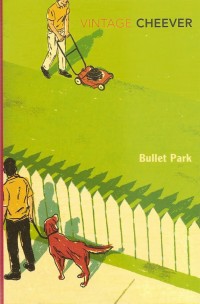
Bullet Park

Bullet Park
by John Cheever

I wasn’t much aware of John Cheever until a year or two ago. And even then I lumped him together with the great big male American 20th-century greats, which made me feel that I should read him, but didn’t really feel much inclination to. So I might never have read this novel if my book club hadn’t chosen it. And I’m glad they did, as it was a more enjoyable read than I expected.

This is a comedy, poking fun at suburbia, but it’s a dark, subtle kind of comedy. I certainly didn’t laugh out loud. The story is that of Eliot Nailles, sensible middle-class long-term resident of Bullet Park, a New York suburb, and his recently arrived neighbour Paul Hammer. At first glance Nailles is hard working, happily married, blessed with a perfect teenage son and admired by all around him, while Hammer is somehow mysterious, with a wife who says things she shouldn’t after a few drinks.

The first half of the book, perhaps predictably, cuts through that façade of suburbia and looks behind the closed doors at the details of Nailles’ life. His love for his wife Nellie borders on obsession but does she feel anything like the same loyalty for him? And his son Tony seems to have been struck down suddenly with some form of bedridden depression, which Nailles is trying desperately to both understand and find a cure for.

What I found interesting was that Cheever doesn’t entirely subvert the prevalent view of suburbia, because overall the picture painted is one of dreariness and predictability. Not that the writing is at all dreary, but if this section had gone on much longer I think I would soon have become bored.

“There seemed to be some metric regulation to the pace of the talk. It was emotional, intimate, evocative and as random as poetry. They had come from other places and would go to other places but sitting against the light at four in the afternoon they seemed as permanent as the beer pulls.”

What saves this book is the switch at the start of part two to Hammer’s story. This part is narrated by Hammer and fills in his backstory, and I was immediately grinning and enjoying the ride that he takes you on. He has a wonderful turn of phrase and a calculated assessment of which facts to give. He is an archetypal unreliable narrator, which makes it all the harder to figure out what is coming in part three, when the narrative switches back to the two men in Bullet Park.

“We traditionally associate nakedness with judgments and eternity and so on those beaches where we are mostly naked the scene seems apocalyptic. Standing at the surf line we seem, quite innocently, to have strayed into a timeless moral vortex.”

Hammer and Nailles are very different people, both full of ambiguity, but neither came 100% to life for me. I think this comes down to the style of writing. We talked at book club about how this might be related to Cheever being for the most part a short-story writer, and how this novel in many ways feels like a long short story. This is a slight criticism, but only a slight one. And certainly I would be interested to read Cheever’s short fiction and see if his style is better suited to that.

The writing is often beautiful and the story includes some wonderful quirks, that completely thrilled me. For instance, Hammer has an obsession with yellow rooms – they have to be a specific shade of yellow and he has to find them already painted that colour. Hammer’s mother (a fairly minor character but an absolutely brilliant one) decides that her therapist is too expensive so she takes to analysing herself, aloud.

“Three times a week, I lie down on my bed and talk to myself for an hour. I’m very frank. I don’t spare myself any unpleasantness. The therapy seems to be quite effective and, of course, it doesn’t cost me a cent.”

In the end, I liked this book but I didn’t love it. This is partly related to the ending, which I won’t discuss here and I wasn’t necessarily disappointed by, but I did feel a certain…deflation at. But I also wonder if it’s related to the comedy not being that funny but also not that biting. Another thing we mentioned at book club was that this book reads like a satire without a clear target. Bullet Park is both a safe, happy place and a dull or even sinister place. But New York City gets lots of mentions and it isn’t painted as particularly better or worse than suburbia. And society itself is similarly both lampooned and forgiven. I think ultimately I would have enjoyed it more if it was either more sharp and biting, or if it had more relatable characters.

First published 1969 by Knopf.

Source: I bought this from Topping Books in Bath.

Kate Gardner Reviews

I had to crack every word one by one

January 19, 2014 2 Comments

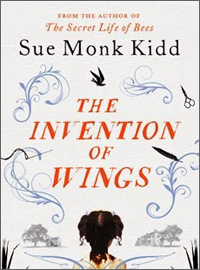
The Invention of Wings

The Invention of Wings
by Sue Monk Kidd

It is a while since I have been so thoroughly engrossed by a book, to the point where no matter where I was, day or night, I wanted nothing more than to be reading this book. Which of course means that it was over far too soon. So this definitely comes under the category of A Good Read.

It’s the fictionalised story of real-life anti-slavery campaigner Sarah Grimké, who was raised in Charleston, South Carolina, in a slave-owning family. But it’s also the story of the (almost entirely fictional) slave girl Hetty who was given to Sarah as a birthday present when she turned 11. The two girls take turns at telling the story, painting two lives closely linked and yet starkly different.

“The skies were bright cerulean, teeming with ferocious winds, spilling mallards and wood drakes from the clouds. Up and down the lanes, the fences were bright with yellow jasmine, its musk a sweet, choking smoke. I rode with the same drunk sensuality with which I had reclined in the copper tub, riding till the light smeared, returning with the falling dark.”

Sarah is the middle daughter (there are also several brothers – her mother is…prolific) and while considered a little plain and too intelligent for her own good, it is her wilfulness and ambition that get her in trouble. As a child she dreams of becoming the first female lawyer and devours the books that her father (a powerful legislator) secretly allows her until he realises that she is taking her dream seriously. When he shoots down that dream, it takes her many years to find another way to do something about the issue nearest to her heart – abolition of slavery.

Hetty, or Handful as she is known among the slaves, might have been happy with her lot – the cruelties of Mrs Grimké, or Missus, notwithstanding – were it not for her mother Charlotte who harbours such hatred of her lot that she devises small revenges against her owners and plots their eventual escape. Handful is practical and in many ways protected by Sarah, but between Charlotte’s unhappiness and Sarah’s abolitionist leanings, she catches the bug – the yearning for freedom.

“The man’s writing looked like scribble. I had to crack every word one by one and pick out the sound the way we cracked blue crabs in the fall and picked out the meat till our fingers bled. The words came lumps at a time.”

The other major character is Nina, Sarah’s youngest sister, who is in many ways a daughter to her. They are so close that it is never clear whether Nina’s small revolutions – from refusing baptism to writing anti-slavery pamphlets – are entirely her own, or the influence of Sarah. She’s an interesting character because she is more beautiful, more determined, more confident than Sarah, and yet it is Sarah’s lead that she follows.

I think it’s important that Kidd chose Sarah to narrate the story, not Nina, because Sarah is undoubtedly more troubled. She suffers from a stammer and, after the dream to become a lawyer is snatched away, never again feels that confidence in her abilities. She fervently feels that slavery is wrong (in fact, the day that she is given Handful she tries to grant her freedom, but of course that isn’t allowed) and more than that, she feels that women and coloured people are equal to white men in the eyes of God, but for much of her life she feels helpless to do anything about those beliefs.

“They say in extreme moments time will slow, returning to its unmoving core, and standing there, it seemed as if everything stopped. Within the stillness, I felt the old, irrepressible ache to know what my point in the world might be. I felt the longing more solemnly than anything I’d ever felt.”

What I thought was wonderful about this book was that it isn’t an anti-slavery treatise (after all, I think we all know these days that slavery is bad, we don’t need persuading), it’s a warm engaging story full of characters painted in all sorts of shades of grey. And there’s action and adventure too, from the terrible punishments meted out to slaves to a planned slave revolution. But there’s also romance, broken hearts, social faux pas and outright castigation. There are complicated relationships between people and there are terrible decisions that have to be made.

I also appreciated that the publishers have included quite a long author’s note at the end detailing Kidd’s historical research, including where she did and didn’t deviate from history in her fiction.

Clearly, I outright loved this book. I now plan to look out all Kidd’s previous works and hope that it all lives up to this high standard.

Published January 2014 by Tinder Press, an imprint of Headline.

Source: This book was kindly sent to me by the publisher in return for an honest review.

Kate Gardner Reviews

Instability is a permanent condition that adapts with the times

January 15, 2014February 9, 2020

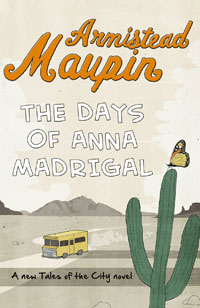
The Days of Anna Madrigal

The Days of Anna Madrigal
by Armistead Maupin

I thought quite hard about what should be my first book of the new year and this felt like a really good choice. I was really excited to be sent a copy of this, the latest Tales of the City novel, having loved the first book in the series. And this ninth instalment is just as funny, touching, well observed and eye-opening as that first one was for me. Those who haven’t read the whole series might find spoilers in this review.

Anna Madrigal was the eccentric but beloved landlady of the legendary 28 Barbary Lane. Now she is very old and, feeling that her time is near, takes a trip to her childhood home in Nevada, hoping to come to peace with the actions of the boy she once was. At the same time, several of her dearest friends are heading for the annual Burning Man festival, also in Nevada, and they have their own gremlins to deal with. Will Shawna take the biggest step of her life and become a mother? Will Michael find peace with his younger, hipper husband? Will Jake’s painstaking plan to honour Anna come to fruition or fall apart in the desert dust?

“‘Chillax? You don’t say chillax.’
‘I’m saying it now. Because you’re acting like you’re twelve and hormonal.’
If only he knew, thought Michael. Sixty-two was a lot like twelve and hormonal. Teenagers rage against the end of childhood, old people against the end of everything. Instability is a permanent condition that adapts with the times.”

This book was, perhaps inevitably, a little more serious than the start of the series was. It’s certainly not without humour, or lighter moments, but the overarching themes include ageing, death and betrayal, and when the death that’s most imminent is that of a character who has been beloved through eight previous books over 35 years, well, you can’t be flippant about it.

There are also more positive themes such as renewal and acceptance. Which all sounds remarkably worthy, and that’s one thing this book isn’t. It’s touching, moving even, but never overly sentimental. In fact, I found Anna just as hard to get inside the head of as ever. But then the other characters have the same problem with her so I guess that’s just how she is.

“Summer had been warmer than usual this year, but the heat that throbbed in the East Bay was already coaxing pale fingers of fog into the city. Anna could feel this on her skin, the chilly caress she had come to think of as ‘candle weather’.”

There’s quite a broad cast of characters here, most of whom (though not all) are LGBT, and I like how the sheer number of people he’s created allows Maupin to not stereotype or pigeonhole any one character. They are all human and interesting. They have realistically complicated relationships with one another, which I know is partly a result of having several previous books about most of these people. But it’s also an accurate reflection of how the world is. Couples break up and move on but often still have mutual friends. Sometimes if you examine how you met your best friend you realise that to begin with they were your ex-boyfriend’s boss’s landlady, and you’re no longer in touch with your ex but that tenuous connection became the most important friendship of your life.

It’s hard to write much more about this book without giving away the events in it, but I really did find it charming and enjoyable, and I am glad to have been reminded to go back to this wonderful series.

Published January 2014 by Doubleday, an imprint of Transworld.

Source: This book was kindly sent to me by the publisher in return for an honest review.

Kate Gardner Reviews

This is mad, and I promise. All those words

January 9, 2014

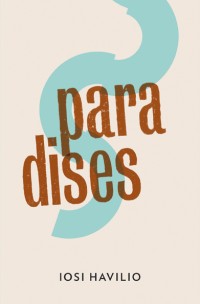
Paradises

Paradises
by Iosi Havilio
translated from Spanish by Beth Fowler

I got this book as part of my subscription to And Other Stories. I didn’t realise that it’s a sequel to Havilio’s first novel, Open Door, but I’m not sure how much that mattered. However, I guess that does mean that this review might contain spoilers to the first book (which I fully intend to go back and read now).

This novel follows a young mother who, suddenly widowed and forced off her husband’s farm, moves to Buenos Aires with her four-year-old son Simón. She finds work, housing and friends in a poor, dodgy corner of the city.

“It’s me who ends up carrying Simón most of the way, and if at first it feels like he’ll break my back, I adapt as we go and that annoying kick between the ribs becomes just another part of my body. Like everything, once the novelty has passed, things stop hurting or making you happy.”

The unnamed narrator floats through life, letting things happen to her, which was sometimes frustrating but totally believable. There are fleeting references to a lunatic asylum in her past, and she does show non-specific signs of some kind of mental illness – a loose hold on reality, an inability to say no to some really bad ideas, a surprising comfort with lying.

“I think about how each of us had to devise our truth in relation to the other, a comparison of before and after. And that’s the reason for all the affectations, the smiles, the embarrassment, the surprise, the And you? This is mad, and I promise. All those words.”

In some ways this is a story of survival. The narrator is doing what she can to get through life and parenthood. Though she’s new to the city, she is some ways ideally suited to this kind of life, though she is also the type of person most at risk from it.

Her vagueness isn’t just apparent in her narration, it’s also clear from the way her friends interact with her. Most of them take what they want from her silence, interpreting it the way that suits them best, but then other people (probably those who are best for her) struggle and fail to understand.

“I look into his eyes, sad, broken eyes like an orphaned, tortured cat’s, I don’t know what to say to him…I sympathise in silence, with my eyebrows, all the words of consolation that occur to me turn out to be impossible to articulate. He realises this and must feel a bit disappointed.”

I loved the opening of this novel, with the uncomfortable funeral and the final days at the farm. And I liked the rest of it, but I think I did ultimately find the narrator too vague and frustrating to love the book overall.

Published 2013 by And Other Stories.

Source: I subscribe to the publisher.

Kate Gardner Reviews

The snarling cries of a wind eating its way

January 4, 2014January 4, 2014 3 Comments

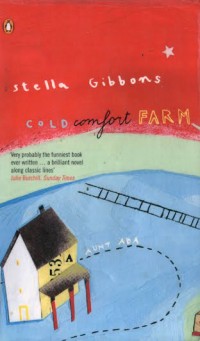
cold comfort farm book cover

Cold Comfort Farm
by Stella Gibbons

I read this novel as the Guardian Reading Group picked it as the book for December and it had already sat for too long on the TBR. It’s one of those books so beloved, and described so often in hyperbolic terms, that I worried I would be disappointed. It turns out, I was not.

I suppose my biggest fear was that I wouldn’t find it funny, that the comedy would have dated. And there are aspects of the book that show their age (some racism/antisemitism and homophobia) but the comedy is still very funny.

The story is that of Flora Poste, who is well brought up, highly educated and suddenly orphaned, therefore in need of somewhere to live. Eschewing all the easy options available from her various friends in London, she writes to all her distant relatives and accepts the offer that sounds the strangest and least appealing – Cold Comfort Farm near Howling in Sussex, with the wonderfully named Aunt Ada Doom and her large family.

Flora is a busybody and immediately decides that these strange parochial relatives, with their gloomy demeanour and dislike of cleaning, need straightening up, so she sets herself the challenge of sorting them all out. And it’s a big challenge. From the lustful young man Seth, who gets the serving girl pregnant every spring, to doddering old farmhand Adam, who fails to notice when hoofs and horns fall off his beloved cows, to raving old Ada Doom herself, who never leaves her room yet wields a strange power over the farm, which may or may not be related to that fateful night when she saw something nasty in the woodshed.

“Aunt Ada Doom sat in her room upstairs…alone. There was something almost symbolic in her solitude. She was the core, the matrix; the focusing-point of the house—and she was, like all cores, utterly alone. You never heard of two cores to a thing, did you? Well, then”

Oh, and I should also mention that this is set in a near future (or what was near future at the time it was written), so it has a touch of SF mixed in there. It’s quite subtle but there are small details, especially toward the end – video phones, airmail literally dropped at the front door, personal planes to the nearest field – which add an extra level of strangeness. I’m not quite sure what the purpose of the future setting was – perhaps to make the strong female lead and satire excusable in some way?

“‘She – she’s mad.’
The word lay between them in the indifferent air. Time, which had been behaving normally lately, suddenly began to spin upon a bright point in endless space.”

If there’s one thing this book has in spades, it’s satire. Right from the author’s foreword when Gibbons tells her friend Tony that she has “marked what I consider the finer passages with one, two or three stars”, which “ought to help the reviewers” and indeed there are passages so marked throughout the book, all particularly overblown examples of satirising the prose of “country” novels such as those by George Eliot.

“**Dawn crept over the Downs like a sinister white animal, followed by the snarling cries of a wind eating its way between the black boughs of the thorns. The wind was the furious voice that was baring the dormers and mullions and scullions of Cold Comfort Farm.”

One of the questions raised on the Guardian Reading Group was whether or not we are supposed to admire Flora. She is an interfering city girl who decides that these country folk aren’t up to scratch and sets out to change them into a more acceptable “normality”. Or is that also part of the satire? She is after all in love with her cousin back in London, who happens to be a vicar, so her own story is pretty much a satire of a Jane Austen plot.

“The brittle air, on which the fans of the trees were etched like ageing skeletons, seemed thronged by the bright, invisible ghosts of a million dead summers. The cold beat in glassy waves against the eyelids of anybody who happened to be out in it.”

I like that the satire is of literary styles, rather than any people or ways of life (or at least that’s how I read it). And I must say I found Flora adorable, which is surprising because it’s in a way irritating that she is so capable and right about everything, but then that also makes her a brilliant strong female character. And she wasn’t the only surprise for me. Most of the characters begin as almost surreal fairytale types but become human as you get to know them (or should that be as Flora works her magic?).

I really enjoyed this book and can definitely see myself returning to it. The question now is do I seek out the sequels that Gibbons wrote, which are by most accounts good but not as good, or leave it at this, the pinnacle of her ability?

First published 1938 by Penguin Books.

Source: I bought it secondhand, probably from a charity shop.

Kate Gardner Reviews

The world is bathed in the colour of heat

December 20, 2013December 20, 2013 2 Comments

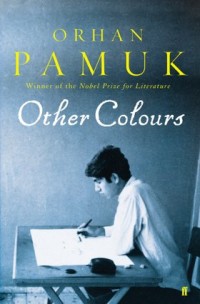
Other ColoursOther Colours: Writings on Life, Art, Books and Cities
by Orhan Pamuk
translated from Turkish by Maureen Freely

I completely fell in love with Pamuk’s novel Snow when it came out so when I saw he had a new book out I snapped it up before realising that it was a collection of his essays. And then it sat on the shelf unread for five or six years. Ahem.

Pamuk’s writings as collected here are…varied, from a light-hearted series written as a regular newspaper column to serious literary analysis and his Nobel Prize speech. And my enjoyment of them was pretty varied too. The short pieces from the newspaper column were sweet, brief pithy observations about life but the longer essays tended to get a bit bogged down with either name-dropping all the classic authors he’s read or talking at length about being a bestselling author – which I couldn’t help but find big-headed. Perhaps it’s a cultural thing.

“We see things and we don’t. The world is bathed in the colour of heat, and in our minds we can see this too.”

Pamuk is an interesting man with an interesting life, but perhaps a little repetitive even when I spread my reading of this book out over three or four months. There was lots of theorising about East versus West and Turkish politics, which I liked, plus backgrounds to most of his books, e.g. months spent in Kars while writing Snow, which is naturally interesting to any fan.

“To those viewing them from the outside, one city can seem much like the next, but a city’s collective memory is its soul, and its ruins are its most eloquent testimony.”

One of my problems with this book is that Pamuk does that thing when talking of being a writer: he generalises that all writers must be this way or feel this way. Why? Are there not many thousands of writers producing very different work from very different backgrounds? Can they maybe not have very different personalities and motivations too?

“The stones we writers use are words. As we hold them in our hands, sensing the ways in which each of them is connected to the others, looking at them sometimes from afar, sometimes almost caressing them with our fingers and the tips of our pens, weighing them, moving them around.”

(I should note that the above quote is not one I consider over-generalised. I quite like this phrasing. It’s more the stuff about working methods and personality type that wound me up.)

On the other hand Pamuk is a gifted writer, with great skill at bringing scenes, real or imagined, to life, and I still intend to read more of his fiction. (In fact, this book did include one short story, which was very good.) But I might give any future essay collections of his a miss.

Published 2007 by Faber & Faber.

Source: I honestly don’t remember.

Challenges: This counts towards the 2013 TBR Pile Challenge.

Kate Gardner Reviews

It’s a queer thing, people always moving west

December 16, 2013 3 Comments

These Happy Golden YearsThese Happy Golden Years
by Laura Ingalls Wilder

Here I am already, at the end of the Little House series. I guess that’s how you can tell they’re strictly children’s books, the way I got through seven of them so quickly! Despite a rocky start, I enjoyed the series overall and am a little sad to have reached the end.

The previous book, Little Town on the Prairie, ended with Laura being offered a three-month teaching job, aged just 15. She knew she had to accept it because she desperately wants to help with the fees to keep Mary at the college for the blind, but this teaching post is in midwinter at a town 12 miles away from her home in De Smet, so she will have to live with strangers. And she’s so young still, she doesn’t even know how to teach.

This book picks up just a few days later, with Laura being driven by Pa to her new job. I would be fascinated to know how accurately this reflects the author’s real-life experience because this first job is not a happy one. Laura must teach children who are her own age or older and who don’t recognise her authority. But even worse than that, she must stay with a couple who argue constantly, the wife of whom makes it clear she resents having Laura there. It is an intensely uncomfortable situation.

The light in the darkness is that every Friday afternoon, Almanzo Wilder turns up with his sleigh to take her home to her family for the weekend. No-one has asked him to do this, and Laura is so grateful to be able to see her family, albeit briefly, that for the first few weekends she doesn’t question it, though she feels awkward not knowing what to talk about for the long journey each way. Eventually, she figures out that Almanzo likes her like that and has an interesting reaction.

This book really is all about watching Laura grow up, from 15 to 18, from that first teaching post to accepting any job she is offered to help Mary out, from being nervous of Almanzo’s interest in her to requiting it. After those first few months, there isn’t much that’s negative, but I still found this book deeply touching. I was caught up emotionally in Laura’s story and related to her in many ways, as she worries about being quieter than other girls, and therefore less interesting. But of course Almanzo likes her for her wild spirit and sense of adventure, which he shares. It seems the name “Wilder” was a bit of nominative determinism!

I really do feel like the Little House characters have become friends and I’m sure I will come back to them in the future. It’s also made me want to go back to the series that I loved when I was young – Anne of Green Gables. But maybe I should make a dent in the TBR before I embark on that!

“‘It’s a queer thing,’ said Pa. ‘People always moving west. Out here it is like the edge of a wave, when a river’s rising. They come and they go, back and forth, but all the time the bulk of them keep moving on west.'”

Published 1943 by Harper & Brothers.

Source: Google Books

Kate Gardner Reviews

Life had once been normal but it was so hard to recall

December 13, 2013

I thoroughly enjoyed the Split Worlds trilogy by Emma Newman and heartily recommend it to absolutely everyone, but I feel there’s a limited amount I can say about books 2 and 3 without spoiling the plot of the first in the series, so here are my very brief reviews.

Any Other Name

Any Other Name
The Split Worlds book 2
by Emma Newman

The series continues with another excellent adventure featuring Cathy, the reluctant member of fae-touched society, and Max, the investigator whose soul is trapped in a gargoyle. I worried this would be the toughest of the trilogy – to set up the final part the characters most likely have to both start and end in a bad place. But of course I needn’t have worried. There were just enough new twists and reveals while continuing and building on the set-up of book 1 (Between Two Thorns). I still love both the lead characters and I really appreciate the wonderful plot contrivance that allows Cathy (and others) to be aware of the essentially historical setting they live in and the inequalities of their society. It’s tough to say much about the plot without giving away what happened in book 1, so suffice to say that both Max and Cathy find themselves embroiled in much bigger problems than they thought they were getting into. So much fun, and thoroughly absorbing.

“I would like it if once, just once, a man would not decide what’s best for me without seeing how I feel about it first.”

Published 2013 by Angry Robot.

Source: Forbidden Planet Bristol.

All is Fair
The Split Worlds book 3
by Emma Newman

Ooh, it’s all kicking off now! That was pretty much my feeling throughout this final(?) instalment. It had become clear in book 2 that the problems in the Split Worlds ran deep and involved all sorts of deep corruptions that it seemed impossible would be fully cleared up by the end of this book. In fact I worried a few times that too much was happening at once and it would be too neat to resolve it all so quickly. I hope it’s not giving too much away to say that, while some threads were wrapped up, others are left loose so there is certainly potential for the story of the Split Worlds to continue, though whether future books would centre on Cathy and Max I am not sure of. I’ll admit there were moments where the story went in a direction I didn’t want it to, but I always ended up persuaded that that was the right decision. Because no-one’s perfect, and no solution is neat and tidy for everyone. I loved the new character Rupert, the Sorcerer of Mercia; he was brilliantly eccentric in a completely different way from Ekstrand, the Sorcerer of Wessex (who you may remember is completely useless on certain days of the week). Also, big thumbs up for the appearance of the excellent Bath bookshop Mr B’s Emporium of Reading Delights (which I realise now may have had some influence on the naming of the magic shop that plays a major role in the trilogy, The Emporium of Things in Between and Besides). I really did love this book and hope that Newman does have some more Split Worlds tales up her sleeves!

“He knew, intellectually, that his life had once been normal but it was so hard to recall. The bereavement was like the camphor in his grandmother’s clothes; it perfused everything and the smell just lingered on and on after the mothballs were gone.”

Published 2013 by Angry Robot Books.

Source: Forbidden Planet Bristol.

Kate Gardner Reviews

Dark suggestions of extramarital affairs, hidden wealth and poisoning

December 6, 2013

The Most Remarkable Woman in England

The Most Remarkable Woman in England:
Poison, celebrity and the trials of Beatrice Pace

by John Carter Wood

I think I first heard about this book in the Guardian, which goes to show that I do still occasionally read newspaper review pages and like something I see there. Now, I mostly liked the sound of this book because it’s about a historical event (okay, a death that may or may not have been murder) in the Forest of Dean, but it’s about so much more than that, tapping into issues around celebrity, poverty, gender equality, domestic violence and depression.

The history being recounted here is that of Harry Pace, a quarryman and sheep farmer who died in 1928 slowly and painfully, aged just 36, and his wife Beatrice Pace who was accused of murdering her husband by poisoning him. The long-drawn-out inquest and subsequent trial were the sensational news story of their day, not just locally in the Forest of Dean but also nationally, with details both revealed and (amazingly) kept hidden about infidelities, domestic violence and other dark secrets.

“[Harry Pace’s death might have] remained as obscure as that of any other working-class person. But investigations by the local police were soon accompanied by dark suggestions of extramarital affairs, hidden wealth and poisoning. The local coroner’s decision to postpone the funeral and order an urgent post-mortem suddenly made Harry’s demise newsworthy, especially when it was later proven that he had died from a large dose of arsenic. Precisely how it had gotten into his body was anything but clear, but there were only three obvious possibilities – accident, suicide or murder – and, at first, no way of deciding among them.”

You might think that a book about a mysterious death in (or very near to) my hometown back in the 1920s sounds a bit gruesome and/or specialised. But while the setting was certainly the reason for my initial interest, it was the way the story was told that kept me hooked.

Because this is a really well written book. Wood, a historian, acknowledges himself on his blog that he was trying to write for both a general audience and an academic one, and I think that shows, but not at all in a bad way. I have tried to read a few historical books written for a popular audience and generally I’ve struggled. Even the super successful The Suspicions of Mr Whicher, which it’s hard not to compare this to, didn’t entirely get it right in my view.

The way in which Wood does get it right is, to begin with, his identifying what it was about the case that made its players instantly famous. He has some very smart things to say about celebrity culture being tied to social and political changes, such as women’s liberation or distrust of the police force. Wood quotes extensively from original sources, which serves two purposes: you are left in no doubt as to where each fact/opinions comes from, and you get a real flavour of the time and place. Papers quoted Beatrice and other key witnesses extensively (and indeed both Beatrice and her oldest daughter had their stories serialised in the national press) so there’s lots of material to be drawn from and Wood has done an admirable job picking out the right lines to tell his story.

“The ‘seemingly interminable’ inquest stretched through April and May, attracting ever more attention. By mid-May, the World’s Pictorial News observed: ‘Throughout all these months of inquiries, throughout all the ten hearings before the Coroner, the widow has been called upon to face the gaze of curious eyes. Crowds flocked into Coleford from villages for miles around to see the woman who had become such a figure of public interest.'”

Because this is after all Wood’s story above all. He works at the Institute of European History in Germany, specialising in the history of crime, policing, violence and media; and those interests are very much at the fore. Which is in many ways what makes this book interesting – it doesn’t just lay out the facts and then have a stab at “solving the case”, instead it uses the case as a detailed case study. And they’re all fascinating subjects that are still relevant now.

I know that this book worked in a narrative sense because for most of the time I was reading it I felt a prickling at the back of my neck that I only get from a good crime book, whether true or fictional. It really is a very readable book, despite its extensive references. I’ll keep an eye out with interest for the next research interest Wood decides to expand into a whole book. I’d also like to thank Wood for e-mailing me with the genuinely interesting fact that the journalist most involved in covering the Pace case, Bernard O’Donnell, was the father of Peter O’Donnell, who created (and wrote the many many stories about) the character Modesty Blaise, who I really like. That’s a good fact.

Published 2012 by Manchester University Press.

Source: Christmas present from my Mum.

Kate Gardner Reviews

If nothing comes near, I’ll be here, still

December 2, 2013

Stone in a Landslide

Stone in a Landslide
by Maria Barbal
translated from Catalan by Laura McGloughlin and Paul Mitchell

This book takes a whole life and tells it in less than 120 pages, which is both its strength and its weakness. There is some beautiful writing, but there’s also a lot of speeding past things that another writer might have taken a whole novel to explore. It feels like a bit of a missed opportunity.

The life told is that of Conxa, a poor Catalan woman whose story begins when she is a child in the early 20th century. There are three major things that happen in her life that each could have been central to a chunky novel but here are dealt with in 10 or 15 pages. First, she is from a large rural family that can’t easily support all the children, while her aunt and uncle are childless and need help to manage their house and land, so at 13 Conxa is sent on a day’s journey, the furthest she has ever travelled, to begin a new life at her aunt’s house. She has gone from countryside to small town, from familiar to unfamiliar and it takes years for her to settle in.

“My mother was a woman who knew only two things: how to work and how to save…She was always the last to go to bed and sometimes she’d say a rosary. But for all her devotion, I’m sure she didn’t even get to half a mystery. Her tiredness must have held her trapped, like a sparrow in a snare.”

Perhaps the biggest thing, from Conxa’s perspective, is her falling in love with Jaume. He’s a builder and carpenter who travels a lot for his work, and consequently is much more worldly and politically aware then Conxa, who shies away from such things. I found it difficult to sympathise with Conxa’s lack of interest in the wider world, even though the story is narrated by her voice, so we hear her reasons first hand. It keeps the story very narrow, telling just her life rather than the history of the world or Spain or even just Catalonia at that time, which I can see has its advantages, but it’s not the perspective I would prefer to read.

The final major event for Conxa is the Spanish Civil War. While the First World War appears to have happened without even a hint of it in Conxa’s narrative, the Spanish Civil War is unavoidable. Jaume’s interest in politics makes his absences from home suspicious and it’s little surprise when terror comes to their doorstep. But still Conxa never offers explanation or her own opinion, only fear.

“I feel like a stone after a landslide. If someone or something stirs it, I’ll come tumbling down with the others. If nothing comes near, I’ll be here, still, for days and days.”

Weaving between and around these three is the everyday life of sustenance farming and village gossip. And none of these are things that lack interest, or told badly, only too briefly to really make me feel involved. I usually like spare prose but I think this was too much of an extreme and I just wanted there to be more to it.

Pedra de Tartera published 1985 by Columna Edicions.
This translation published 2010 by Peirene Press.

Source: Bought direct from the publisher.

Kate Gardner Reviews

Posts pagination

1 … 42 43 44 … 70

Archives

RSS Nose in a book

  • Book review: Monkey Grip by Helen Garner
  • January 2026 reading round-up
  • TV review: The Durrells

Me on the internets

  • @kate_in_a_book@mas.to (Mastodon)
  • Flickr/noseinabook
  • Instagram/kate_in_a_book
  • StoryGraph/kate_in_a_book

Categories

  • Blog
  • Reviews
  • Uncategorized
Proudly powered by WordPress | Theme: Dream by vsFish.