Nose in a book

Reviews and other ramblings

  • Home
  • Reviews archive
    • Book reviews
    • TV reviews
    • Theatre reviews
  • TBR
  • Challenges
    • The Classics Club
    • 2014 Popular-Science Reading Challenge
    • Cookery challenge
    • The Gilmore Girls Reading Challenge
    • 2013 TBR Pile Challenge
    • 2013 Translation Challenge
    • Crime and Punishment read-a-long
  • About
    • Cookie legal stuff
  • Home
  • Reviews archive
    • Book reviews
    • TV reviews
    • Theatre reviews
  • TBR
  • Challenges
    • The Classics Club
    • 2014 Popular-Science Reading Challenge
    • Cookery challenge
    • The Gilmore Girls Reading Challenge
    • 2013 TBR Pile Challenge
    • 2013 Translation Challenge
    • Crime and Punishment read-a-long
  • About
    • Cookie legal stuff

Category: Reviews

I had no memory any more, only a puzzle of images

March 13, 2014 2 Comments

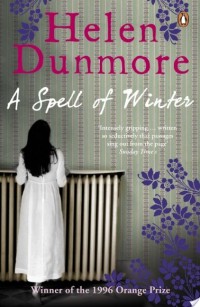
A Spell of Winter

A Spell of Winter
by Helen Dunmore

Dunmore is one of those authors I’ve been hearing good things about for years but hadn’t got round to reading, despite her being local and exactly suited to my taste. Which perhaps gives away what I feel about this book!

The story is narrated by Cathy and in a slightly dreamlike nonlinear fashion she tells us how she went from happy child playing endlessly with her brother Rob, to depressed 20-something seemingly living alone in a big old house that’s falling apart. The setting is the early 20th century (in fact, the First World War acts as a big dividing line in the narrative) and a country house estate owned by Cathy’s grandfather. The facts of her life come together slowly, so although we learn early on that her grandfather, parents and brother are no longer around, the when and why take some time to be revealed. And because she, especially at first, jumps around in time, sometimes I missed whopping great clues to something that happened later and it was only with hindsight I realised I should have seen it coming.

“I had no memory any more, only a puzzle of images, each one so bright I had to believe it as it burnt up in my mind.”

The slow reveal is a recurring trope in this novel. But it never gets annoying, even when I realised after finishing the book how many mysteries are actually never resolved. The basic facts, of a small family living largely in isolation from the world and everything falling apart, are recognisable as a classic storyline, and rightly so. But Dunmore does bring something new to it, and I don’t just mean the inappropriate closeness of Cathy and Rob (after all, that’s been done before too).

“My winter excitement quickened each year with the approach of darkness. I wanted the temperature to drop lower and lower until not even a trace of mercury showed against the figures. I wanted us to wake to a kingdom of ice where our breath would turn to icicles as it left our lips and we would walk through tunnels of snow to the outhouses and find birds fallen dead from the air. I willed the snow to lie for ever, and buried my head under the pillow so as not to hear the chuckle and drip of thaw.”

For a start, the writing is beautiful. Dunmore somehow combines really vivid descriptions and gripping story with an ethereal quality, with the first chapter and epilogue feeling particularly trance-like. This, along with the first-person narrative, plants the question of how much of what we are told is real, or how much is solely in Cathy’s imagination. It certainly seems at times that she is not told things – she is after all the younger child of a (relatively) well-off family with guilty secrets at a time when women were far from equal. But this means she snatches at servant gossip or inferences to build her own ideas, not all of which are wholly proved or disproved. For instance, her grandfather is “the man from another place” and she at one point refers to herself as “half English”, but this is never fully explained.

“I ought to have made sure I knew more. He’d had a past, a geography of silence. None of us had ever mapped it.”

I feel I would be doing a disservice to the book if I didn’t say something about the big unavoidable subject at its centre but for readers like me who don’t read blurbs it will count as a spoiler so…don’t read on unless you’ve read the book or don’t mind!

*** SPOILERS BEGIN ***

So – incest. This is a tough subject for a lot of people and I was both disturbed and impressed by Dunmore that she doesn’t just imply it and leave it oblique. She has Cathy describe fully and sensually her teenage sexual awakening and it is completely sympathetic and in many ways inevitable. Cathy and Rob are entirely each other’s world, rarely seeing others their own age. But they are also both completely aware of what they are doing and both the social implications and the moral position of it.

This very much ties in to another major subject in the book – mental health. There are two occasions when characters have breakdowns in their mental health following something traumatic happening, and the story poses the question of whether this is a natural reaction to what has happened, or something that was always lingering inside them, perhaps something hereditary. Cathy wonders if her unhealthy relationship with her brother proves right all those whispers about how she is so like her mother, who ran away.

I did start to worry that Cathy’s situation had got too dark and that there was no good way out for her, but bizarrely the First World War came at just the right time for her. She has complained all along that she is too sturdily built to be a beauty but with all the men gone and a farm to run she discovers how capable she is. I loved this transformation. Though it doesn’t make her happy, it made me like her again as a person, which isn’t necessary for me to like a book but usually makes it a more pleasant read.

*** SPOILERS END ***

I really enjoyed this book. The writing style and the story, with its period setting and sensationalist angle, reminded me a lot of Daphne du Maurier, which is high praise indeed! I will definitely have to read more by Dunmore. Anyone have any recommendations?

Published in 1995 by Viking.
Winner of the 1996 Orange Prize.

Source: Topping Bookshop, Bath.

Kate Gardner Reviews

Being completely and utterly stuck can be a good thing

March 5, 2014

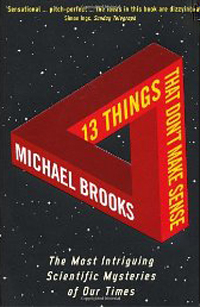
13 Things That Don't Make Sense

13 Things That Don’t Make Sense: the Most Intriguing Scientific Mysteries of Our Time
by Michael Brooks

This is my second read in my 2014 Popular-Science Reading Challenge. It deals with quite a disparate range of areas of science. I enjoyed reading it but little of the science has stayed with me.

To be fair, while reading it I was impressed by how well it explained some areas of science I had previously found hard to grasp, such as redshift. And I enjoyed interesting random titbits with Tim. But I did have reservations as well.

“I like to think of scientists as on top of things, able to explain the world we live in, masters of their universe. But maybe that’s just a comforting delusion…In science, being completely and utterly stuck can be a good thing; it often means a revolution is coming.”

The scientific mysteries covered range from ones I already knew something about, such as dark matter and free will, to ones I hadn’t heard of, or didn’t know were mysteries – a freaky giant virus that redefined what we consider to be “alive”, or the Pioneer anomaly.

What the chapters actually contain is also very varied. Some are very linear, following the story of one fairly specific topic from start to controversy to present, such as cold fusion (which is one of those things I’d heard of but didn’t realise had some basis in reality). Others are much wider ranging, taking massive topics – life, death and sex – and explaining in what way they are scientific mysteries. For instance, is life just the result of chemical reactions? The very simplest forms of life may be no more than that, but complex life has so far defied chemical explanation.

“Why do living things die? Obviously, things kill each other – that’s part of the natural order. But what causes ‘natural’ death? It is a question that splits biologists. It has become like a game of ping-pong; over the years, theories have been batted back and forth [but] none of the theories fit all of the available evidence.”

One other tack that Brooks takes is to start with a relatively small scientific anomaly that gives food for big discussion. For instance, the Wow! signal leads to explaining the SETI project and from there the prospects for alien life. Actually that’s one chapter I found a bit disappointing, perhaps because I don’t think I learned anything new from it.

But my main reservation is how often Brooks takes the side of the “underdog”, defending many scientific topics – and indeed scientists – that have been widely maligned. While I accept that it’s good journalism – and more interesting for the reader – to present both sides of the story, I can’t help thinking there’s probably good reason these are considered fringe topics. But perhaps I shouldn’t have been surprised – the last chapter does after all deal with homeopathy and it felt a little like the author was having to try way too hard to find justification for including it in the book.

I’ll continue with the challenge but I think perhaps I’d like a science book with a storyline next. Perhaps A Hole at the Bottom of the Sea: the Race to Kill the BP Oil Gusher by Joel Achenbach.

Published 2009 by Doubleday/Profile Books.

Source: Borrowed from a friend.

Challenges: This counts towards the 2014 Popular-Science Reading Challenge.

Kate Gardner Reviews

Most stories about the past have an element of pain

February 24, 2014 2 Comments

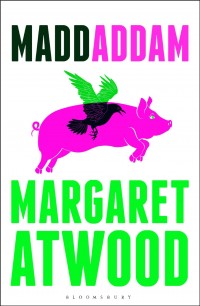
Maddaddam

Maddaddam
by Margaret Atwood

This is the third instalment in Atwood’s Maddaddam trilogy, following on from Oryx and Crake and The Year of the Flood, so this may review contain spoilers for the previous two books. Once again we are in a post-apocalyptic future that feels at once entirely alien and all too possible.

Like the previous two books, this novel looks back to a pre-“flood” story, while also dealing with the post-flood present, but there is more of the present than there has been previously, because really here that’s the emphasis – is this the new way of things? Can humanity survive and if so, how?

The pre-flood story that is slotted into the narrative is mostly about Zeb, who was a fairly minor character in The Year of the Flood but turns out to be an important link between everyone and everything else. However, this wasn’t clear at first and it seemed strange that the flashbacks should linger for so long on him. In particular, there’s an early episode about him having killed a bear that frankly dragged a bit. But once the pace of his back story picked up and some of the links to the wider story became clear, I did enjoy getting to see all the same events again from yet another fresh perspective.

“Will this be a painful story? It’s likely: most stories about the past have an element of pain in them, now that the past has been ruptured so violently, so irreparably. But not, surely, for the first time in human history. How many others have stood in this place? Left behind, with all gone, all swept away.”

The post-flood story is less contemplative than it had been in the previous two books; in fact there’s quite a bit of action. The plague-surviving humans (a mix of God’s Gardeners and Maddaddamites) and the Crakers are learning to understand each other and co-exist, and this raises a lot of issues. Are the Crakers human – and indeed, what is the nature of humanity? Are culture and storytelling innate or taught? Can/should the humans protect the Crakers from bad stuff and teach them knowledge, or should their innocence be maintained as Crake intended? Are the Crakers the only hope for the future?

“He could sense words rising from him, burning away in the sun. Soon he’d be wordless, and then would he still be able to think? No and yes, yes and no. He’d be up against it, up against everything that filled the space he was moving through, with no glass pane of language coming between him and not-him.”

One of the recurring scenes in this book is the Crakers’ story time. The Crakers insist on the daily ritual that Jimmy/Snowman began in Oryx and Crake, and though the storyteller now varies, the style is the same – a somewhat stilted, sanitised version of the truth. These sections are at first odd, irritating even, but gradually become familiar and often humorous, and finally they become the backbone of the whole novel.

“In the beginning, you lived inside the Egg. That is where Crake made you. Yes, good, kind Crake. Please stop singing or I can’t go on with the story…All around the Egg was the chaos, with many, many people who were not like you. Because they had an extra skin. That skin is called clothes.”

This was a satisfying end to the trilogy but it didn’t quite match up to the high point of The Year of the Flood for me.

Published 2013 by Bloomsbury.

Source: Bought at an author event run as part of Bristol Festival of Ideas.

Kate Gardner Reviews

The truth is complicated

February 20, 2014 2 Comments

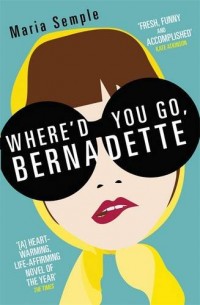
Where'd You Go, Bernadette

Where’d You Go, Bernadette
by Maria Semple

I picked up this comedy for a quick read when I was struggling to get into another book and it turned out to be much better than I had expected: funny but also original and compelling.

The story is told from the perspective of 15-year-old Seattle-resident Bee (short for Balakrishna), whose mother Bernadette has gone missing. Who Bernadette really is and why she disappeared is gradually pieced together and it’s both an odder story and a more relatable one than it at first appears.

“The first annoying thing is when I ask Dad what he thinks happened to Mom, he always says, ‘What’s most important is for you to understand it’s not your fault.’ You’ll notice that wasn’t even the question. When I press him, he says the second annoying thing, ‘The truth is complicated. There’s no way one person can ever know everything about another person.’ “

Semple rips into Seattle culture, but it’s humour with an edge of fondness. She satirizes the dominance of Microsoft and its influence over the city, the difficulty of being a retiring artistic type in a social group that puts pressure on to get involved at your child’s school. But she also acknowledges that, unlike in California (where Bernadette and her husband Elgie moved from), people in Seattle (including teenage children) aren’t obsessed with fashion or the latest gizmos.

The story is mostly told through e-mails and letters, with some being brief notes and others much longer storytelling affairs. This meant there were not only lots of voices, but some characters were depicted in multiple facets of their life and I thought this was handled well. It was a nice update to the epistolary style without feeling like it was trying too hard to be modern (except where mocking modernity).

“Your mission statement says Galer Street [School] is based on global ‘connectitude’. (You people don’t just think outside the box, you think outside the dictionary!)…you must emancipate yourselves from what I am calling Subaru Parent mentality and start thinking more like Mercedes Parents…Grab your crampons because we have an uphill climb. But fear not: I do underdog.”

I liked the combination of themes dealt with – there’s career versus family (for men and women) and how everyone, even your nearest and dearest, is a mystery to everyone but themselves. The book also touches on technological developments (through the character of Elgie) and the fight to balance societal and commercial pressures. And without giving anything away, I loved the final section, which could have felt like it just wrapped everything up neatly, but managed to steer clear of that, just as it managed to get emotional without seeming mawkish.

Semple’s is the comedy of everyday irritations and she judges well the point when something stops being funny or when it stops being acceptable to get annoyed. Not that that line is never crossed, but the character in question stops being sympathetic, which is such a realistic means of showing up character flaws.

I must admit that, more than a week later, this book hasn’t particularly stayed with me, but as you can tell I enjoyed it while it lasted.

Published 2012 by Weidenfeld & Nicolson.

Source: Amazon.

Kate Gardner Reviews

Life changes fast. Life changes in the instant

February 12, 2014 2 Comments

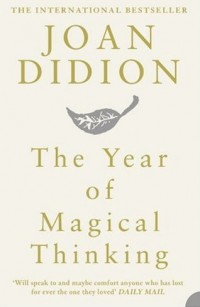
The Year of Magical Thinking

The Year of Magical Thinking
by Joan Didion

Since discovering Didion last year, I have been eager to read more of her work, and where better to start than her famous memoir of the year following her husband’s death? Thankfully my book club agreed and we picked it for our February meeting.

This book wasn’t quite what I expected. I thought it would be very slow and contemplative, so I started it well ahead of book club. But actually I sped through it, I might almost call it gripping. The book starts with Didion’s husband John Gregory Dunne dying of a sudden heart attack. But at the same time their daughter Quintana was in intensive care fighting pneumonia, so Didion couldn’t let herself fall apart or retreat into herself. She dealt with this odd delay in her grief by writing about it, then and there.

“Life changes fast. Life changes in the instant. You sit down to dinner and life as you know it ends.”

This is very much a memoir of that specific year in Didion’s life, not of her life before. Nor is it about her husband, though obviously memories of him do feature, but only in relation to Didion experiencing them resurfacing, which often results in some of the book’s more moving moments. She will mention in a very matter-of-fact way that she can no longer drive down certain streets or let herself see certain landmarks because the memories they recall threaten to break her, and it is only when you think about what she has said that you realise how close to the edge she is.

“One day when I was talking on the telephone in the office I mindlessly turned the pages of the dictionary that he had always left open on the table by the desk. When I realized what I had done I was stricken: what word had he last looked up, what had he been thinking? By turning the pages had I lost the message?”

Because what’s interesting about this book is that although it is raw and honest, Didion’s emotions are processed in a very cerebral, intelligent way, so initially she seems a little cold or detached (which is no doubt partly shock), and it takes time to realise that this is a very emotional, hurt person, dealing with that pain the only way she can. As the book goes on, feelings come more to the fore, and some of the more recognisable signs of grief such as regrets and obsession over details emerge.

“What would I give to be able to discuss this with John? What would I give to be able to discuss anything with John? What would I give to be able to say one small thing that made him happy? What would that one that one small thing be? If I had said it in time would it have worked?”

The precarious health of Quintana does of course complicate the grieving process. It gives Didion something to focus on but also an excuse not to get back to “real life”. It’s also the aspect of the book that consolidated my sympathy for Didion, because while it may sound harsh, it’s hard to ignore the fact that Didion and her husband lived a very privileged life – they were famous, successful and well paid, with multiple homes and an intimate knowledge of the best hotels in many a city. I think this bald fact ran the risk of detracting from any sympathy I felt, but for the most part I was fully on Didion’s side, absorbed in her story.

I liked that I was able to recognise the style of Didion the novelist in this book, even though it was a very different beast. She makes use of quotes, repetition, research and fractions of thoughts, returns over and over to certain moments, in an otherwise linear narrative. I was reminded of how much I enjoyed The Last Thing He Wanted and will continue to check out her back catalogue.

First published 2005 by Alfred A Knopf/HarperCollins.

Source: Foyles Bristol.

Challenges: This counts towards the Rory Gilmore Reading Challenge.

Kate Gardner Reviews

Such innocent words to drop like hot cinders

February 9, 2014February 9, 2014

The Ship Who Sang

The Ship Who Sang
by Anne McCaffrey

As with most of my SF reading, this was a recommendation from Tim and it was one of his most successful recommendations, by which I mean I loved it and was happy to learn that it was the first book in a series.

This really felt like it had an original but somehow classic set-up. In a future with commonplace space travel and human settlements on other planets, science has found a fascinating way to help children born with certain birth defects. Those who are born with a body that is useless but a brain that is high-functioning are trained to become encapsulated brains, plugged into one of the Federation of Planets’ specially designed shells, such as a space ship, fully controlling it in every way. Each “brain ship” is partnered with a “brawn” – an able-bodied pilot whose job is not really to fly to ship (though they can, if needed) but to keep the brain company and be their “mobile half” as they run jobs for the Federation across the known universe.

“Shell-people were schooled to examine every aspect of a problem or situation before making a prognosis…Therefore to Helva, the problem that she couldn’t open her mouth to sing, among other restrictions, did not bother her. She would work out a method, by-passing her limitations, whereby she could sing.”

This book had me hooked from page one, and the way it did that is that we learn all of the above by following the brain ship Helva from her birth, through her schooling and transfer to ship 834 and on into her adulthood as a working brain ship. This is essentially an adventure story, one with plenty of heart and a great character at its centre. Helva is, in her own words, “all woman”, despite her useless body, and she has a wry sense of humour that often wrong-foots her passengers, especially those who think the voice speaking to them is that of a mere ship’s computer!

“He directed his bow toward the central pillar where Helva was. Her own personal preference crystallised at that precise moment and for that particular reason: Jennan, alone of the men, had addressed his remarks directly at her physical presence, regardless of the fact that he knew she could pick up his image wherever he was in the ship and regardless of the fact that her body was behind massive metal walls.”

I like that McCaffrey didn’t present the brain ships as ubiquitous and universally accepted. There are many characters who have qualms about this form of genetic engineering, whether that be for ethical reasons or just their own uneasiness about the end result. There are some thorny issues around their service to the Federation, as they do earn money, but this is deducted against their debt resulting from their training and brain ships can take centuries to pay off and earn the freedom to work for other employers.

“Theoda was talking nervously, her eyes restlessly searching over the supplies in the galley cupboards…’Do you enjoy your work? It must be a tremendous satisfaction.’
Such innocent words to drop like hot cinders on Helva…Rapidly Helva began to talk, anything to keep herself from being subjected to another such unpredictably rasping civility.”

The novel is very much episodic, which makes sense as five of the six chapters were originally published as short stories, but there’s still a through storyline that makes it work as a novel. In fact I’m curious how much was changed from those original stories, because if anything it flows too well as a novel for those stories to have properly stood alone. Perhaps I’ll have to hunt them out and see!

I loved Helva and was completely emotionally involved in her story. I really liked McCaffrey’s style of writing and fully intend to search out more of it.

First published 1969 by Rapp & Whiting. (Selected sections previously published 1961–1969 in various publications.)

Source: Borrowed from Tim.

Kate Gardner Reviews

No-one should be embarrassed about getting sick in space

January 30, 2014February 15, 2014 3 Comments

Packing for Mars

Packing for Mars: the Curious Science of Life in Space
by Mary Roach

This was my first read for the 2014 Popular Science Reading Challenge. It was perhaps a bit of an easy choice to begin with, as I knew Roach’s reputation for humour and I’m already familiar with the subject. But it was still a good, enjoyable read.

Roach’s premise is to look at the nitty gritty detail of what would be involved in sending humans to Mars. But this isn’t about rockets and propulsion systems, this is about the human side – how will people cope with a year or more stuck in a rocket? She looks at this biologically, psychologically, but also at the practical side of things – food, facilities and so on.

“As a gross overgeneralization, the Japanese are well suited to life on a space station. They’re accustomed to small spaces and limited privacy. They’re a lighter, more compact payload than the average American. Perhaps most important, they’re raised to be polite and to keep their emotions in check.”

Roach has spoken to almost everyone who can contribute to this conversation – experts from NASA, the European, Russian, Canadian and other space agencies, university researchers, astronauts – and she really has a gift for picking out the curious details, the facts that make you laugh and learn. She also clearly has a fondness for asking the awkward questions, the things most people don’t discuss, so there’s a chapter each on sex in space, vomit and human waste.

“No-one, not Jake Garn or Rusty Schweickart or Frank Vomiting [Borman], should be embarrassed about getting sick in space. Some 50–75 per cent of astronauts have suffered symptoms of space motion sickness. ‘That’s why you don’t see much shuttle news footage the first day or two. They’re all, like, throwing up in a corner somewhere,’ says Mike Zolensky [NASA curator].”

It’s a genuinely interesting book on a topic that has been extensively researched despite it not being definite that it will ever happen. Roach manages to show great respect for astronauts and scientists while at the same time probing for very intimate facts. She shows a sense of humour about her own curiosity as well as the facts she discovers. But she is also tenacious when she wants to be, doggedly pursuing the truth behind various intriguing rumours.

“It is hard to imagine anyone going through the significant risk and hassle of catheterizing a chimpanzee just to keep him from playing with himself during training sessions. As for the balloon catheter, it was patented in 1963 – two years after Enos’s flight – as a tool to remove blood clots, not to discourage chimpanzee masturbation…Enos, your name is cleared.”

I think what holds me back from outright loving this book is that it didn’t stick closely enough to its premise. Particularly in the second half of the book, it felt more like a book about historical and current humans in space, with some chapters not even mentioning how experience to date in the topic at hand might be extrapolated to a manned Mars mission. And that would have been fine without the title and opening chapters concentrating on the Mars idea. Obviously some historical stuff is necessary, and it’s all extremely interesting, but it isn’t quite the book it sets out to be.

My one other quibble is that early on Roach refers to “US astronaut Helen Sherman”. Oh no no no. Helen Sharman was the first Briton in space. She wasn’t even trained in the US; she trained in Russia with the cosmonauts she flew with to Mir space station. So that’s two errors in one sentence. And I’m by no means an expert in any of this stuff, so how do I know that the rest of the book isn’t riddled with errors? (Obviously these might well be typesetting errors rather than Roach’s own, but it’s still a bit shoddy.)

But those fairly minor gripes aside, this was a very entertaining and informative book.

Published 2010 by Oneworld.

Source: Borrowed from work.

Challenges: This counts toward the 2014 Popular Science Reading Challenge.

Kate Gardner Reviews

Bristol Old Vic Ferment Fortnight

January 26, 2014 2 Comments
Bristol Old Vic
(CC-BY NotFromUtrecht)

Bristol Ferment is the community of theatre-makers from Bristol and the South West that Bristol Old Vic supports and helps to develop exciting and adventurous new work. Twice a year, we can get a glimpse behind the scenes of the artistic process during Ferment Fortnight, when work in progress is performed and discussed directly with the audience.

The current Ferment Fortnight runs until 31 January, so there’s still time to check it out for yourself.

The Stillness of the Storm That Never Came at All
by Clerke and Joy
Bristol Old Vic, Friday 24 January 2014

I arrived in the Studio Theatre to the powerful smell of garam masala, coming from a large pool of it spread on the theatre floor. Josephine Joy created sound effects using a laptop, a microphone and an array of electrical goods, while Rachael Clerke delivered a monologue about an Indian girl who has just moved to Mumbai after studying abroad in London. The sounds were a combination of traffic, voices, weather and domestic appliances, occasionally ratcheted up so that they threatened to drown out the monologue. Combined with the spice smell this gave a powerful sense of place to the story, especially considering there were no visual cues to place it anywhere particular. The story is currently only a snippet but it was absorbing and well written, and I definitely felt that a whole character had been created in this brief snatch of a play.

After the performance we had a Q&A in which Clerke and Joy explained the roots of the show and where they hope to take it (as well as encouraging lots of feedback, which is after all the whole point of Ferment Fortnight). Their plan is to write three monologues for three actors, each set in a different city. They will have a musician or DJ on stage and do a lot of their scene-setting with soundscapes. They have themes they want to explore but no firm story as yet. (To be fair, I should mention that they have only been writing this for a few days, having not long been back in the UK after spending three weeks in Mumbai running theatre workshops and developing the concept for this show.) Their themes include weather, feminism, decline in industry, reclaimed land, migration and oral storytelling – which is quite an eclectic bag, yet I can see it working. All of those are already present to some extent and the choice of the other two cities (one of which is likely to be Belfast, but the third is completely unknown right now) will no doubt both be informed by and have an effect on that list of themes.

The monologue text came from the workshops and some other conversations that Clerke and Joy held in Mumbai. I thought they demonstrated a gift for picking out the thoughts and observations that got to the heart of what this one lonely girl’s experience of Mumbai would be like. This play has the potential to turn into a really fascinating glimpse of some very different locations and lives.

I loved this opportunity to see something so raw and new, something unformed but brimming with potential. I’ll definitely be checking out future Ferment performances.

Disclaimer: A free ticket was kindly supplied to me by the theatre in return for contributing a review to Theatre Bristol Writers.

Kate Gardner Reviews

We seem to have strayed into a timeless moral vortex

January 22, 2014

Bullet Park

Bullet Park
by John Cheever

I wasn’t much aware of John Cheever until a year or two ago. And even then I lumped him together with the great big male American 20th-century greats, which made me feel that I should read him, but didn’t really feel much inclination to. So I might never have read this novel if my book club hadn’t chosen it. And I’m glad they did, as it was a more enjoyable read than I expected.

This is a comedy, poking fun at suburbia, but it’s a dark, subtle kind of comedy. I certainly didn’t laugh out loud. The story is that of Eliot Nailles, sensible middle-class long-term resident of Bullet Park, a New York suburb, and his recently arrived neighbour Paul Hammer. At first glance Nailles is hard working, happily married, blessed with a perfect teenage son and admired by all around him, while Hammer is somehow mysterious, with a wife who says things she shouldn’t after a few drinks.

The first half of the book, perhaps predictably, cuts through that façade of suburbia and looks behind the closed doors at the details of Nailles’ life. His love for his wife Nellie borders on obsession but does she feel anything like the same loyalty for him? And his son Tony seems to have been struck down suddenly with some form of bedridden depression, which Nailles is trying desperately to both understand and find a cure for.

What I found interesting was that Cheever doesn’t entirely subvert the prevalent view of suburbia, because overall the picture painted is one of dreariness and predictability. Not that the writing is at all dreary, but if this section had gone on much longer I think I would soon have become bored.

“There seemed to be some metric regulation to the pace of the talk. It was emotional, intimate, evocative and as random as poetry. They had come from other places and would go to other places but sitting against the light at four in the afternoon they seemed as permanent as the beer pulls.”

What saves this book is the switch at the start of part two to Hammer’s story. This part is narrated by Hammer and fills in his backstory, and I was immediately grinning and enjoying the ride that he takes you on. He has a wonderful turn of phrase and a calculated assessment of which facts to give. He is an archetypal unreliable narrator, which makes it all the harder to figure out what is coming in part three, when the narrative switches back to the two men in Bullet Park.

“We traditionally associate nakedness with judgments and eternity and so on those beaches where we are mostly naked the scene seems apocalyptic. Standing at the surf line we seem, quite innocently, to have strayed into a timeless moral vortex.”

Hammer and Nailles are very different people, both full of ambiguity, but neither came 100% to life for me. I think this comes down to the style of writing. We talked at book club about how this might be related to Cheever being for the most part a short-story writer, and how this novel in many ways feels like a long short story. This is a slight criticism, but only a slight one. And certainly I would be interested to read Cheever’s short fiction and see if his style is better suited to that.

The writing is often beautiful and the story includes some wonderful quirks, that completely thrilled me. For instance, Hammer has an obsession with yellow rooms – they have to be a specific shade of yellow and he has to find them already painted that colour. Hammer’s mother (a fairly minor character but an absolutely brilliant one) decides that her therapist is too expensive so she takes to analysing herself, aloud.

“Three times a week, I lie down on my bed and talk to myself for an hour. I’m very frank. I don’t spare myself any unpleasantness. The therapy seems to be quite effective and, of course, it doesn’t cost me a cent.”

In the end, I liked this book but I didn’t love it. This is partly related to the ending, which I won’t discuss here and I wasn’t necessarily disappointed by, but I did feel a certain…deflation at. But I also wonder if it’s related to the comedy not being that funny but also not that biting. Another thing we mentioned at book club was that this book reads like a satire without a clear target. Bullet Park is both a safe, happy place and a dull or even sinister place. But New York City gets lots of mentions and it isn’t painted as particularly better or worse than suburbia. And society itself is similarly both lampooned and forgiven. I think ultimately I would have enjoyed it more if it was either more sharp and biting, or if it had more relatable characters.

First published 1969 by Knopf.

Source: I bought this from Topping Books in Bath.

Kate Gardner Reviews

I had to crack every word one by one

January 19, 2014 2 Comments

The Invention of Wings

The Invention of Wings
by Sue Monk Kidd

It is a while since I have been so thoroughly engrossed by a book, to the point where no matter where I was, day or night, I wanted nothing more than to be reading this book. Which of course means that it was over far too soon. So this definitely comes under the category of A Good Read.

It’s the fictionalised story of real-life anti-slavery campaigner Sarah Grimké, who was raised in Charleston, South Carolina, in a slave-owning family. But it’s also the story of the (almost entirely fictional) slave girl Hetty who was given to Sarah as a birthday present when she turned 11. The two girls take turns at telling the story, painting two lives closely linked and yet starkly different.

“The skies were bright cerulean, teeming with ferocious winds, spilling mallards and wood drakes from the clouds. Up and down the lanes, the fences were bright with yellow jasmine, its musk a sweet, choking smoke. I rode with the same drunk sensuality with which I had reclined in the copper tub, riding till the light smeared, returning with the falling dark.”

Sarah is the middle daughter (there are also several brothers – her mother is…prolific) and while considered a little plain and too intelligent for her own good, it is her wilfulness and ambition that get her in trouble. As a child she dreams of becoming the first female lawyer and devours the books that her father (a powerful legislator) secretly allows her until he realises that she is taking her dream seriously. When he shoots down that dream, it takes her many years to find another way to do something about the issue nearest to her heart – abolition of slavery.

Hetty, or Handful as she is known among the slaves, might have been happy with her lot – the cruelties of Mrs Grimké, or Missus, notwithstanding – were it not for her mother Charlotte who harbours such hatred of her lot that she devises small revenges against her owners and plots their eventual escape. Handful is practical and in many ways protected by Sarah, but between Charlotte’s unhappiness and Sarah’s abolitionist leanings, she catches the bug – the yearning for freedom.

“The man’s writing looked like scribble. I had to crack every word one by one and pick out the sound the way we cracked blue crabs in the fall and picked out the meat till our fingers bled. The words came lumps at a time.”

The other major character is Nina, Sarah’s youngest sister, who is in many ways a daughter to her. They are so close that it is never clear whether Nina’s small revolutions – from refusing baptism to writing anti-slavery pamphlets – are entirely her own, or the influence of Sarah. She’s an interesting character because she is more beautiful, more determined, more confident than Sarah, and yet it is Sarah’s lead that she follows.

I think it’s important that Kidd chose Sarah to narrate the story, not Nina, because Sarah is undoubtedly more troubled. She suffers from a stammer and, after the dream to become a lawyer is snatched away, never again feels that confidence in her abilities. She fervently feels that slavery is wrong (in fact, the day that she is given Handful she tries to grant her freedom, but of course that isn’t allowed) and more than that, she feels that women and coloured people are equal to white men in the eyes of God, but for much of her life she feels helpless to do anything about those beliefs.

“They say in extreme moments time will slow, returning to its unmoving core, and standing there, it seemed as if everything stopped. Within the stillness, I felt the old, irrepressible ache to know what my point in the world might be. I felt the longing more solemnly than anything I’d ever felt.”

What I thought was wonderful about this book was that it isn’t an anti-slavery treatise (after all, I think we all know these days that slavery is bad, we don’t need persuading), it’s a warm engaging story full of characters painted in all sorts of shades of grey. And there’s action and adventure too, from the terrible punishments meted out to slaves to a planned slave revolution. But there’s also romance, broken hearts, social faux pas and outright castigation. There are complicated relationships between people and there are terrible decisions that have to be made.

I also appreciated that the publishers have included quite a long author’s note at the end detailing Kidd’s historical research, including where she did and didn’t deviate from history in her fiction.

Clearly, I outright loved this book. I now plan to look out all Kidd’s previous works and hope that it all lives up to this high standard.

Published January 2014 by Tinder Press, an imprint of Headline.

Source: This book was kindly sent to me by the publisher in return for an honest review.

Kate Gardner Reviews

Posts pagination

1 … 41 42 43 … 70

Archives

RSS Nose in a book

  • 2025 reading stats and top reads
  • December 2025 reading round-up
  • Book review: The Galaxy and the Ground Within by Becky Chambers

Me on the internets

  • @kate_in_a_book@mas.to (Mastodon)
  • Flickr/noseinabook
  • Instagram/kate_in_a_book
  • StoryGraph/kate_in_a_book

Categories

  • Blog
  • Reviews
  • Uncategorized
Proudly powered by WordPress | Theme: Dream by vsFish.