Nose in a book

Reviews and other ramblings

  • Home
  • Reviews archive
    • Book reviews
    • TV reviews
    • Theatre reviews
  • TBR
  • Challenges
    • The Classics Club
    • 2014 Popular-Science Reading Challenge
    • Cookery challenge
    • The Gilmore Girls Reading Challenge
    • 2013 TBR Pile Challenge
    • 2013 Translation Challenge
    • Crime and Punishment read-a-long
  • About
    • Cookie legal stuff
  • Home
  • Reviews archive
    • Book reviews
    • TV reviews
    • Theatre reviews
  • TBR
  • Challenges
    • The Classics Club
    • 2014 Popular-Science Reading Challenge
    • Cookery challenge
    • The Gilmore Girls Reading Challenge
    • 2013 TBR Pile Challenge
    • 2013 Translation Challenge
    • Crime and Punishment read-a-long
  • About
    • Cookie legal stuff

Category: Reviews

I liked pretending my body was two hundred tons of unstoppable steel

May 5, 2014

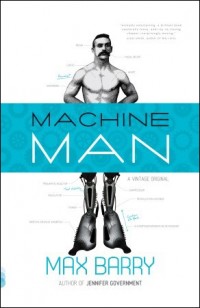
Machine Man

Machine Man
by Max Barry

Max Barry was one of the first authors Tim introduced me to that he loved, back in the heady early days of our relationship when we were young and worried about agreeing on things like whether a book or film or album or TV show was complete genius. We’re over that now, but on Max Barry we still agree – he’s a great author and it is criminal that this book was never properly published in the UK (a Kindle version was eventually released in 2013, presumably after he signed a publishing deal for his new book Lexicon). Tim picked this up in the US and after waiting a year to let him to read it first, I gave up on that and read it for myself.

In fairness, Tim has read the first third or so of this before, albeit in its original unedited form. Barry did something a bit unusual with this book: he published the whole thing online in daily excerpts, initially free and later to subscribers only. Possibly this is related to the lack of a UK publisher, but the formally published version has been heavily edited because, as Barry concedes in his author’s note, what his online fans read (and often fed back on) was just a first draft, and one that was for the most part written on an odd schedule to meet the self-imposed daily deadline.

“As a boy, I wanted to be a train. I didn’t realise this was unusual – that other kids played with trains, not as them. They liked to build tracks and have trains not fall off them. Watch them go through tunnels. I didn’t understand that. What I liked was pretending my body was two hundred tons of unstoppable steel. Imagining I was pistons and valves and hydraulic compressors.”

The story is typical Barry – a sci-fi thriller with great characters, love, humour and a strong anti-corporate theme. Charles Neumann is a scientist and engineer working for Better Future, a large company with fingers in many pies. Charlie is socially awkward, probably autistic. Certainly, his reaction to losing his leg in an industrial accident isn’t a typical one, but in his voice it seems perfectly reasonable. He sees the opportunity to build himself a new leg that’s more than just a prosthesis. But then the artificial leg will be better than his remaining healthy leg, which poses a problem. Or is it an opportunity?

“I woke to a terrible cramp in my foot. Not the foot I had. The other one. I groped around in the dark, grimacing and clutching at empty sheets. I hauled myself upright and turned on the lamp and threw back the sheets. ‘See. Nothing there.’ I was talking to my brain. ‘Nothing to hurt.’ I leaned forward and pretended to massage the space where my toes would have been. As a scientist, I am not proud of this. But it seemed to help.”

An added romantic complication is Lola, the prosthetist, who is surprisingly sympathetic to Charlie’s way of thinking. And there’s a whole array of managers from Better Future whose reaction to Charlie’s surreptitious new project isn’t wholly expected either. He soon finds himself caught in a bewildering web of people he isn’t sure he can trust.

“I had been going about this all wrong. Biology was not ideal. When you thought about it, biological legs couldn’t do anything except convey a small mass from A to B, so long as A and B were not particularly far apart and you were in no hurry. That wasn’t great…If you were designing something within that limitation, then okay, good job. But if you weren’t, it seemed to me you could build in a lot more features.”

This book has some surprising plot turns (not exactly twists) and it definitely fulfils the thriller requirement of keeping you reading avidly. Charlie’s narration gives it all a fresh angle as he often doesn’t understand why people react the way they do, but of course as the reader you can see both sides. It’s darkly funny and also quite moving. I felt at times that this had a lot in common with Flowers for Algernon (which is my favourite sci-fi book) and I wonder if Charlie’s name might be a nod to that classic.

Published 2011 by Vintage Books.

Source: Tim bought it at the Last Bookstore, LA.

Kate Gardner Reviews

The air is like a solid entity

April 28, 2014 2 Comments

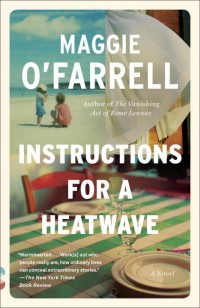
Instructions for a Heatwave

Instructions for a Heatwave
by Maggie O’Farrell

This is a lovely book, a sort of family saga that only covers a month or so of time but manages to encompass whole lives lived and deftly investigates family relationships of all varieties.

In the summer of 1976, Britain was in the grip of a now-legendary heatwave and drought, and O’Farrell uses excerpts from the hastily introduced Drought Act 1976 to intersperse the action. The effects of the heat and water shortage are filtered through one family: the Riordans. Gretta knows her husband Robert is struggling a little to adapt to retirement but she doesn’t expect him to just go missing one day. Their three adult children hurry home to help with the search, but they bring with them their own baggage and conflicts.

“The heat, the heat. It wakes Gretta just after dawn, propelling her from the bed and down the stairs. It inhabits the house like a guest who has outstayed his welcome: it lies along corridors, it circles around curtains, it lolls heavily on sofas and chairs. The air in the kitchen is like a solid entity filling the space, pushing Gretta down into the floor.”

The children are quite different but what they share is that the distinct effects of their childhood can be discerned in their adult selves. Middle child Michael Francis struggles to balance his desire to keep his wife and children happy with his unfulfilled ambition to move to America and be a rock star of the academic world, a desire that is driving his wife away from him. Youngest child Aoife is dyslexic but at a time before such things were known about, she has spent her life hiding her shame at her inability to read, which led to her being labelled fractious and difficult. Oldest child Monica spent the latter half of her childhood effectively raising Aoife, as their mother was often too tired or ill, and her adult life is defined by her wish not to be a mother.

“She cannot read. She cannot do that thing that other people find so artlessly easy: to see arrangements of inked shapes on a page and alchemise them into meaning…She can stack up words inside herself but she cannot get these words down her arm, through her fingers and out on to a page. She doesn’t know why this is. She suspects that, as a baby, she crossed paths with a sorcerer who was in a bad mood that day and…decided to suck this magical ability from her, to leave her cast out, washed up on the shores of illiteracy and ignorance, cursed for ever.”

There are many secrets hiding in cupboards for the Riordan family, some of which are revealed early on in the novel (and therefore included in the previous paragraph), some of which are hinted at and then gradually revealed, while others come completely out of left field, or so it seems. This is partly the effect of the family’s (or at least the parents’) Catholicism, which puts pressure on them all in ways that perhaps wouldn’t have been true for a less religious family. But then again it is 1976, and some of the events recounted are years before that, so at least some of the social pressure is simply of its time. Being Catholic doesn’t just give them all a higher level of guilt, it also makes them different from the people around them so that there are times when they close ranks as a family. Gretta and Robert are both Irish but living in London, and it’s worth remembering that the IRA was at the height of its terrorist activities in the 1970s, so having an Irish connection was another way to be shunned by your English neighbours.

All of which makes this sound like quite a serious book, and certainly it deals with some serious issues, but it does so with warmth and love, not to mention humour. It was a joy to be in the Riordans’ company, even while they were all being incredibly frustrating in their various and different ways. It’s also a very atmospheric book, with a real sense of the heat of that summer and evocative descriptions of its various settings.

“Conversations with his mother can be confusing meanders through a forest of meaning in which nobody has a name and characters drop in and out without warning. You needed to get a toehold, just a slight grasp on your orientation, ascertain the identity of one dramatis persona and then, with any luck, the rest would fall into place.”

One thing that struck me was the realisation that the three adult children are all younger than me. They seem so sure that the paths of their lives are decided, that they are where they will stay, but they’re all in their 20s – so much could still change for them if they can only find their way. Again, this is partly a product of the times. People married and had children much younger then, and such commitments do have a tendency to make big life changes harder to make! But it’s also a bit clever on O’Farrell’s part, combining the uncertainties and the sureness of youth – the children know they are flawed, they fret about it and even try to change, but they are so certain they know themselves inside out when we, as readers, can see that they have plenty left to learn on that score.

As you can tell, I thoroughly enjoyed this book and will be adding O’Farrell to my list of authors to buy in future.

Published 2013 by Tinder Press.

Source: Foyles Bookshop, Bristol.

Kate Gardner Reviews

A benign immensity of unstained light

April 25, 2014 2 Comments

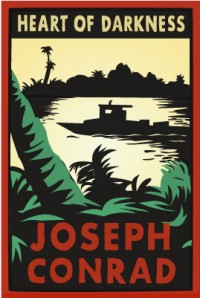
Heart of Darkness

Heart of Darkness
by Joseph Conrad

Perhaps if I had come to this book with no surrounding knowledge my response to it would be different, but I’ve read Chinua Achebe’s essay and many other articles on the subject so I came to this looking for the racism. That said, I think it’s pretty hard to ignore. The question is: is it still a good book, even so?

This is a short, readable book but I’d have to say it’s not gripping because I often found the floweriness of the writing disguised the action – it’s essentially an adventure story but you’d almost not notice that from the style. It is very descriptive – the kind of writing where you can miss the plot moving on because you’re mesmerised by the words.

“The day was ending in a serenity of still and exquisite brilliance. The water shone pacifically; the sky, without a speck, was a benign immensity of unstained light; the very mist on the Essex marshes was like a gauzy and radiant fabric, hung from the wooded rises inland, and draping the low shores in diaphanous folds. Only the gloom to the west, brooding over the upper reaches, became more sombre every minute, as if angered by the approach of the sun.”

What is the plot? An unnamed narrator on a boat on the River Thames introduces fellow crew member Marlow, who in turn tells his story of a job he took in Africa to transport ivory, having had a whim to go on a voyage of discovery like the great explorers. Marlow describes his journey from Europe to Africa, around the coast, then inland by various means (the destination is unnamed but widely agreed to be Congo, where Conrad had himself worked as a riverboat captain for a trading company) until he reached the station where he was to captain a riverboat, only to find that the riverboat has been wrecked and he must rebuild it before he can start his job. Urgency is added by reports that Mr Kurtz, the manager of a remote station upriver, is gravely ill and Marlow needs to fetch him as soon as possible. Kurtz is a bit of a legend within the Company and Marlow feels that their fates became dangerously entwined.

Because this is a story within a story, it can be difficult to decipher the book’s attitude toward Africans. Yes, there are plenty of racist things said, but we hear them through the filter of not one but two narrators – so is this a comment on how European trading companies saw Africans or is it Conrad’s own opinions?

“They howled, and leaped, and spun, and made horrid faces; but what thrilled you was just the thought of their humanity – like yours – the thought of your remote kinship with this wild and passionate uproar. Ugly. Yes, it was ugly enough; but if you were man enough you would admit to yourself that there was in you just the faintest trace of a response to the terrible frankness of that noise, a dim suspicion of there being a meaning in it which you – you so remote from the night of first ages – could comprehend.”

To be clear, we’re not just talking about racist language that might be deemed “of its time” and therefore to an extent excusable. We’re talking about language that characterises many of the Africans as lesser beings, as supernatural monsters or as inferior idiots. And while Marlow develops a fondness for at least one African member of his riverboat crew, he also states that it was wrong to train this man to do a job, that it is somehow an unnatural pretence.

On the other hand, the Company’s treatment of natives appears to be condemned by Conrad, as he describes in clearly negative language enslaved Africans and the devastating effect of the trading routes on the settlements that they pass through or near. Marlow certainly shows no love for the Company in general, finding fault with most of its employees whom he meets and struggling to bite his tongue in the face of nepotism, incompetence and corruption.

An added level of ambiguity comes from the dreamlike, or rather nightmarish, quality of the story as a result of Marlow’s psychological state. The unfamiliar heat, lack of sufficient food and recurrent illness combine with a growing fear of attack (which is in fairness justified as the riverboat and its crew are indeed attacked) to create a kind of madness. The Company sends Marlow to see a doctor before he leaves Europe and the doctor does a psychological assessment, stating that he finds the effects of such voyages on Europeans to be “scientifically interesting”. Fairly early on in his travels in Africa, Marlow states that he feels he is becoming “scientifically interesting” (it’s one of my favourite moments in the book). So by his own admission he is therefore unreliable.

“No fear can stand up to hunger, no patience can wear it out, disgust simply does not exist where hunger is…Don’t you know the devilry of lingering starvation, its exasperating torment, its black thoughts, its sombre and brooding ferocity? Well, I do. It takes a man all his inborn strength to fight hunger properly. It’s really easier to face bereavement, dishonour and the perdition of one’s soul – than this kind of prolonged hunger.”

Of course this actually raises more questions. If this degree of psychological imbalance is common in western Europeans who travel to central Africa, is that an excuse for some of the behaviour depicted? Is it a comment on the continent itself – a place that sends men mad? Or is it simply an honest observation of people going there ill equipped for the conditions? (Which would, thinking about it, be further condemnation of the Company, as it was responsible for the wellbeing of its employees.)

I can certainly see how so many books, essays, articles and theses have been written about this book, as there is far more I could say about these subjects and more. But for me it comes down to quality of writing, and on that count Conrad scores fairly high. The writing is gorgeous and atmospheric. I suspect I could pick out any line and it would be a great quote. Perhaps the story would benefit from more straightforward language but the prose would not.

“Do you see the story? Do you see anything? It seems to me I am trying to tell you a dream – making a vain attempt, because no relation of a dream can convey the dream-sensation, that commingling of absurdity, surprise and bewilderment in a tremor of struggling revolt, that notion of being captured by the incredible which is the very essence of dreams.”

Which, overall, leaves me predictably on the fence about this one. I’m glad I’ve read it but I can’t say I side wholly with Conrad’s detractors or his defenders. I got the uncomfortable feeling that he was objecting to the mistreatment of Africans much as he might object to dogs or horses being beaten, overworked, made homeless, etc. But it’s hard to deny that it’s a beautiful piece of writing.

Have you read this? What did you think?

Originally published 1899 in Blackwoods Magazine.

Source: Project Gutenberg.

Challenges: This counts toward the Rory Gilmore Reading Challenge.

Kate Gardner Reviews

The Tinderbox

April 24, 2014

The Tinderbox

Bristol Old Vic Studio, 23 April 2014
Bristol Old Vic Young Company

Writer Silva Semerciyan has turned Hans Christian Andersen’s brief, frightening tale The Tinderbox (and I remember the image of those big dogs with saucer eyes haunting me from the pages of my book of fairy tales) into an epic, devastating story. The result is a timeless lesson about the lengths parents will go to to save their own child, or the lengths those with power will go to to retain it. The fairytale classic beginning of a prophecy of doom told about a baby princess leads to bloody and hopeless war, ruthless laws and terrible poverty. The show has also, wisely, updated the role of the 17-year-old princess, making her a smart architecture nerd who has been kept hidden from the reality of her parents’ tyrannical rule.

Of course, theatre is about more than just story and the Young Company has done a great job with all aspects of this show. The live musical accompaniment sets the tone – occasionally playful, occasionally loud and scary but mostly thoughtful and brooding. Pianist (and musical director) Hettie Feiler gets it just right (including at one point crouching on the floor and plucking the piano’s strings to spooky effect) but I must also mention the remarkable singing voice of Lorenzo Niyongabo (who plays the king).

Props and staging are kept quite simple. Wooden chairs and wooden sticks form the basis of scenes from battleground to pub to palace to forest. They also add percussion to the soundtrack, which often thunders ominously through the Studio theatre. There was a moment when the cast, dressed as soldiers, pointed sticks at the audience and lunged with a loud grunt and it was genuinely scary.

The actors, for all their youth, are great. In fact for most of the time you can easily forget their youth. I was particularly impressed by Beth Collins as the queen, and by whichever member of the ensemble cast it was who played the heavily pregnant prison guard. Occasionally the mask would slip, when players were on stage but not speaking, and I would remember briefly that these are teenagers who have just devoted their school holiday to final rehearsals. But only briefly.

Most of the cast had a box of matches affixed to their costume so that a recurring motif of striking matches was used for everything from falling in love to adding yet more fear or tension. But it’s not all dark – the show also has a sense of humour, and of course a love story. Because it is still at heart a fairy tale.

Disclaimer: A free ticket was kindly supplied to me by the theatre in return for contributing a review to Theatre Bristol Writers.

Kate Gardner Reviews

That we came out of it is a miracle

April 17, 2014April 17, 2014 4 Comments

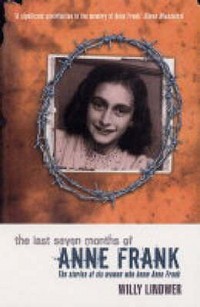
The Last Seven Months of Anne Frank

The Last Seven Months of Anne Frank
by Willy Lindwer
translated from Dutch by Alison Meersschaert

This was a tough read, in more ways than one, but it was also an enlightening and occasionally reaffirming one and I’m glad I have read it, so thank you H (who gave this to me as a present).

The title is to be honest misleading. This is not a book about Anne Frank. Rather, Anne Frank is a loose link between six Dutch women who tell their stories of the war and their experiences of concentration camps. More accurately what they have in common is that they were all arrested by the Nazis toward the end of the occupation of the Netherlands and taken to Westerbork, the Dutch transit camp, and from there were transported to Germany or Poland – to Auschwitz-Birkenau or to Bergen-Belsen, where they had contact with Anne Frank and some other members of her family. But for the most part Anne Frank’s role in this book is small. Really, these are the stories of six remarkable women who survived not only the war but also the Nazi concentration camps.

“I always envied the birds who could fly away. It seemed so fantastic to me to be able to fly, to go wherever you wanted to…You saw the birds everywhere; everywhere, there were birds, even in Auschwitz, even in Birkenau, and certainly in Bergen-Belsen, where it was so beautifully green and, at the same time, so gruesomely grey.”
— Rachel van Amerongen-Frankfoorder

Five of the women were, like the Frank family and other occupants of the Secret Annexe, arrested in summer 1944 and they met the Franks at Westerbork (only one of these five had half known the Franks beforehand, as she was at the Jewish Lyceum with Anne and Margot, but not in either of their classes). Their late arrests are the result of them having been in hiding. Three of them worked for the Resistance, helping others to hide, producing pamphlets or false papers, getting food or ration books to where they were needed, and they were arrested for this rather than for being Jewish (though they all had Jewish heritage).

The one story that is different from the others and most strongly adheres to the book’s title is that of Hannah Elisabeth Pick-Goslar, who had been a close friend of Anne Frank’s (in the diary she was originally given the pseudonym Lies Goosens but more recent editions use her childhood name Hanneli Goslar). She had a very similar background to Anne, born in Germany to a respected Jewish family in 1928, they moved to Amsterdam in 1933 as a result of anti-Jewish legislation and her father, a lawyer, set up a firm to advise refugees. She went to all the same schools as Anne and lived on the same street. Their families even went away together a few times (a postcard from one of those holidays is still on the wall of Anne’s room in Anne Frank House). As the Goslars were more religious, the Franks would go to them for Jewish holidays and Hannah would go to the Franks for national holidays (New Year and Sinterklaas). Hannah was one of the first to find out that the Franks had disappeared in 1942, but she was told the false story that the Franks had gone to Switzerland (where Otto Frank’s mother lived). Hannah writes about Anne as a good friend who was charming, beautiful, flirtatious and already considered a talented writer, but also as someone who was often sick and, as anyone who has read her diary knows, stubborn.

The Goslars were rounded up by the Nazis in June 1943 and thanks to political connections spent eight months in Westerbork before moving on to Bergen-Belsen, where they were kept in relative comfort (and stayed together as a family, which was extremely rare). When Hannah found out that Anne and Margot were in another camp on the site, separated from her by a barbed wire fence, she arranged to speak to Anne regularly and threw small packages of food over. It is clear from Hannah’s description that Anne’s side of the fence suffered far worse conditions and that Anne herself was desperately changed, had basically given up, but it is the testimonies of the other women in this book that really fill in how awful those conditions were.

Perhaps the most touching part of Hannah’s story comes after the war ended. She and her sister, now orphans aged 16 and 5, had returned to the Netherlands and were waiting to see who would adopt them, when Otto Frank showed up. He had seen their names on a list and travelled a long way to come and help them (considering he himself had only recently returned from Auschwitz). He took them first to Switzerland, where they had an uncle, and then helped Hannah apply for Israeli citizenship. They stayed in touch until he died and Hannah describes him as being like a father to her. Her words made me look on Otto Frank very differently, as a man who despite all his work around Anne’s diary actually did move on and find happiness and fulfilment.

The other five women’s stories are quite different, to be honest much darker, and I think it does them a disservice to make it all about Anne Frank. But to a certain extent this is acknowledged by the author’s introduction. Lindwer writes that he interviewed these women in the 1980s for a documentary about Anne Frank and that afterwards he felt it was a shame that such small snippets of their testimonies were used, because telling their stories had been so painful for them but also because they were important stories that deserved to be told. And so this book was born, containing the full interviews, serving (much like the Definitive Edition of Anne Frank’s diary) as a historical record more than as a work of art. It appears as though little has been edited, including facts, as there are multiple points on which these testimonies disagree, but then they are recalling the most painful experiences from 40 years later.

“Auschwitz was really the end of everything; the clay soil always with standing water; a huge quagmire without a sprig of green…There was nothing, nothing that looked alive, no flower, nothing, absolutely nothing. It was the end of everything, really the end. That we came out of it is a miracle. Very religious people understand it better than I do, because I never understood that a higher being – if one exists – could let all of this happen.”
— Lenie de Jong-van Naarden

They are clearly all amazing women and they deal with their past and their survival in different ways. My favourite story (and I’m guessing Lindwer agrees as it gets by far the most pages) is that of Janny Brandes-Brilleslijper who along with her husband Bob worked in the Resistance from 1939, and later at Auschwitz and Bergen-Belsen volunteered as a nurse (she had some first aid training, though with the almost complete lack of supplies there wasn’t much could do for the sick except clean them with only a little water, but she did keep them company and sing songs). But they are all incredible stories and I learned so much, good and bad, from this book.

I suppose it is true that this has taught me more about Anne Frank, but mostly it has made me think of her death differently. It always seemed such hopelessly tragically bad luck that she was on the last Nazi prisoner transport from Holland, that she was moved from Auschwitz just weeks before it was liberated, that she died at Bergen-Belsen just weeks before that too was liberated, even that she died from illness and not from being selected for extermination. And of course it was tragic, but it was sadly not unusual. That last transport train carried more than 1000 people to Auschwitz, of whom just 127 survived the next eight months. The conditions at Bergen-Belsen were so bad that the majority of the inmates died of illness – typhus, starvation, pneumonia – shortly before or in the first few weeks after liberation. It was all awful and I am saddened and disturbed but also glad that I have learned a little more about it.

“I have told this because I want to make it very clear to a large number of people that all discrimination – whatever form it takes – is evil and that the world can go to pieces because of it…It only takes one person to say, ‘He isn’t as good as I am, because he has—’ You fill in the rest…We have to make sure that it will never happen again.”
— Janny Brandes-Brilleslijper

Die Laatste Zeben Maanden: Vrouwen in Het Spoor Van Anne Frank published 1988 by Gooi & Sticht.
This translation first published 1991 by Random House.

Source: This was a present from my friend H who bought it at Anne Frank House in Amsterdam.

Kate Gardner Reviews

I want to go on living even after my death

April 15, 2014 2 Comments

The Diary of a Young Girl

The Diary of a Young Girl
by Anne Frank
edited by Otto H Frank and Mirjam Pressler
translated by Susan Massotty

This Definitive Edition of the diary of Anne Frank is not, according to the publisher’s note, intended to replace the earlier version edited by Anne’s father Otto shortly after her death, but instead to serve as a more accurate historical record for those who have already read the (quite heavily) edited version. It is in some ways quite a different book and almost makes me want to refer to the Critical Edition, which compares Anne’s original diary, her own edits and her father’s edits.

This is one of the aspects of the diary that I only learned this year – Anne Frank edited and rewrote the majority of her own diary in early 1944 after hearing on the radio that the Dutch government wanted after the war to collect eyewitness accounts of Dutch people who had lived through the German occupation. Otto Frank’s edit combined material from both versions of Anne’s diary and even some accounts she wrote about life in hiding that had been thinly veiled as short stories. The Definitive Edition is almost entirely composed of Anne’s self-edits, which I like because that is what she intended to have published herself – it’s why she went to the effort of doing all that editing.

“I don’t want to have lived in vain like most people. I want to be useful or bring enjoyment to all people, even those I’ve never met. I want to go on living even after my death…When I write I can shake off all my cares. My sorrow disappears, my spirits are revived!”

The Definitive Edition is quite a bit longer (30% apparently) than Otto Frank’s edit, because he cut a lot of stuff out. Partly this was because the original publisher was aiming at a young adult audience and therefore wanted something short and without any references to sex or puberty. And Anne, pardon the pun, could be very frank with her diary, which she called Kitty and spoke to like a friend (she even, in some places, writes as though she is addressing questions that Kitty has asked her). But the thing that struck me most reading this edition is that most of what had been cut out was material that might be considered unflattering or even outright cruel about the other occupants of the annexe, especially her mother.

I should probably include a summary of Anne Frank’s story for those who don’t already know it. Otto Frank was a successful businessman in Frankfurt-am-Main, Germany, which is where Anne and her older sister Margot were born. In 1933, when Anne was four, changes to German law regarding Jews led to the family moving to Amsterdam, where Otto continued his business, Opekta. In 1940 the Netherlands was occupied by the Nazis, who immediately introduced anti-Jewish laws there. Otto and his business partner Hermann van Pels signed their business over to a trusted non-Jewish colleague and the girls had to move to a Jewish school, but Otto and his wife Edith anticipated worse to come and soon began planning a safe hiding place. In 1942 a summons arrived for Margot and within days the Frank family was installed in the Secret Annexe – a building attached to the back of the Opekta warehouse that had formerly served as a laboratory and extra office space. The Van Pels family joined them there (Anne gave them pseudonyms in her edited diary, so you may know them as the Van Daans), as did family friend Fritz Pfeffer (Albert Dussel in the diary). They remained hidden for two years, until 4 August 1944, when the SS arrested all eight occupants of the annexe. They were taken to various concentration camps and only Otto Frank survived the war. When he returned to Amsterdam, one of the Opekta secretaries who had helped the families to hide gave him Anne’s diary, which she had retrieved from the annexe and hidden.

“[Miep] brings five library books with her every Saturday, We long for Saturdays because that means books. We’re like little children with a present. Ordinary people don’t know how much books can mean to someone who’s cooped up.”

The diary really is a mixture of many things. It’s an open, honest account of being a teenager, and the joys, frustrations, changes and experiences that most girls will have between 13 and 15 years old (the diary was given to Anne on her 13th birthday, in June 1942). It’s also a record of someone learning to be a writer, from before she harboured that ambition, through discovering it, to beginning to refine her work and identify what kind of writer she might be. It is of course a historical record of being a Jew under Nazi occupation, of Amsterdam in wartime, with all the food shortages and the thefts and suspicion that follow on from privation. And it’s a study of people under intense pressure, squeezed into a fairly small space physically but of course it’s the psychological pressure that made it really claustrophobic.

“I’ve been taking valerian every day to fight the anxiety and depression, but it doesn’t stop me from being even more miserable the next day. A good hearty laugh would help more than ten valerian drops, but we’ve almost forgotten how to laugh. Sometimes I’m afraid my face is going to sag with all this sorrow and that my mouth will permanently droop at the corners.”

Having been to the building itself, at 263 Prinsengracht, Amsterdam, helped me to visualise a lot more of the diary this time around. The annexe was in effect insulated from the warehouse (where none of the workers knew anyone was hiding upstairs) by the Opekta offices, where all the regular staff knew about the occupants of the annexe and helped them a great deal. The neighbouring buildings were all businesses, and therefore empty at night. But although this allowed them to make at least a little noise, they still had to be extremely careful not to ever be seen, so blinds or curtains were kept drawn and windows could only be opened a little overnight, but had to be strictly closed during the day. Outside of business hours they did sometimes leave the annexe and use the rest of the building – most of them took their baths in the office or the office kitchen and they sometimes used the office kitchen to cook – but as break-ins became more frequent this became ever more dangerous.

“I see the eight of us in the Annexe as if we were a patch of blue sky surrounded by menacing black clouds. The perfectly round spot on which we’re standing is still safe, but the clouds are moving in on us, and the ring between us and the approaching danger is being pulled tighter and tighter.”

I don’t remember from my previous reading of the diary there having been so many break-ins and other near-misses and I found myself, in the last couple of months of the diary, thinking each time – was that it? Was that time they forgot to unbolt the warehouse door, or that time the warehouse manager spotted an open window, or that time they actually chased off burglars from the warehouse, the time that someone realised people were hiding there and reported it? It’s genuinely chilling to read Anne describe them as near-misses when maybe one of them wasn’t a miss at all. (Though it could just as easily have been more mundane. A lot of people knew they were there, from food suppliers to official Jewish organisations, and a slip of the tongue or a beating from the police could have betrayed them.)

I realise I’ve written a lot without really reviewing the book itself. Partly that’s because it’s impossible for me to separate the book from the wider story that it’s part of. But of course I do have responses specific to the book. Despite Anne’s edits it is still brutally honest because that is who she was. She records her joys, her rages, her depressions, her contemplations and above all she judges herself. Often she will make a proclamation that sounds ill-thought-through and childish (that she is too independent to need her parents, for example), only to tear it down a few days later, berating herself harshly, especially when she has upset her father, who she doted on. But then there are also passages that are beautiful and/or insightful. She says a few times that she has had to grow up too fast, that going into hiding effectively stole her childhood, and of course she’s right. At 15 she is better read and much more politically aware than I was at that age, but it’s more than that. She becomes quite astute when it comes to understanding people and their motives. Where in 1942 she simply dislikes most of the annexe occupants (her father and Margot are really the only exceptions, and even they come in for criticism), over time she learns to understand them all and be on better terms with them, though the relationships all remain volatile.

For the first half of this reread I didn’t think I had fallen for Anne the way I had previously. The extra material criticising her mother and Mrs van Pels/van Daan turned me off a little. But of course I was won over and if anything the change in Anne over time was more apparent and the ending more poignant. This wasn’t just yet another girl who dreamed of being a writer, this was someone capable of great things who sadly (that word is so inadequate) was only able to give the world one great thing, but what a gift it was.

Het Achterhuis first published 1947.
This translation first published by Doubleday in 1995.
Revised with extra material in 2001.

Kate Gardner Reviews

He could almost feel his psychosoma being buoyed up

April 10, 2014 2 Comments

The Lathe of Heaven

The Lathe of Heaven
by Ursula le Guin

Le Guin is one of the big names in modern science fiction and I had been meaning to read her for years, so I was glad to persuade my book club to join me in the adventure. Sadly, it turned out to be one of my less successful ventures into the genre, or at least a mixed result.

I loved the idea and the story built around it, and the opening chapter was for me quite attention-grabbing. George Orr is strung out on drugs in a version of Portland, Oregon that is suffering from runaway global warming, overpopulation and intense policing. As such he soon catches the attention of the authorities, who refer him to drug rehab in the form of the psychiatrist Dr Haber. Here we learn that Orr had been taking drugs to stop himself from sleeping, because when he dreams, his dreams change the world around him. Haber is initially sceptical but quickly discovers that it’s not only true, but that he can use hypnosis to influence Orr’s dreams. So begins the tug of war between the two men, fighting for control of Orr’s power.

“Current-borne, wave-flung, tugged hugely by the whole might of the ocean, the jellyfish drifts in the tidal abyss. The light shines through it, and dark enters it…Hanging, swaying, pulsing, the most vulnerable and insubstantial creature, it has for its defence the violence and power of the whole ocean.”

It really is a wonderfully original premise that remained original and fascinating throughout. At its heart it’s such a simple idea, but one with almost infinite possibilities, so I was glad that Le Guin kept the story focused quite narrowly on Orr. She does throw in a romance, but it’s done well, sans cheese and gives Orr another facet to consider when making major world-changing decisions.

But I must admit, for all that the idea and the story and even the details of the story thrilled me, I was not hugely impressed by the prose. I found it a little workmanlike, with sometimes wooden dialogue. Perhaps partly I was noticing aspects of the book that haven’t dated well. For instance, there’s a whole storyline revolving around skin colour that was clearly well intentioned and potentially fascinating, but the language used was so old-fashioned it made me cringe.

“Damn the stupid little bastard! He had got out of control. Haber cocked his head and maintained a tolerant, noninterfering silence; it was all he could do…
‘You said you remembered the Plague; but don’t you also remember that there wasn’t any Plague, that nobody died of pollutant cancer, that the population just kept on getting bigger and bigger? No? You don’t remember that?’
…Orr was quite white; the cheekbones stood out in his face. He sat staring up at Haber. He said nothing.”

I also struggled a little with the character of Orr. He’s so very passive, even when he tries to take control. Of course, he had to be a bit wet for the whole story to work, but it certainly makes him difficult to engage with.

However, there were elements I loved about this book. There’s a fantastic (and surreal) sense of humour that nicely balances out the more serious parts. And I like that Dr Haber is almost inscrutable, certainly neither wholly good nor wholly bad. He’s like a parable of a politician, telling himself he has the best of intentions, but in reality with all that power at his fingertips if he can just keep Orr in line… It really is a very interesting dynamic between the two men.

“After a week’s solid rain, barometric pressure was up and the sun was out again, above the river mist. Well aware from a thousand EEG readings of the link between the pressure of the atmosphere and the heaviness of the mind, he could almost feel his psychosoma being buoyed up by that bright, drying wind. Have to keep that up, keep the climate improving, he thought rapidly, almost surreptitiously.”

I have for a long time linked Ursula le Guin with Margaret Atwood because they are female North American writers of a similar age who have included a lot of SF in their back catalogues and are also friends and have discussed Big Ideas together publicly. So I suppose I expected Atwood-style prose. Instead I got an idea that was, I’d suggest, far more impressive than the basis of any Atwood book I have read, but without the mastery of language to make the most of it.

I will certainly try Le Guin again – at the very least the others of her titles included in the SF Masterworks series along with this one – but I am not yet convinced.

First published in Amazing Stories Magazine in 1971.

Source: Borrowed from Tim (who hasn’t actually read this yet, so I will have to get him to read it and have another mini book club about it!)

Kate Gardner Reviews

Anything is a weapon if you’re in deep enough trouble

April 7, 2014June 19, 2014 1 Comment

Hawkeye Volume 1
by Matt Fraction

Hawkeye cover by David Aja

I think Tim is slowly but surely turning me into a Marvel fan. It began with the X-Men films, then the Avengers films, then the TV shows (Ultimate Spider-Man is really very good, and not just “for a cartoon”) and now finally he’s got me reading the comics. Although, thinking about it, I first heard the new Hawkeye comics recommended by Michael Kindness on the Books on the Nightstand podcast and passed that on to Tim, who read the first few and in turn told me I’d like them too. It’s all got a bit meta.

Anyway, the point is that I am writing this review as someone who has never read traditional superhero comics. I’ve read some of the alternative self-contained ones – Watchmen, Saga, League of Extraordinary Gentlemen – but never braved the whole mega universe of dozens or even hundreds of characters interacting over several decades that you are faced with when you pick up a mainstream Marvel or DC comic. Until now. I feel that I’m on the brink of a vortex of thousands of stories and I can’t decide if that’s daunting or exciting!

Of course, Hawkeye isn’t strictly a superhero. He’s a really really good archer. But he is part of the Marvel universe and interacts with proper job superheroes (Captain America, Iron Man, Hulk) and they all have their own storylines that weave in and out of each other’s. What’s nice about this latest series about Hawkeye is that its emphasis is on the time when Hawkeye isn’t working with the Avengers, so it can be read in isolation perhaps more easily and it has a look and feel that aren’t, to me, very “superhero”.

“You cowboy around with the Avengers some. Guys got, what? Armor. Magic. Super-powers. Super-strength. Shrink-dust. Grow-rays. Magic. Healing factors. I’m an orphan raised by carnies. Fighting with a stick and a string from the Paleolithic era. So when I say this looks ‘bad’? I promise you it feels worse.”

In fact, my initial attraction to these comics, and still one of my favourite aspects, is the extremely stylish design. The artwork is simple and stylised with a limited colour palette. This hardback volume includes one crossover comic from the series Young Avengers Presents and the difference in appearance really stands out. So I have nothing but praise for the whole art team.

But I think I wouldn’t have lasted 11 issues if the stories weren’t as good as the art. The basic thesis is that Hawkeye/Clint Barton is a good but flawed man with plenty of secrets and not the best history with women. He lives in New York City in an apartment building with a pretty varied bunch of ne’er-do-wells and tries to fend off the local branch of Russian mafia.

It’s not the first attempt to humanise a hero or to get under the skin of a man who’s afraid of commitment, but that doesn’t stop it from being an interesting combination with action adventure and daily life in a grimier corner of the city. There’s also the quite lovely relationship that Clint has with the Young Avengers Hawkeye, a teenager called Kate whose archery skills can match his but who needs advice on some other aspects of working seedy underworld jobs one day, and then for SHIELD the next day.

“Anything is a weapon if you’re in deep enough trouble. There’s no special training. No special skill. Just the belief that at any time you might have to hurt someone to stay alive. What kind of animal walks into a room and figures out what they can use to hurt people if they have to hurt? What kind…”

Another thing that makes this series stand out is the complicated timeline. It really isn’t always clear what order some events occur in. It’s certainly not linear, even within one issue. And some of the other information supplied can tend to the oblique, rather than spelling it all out for you. It’s genuinely complex writing that both draws you in and slows you down, which is good, as I’ve found that sometimes I tend to race through comics and almost skip the artwork. Here, so much is unsaid that I find myself “reading” the pictures carefully to find any clues not provided in words.

So was I won over because the first comic in this series is about Hawkeye meeting Pizza Dog? Possibly. I am a sucker for a dog lover. But I have stayed interested and am looking forward to volume 2 already. Yay, Hawkguy!

This collection published 2013 by Marvel.

Source: Excelsior! comic-book shop, Bristol.

Kate Gardner Reviews

Summer was departing with reluctant feet

March 28, 2014March 29, 2014 1 Comment

Letters of a Woman Homesteader

Letters of a Woman Homesteader
by Elinore Pruitt Stewart

This is something a bit unusual, and not a book I’d heard of a year ago, or one that there’s a whole lot of information about on the Internet, but it was recommended in the comments to one of my Little House reviews and it sounded like a very appropriate follow-up read, so I downloaded it to my Kindle. But then I spent a few months trying to catch up just a little bit on the teetering towers of unread (physical) books (not very successfully, I might add). It wasn’t until this month, with a few weekends away and a holiday, that I finally dusted off the Kindle and spotted this at the top of the list.

This book is essentially a memoir in the form of letters written, as the title suggests, by a woman homesteader in Wyoming in the early 20th century. Elinore, a widow, started writing to her friend and former employer, a Mrs Coney, in 1909 about the new life she was forging for herself and her daughter Jerrine in Burnt Fork. Coney started reading the letters out at social gatherings and, recognising their popular appeal, suggested she could get them a publisher. A publisher’s note at the start of the book states that little has been changed from the originals and I think this comes over in the tone.

“I am ashamed of my long letters to you, but I am such a murderer of language that I have to use it all to tell anything.”

Which makes this a perhaps not unique but certainly unusual and intriguing historical record, as well as a very well written account of an interesting life led by an intrepid woman who seems to define “can-do spirit”.

“Summer was departing with reluctant feet, unafraid of winter’s messengers, the chill winds.”

Because this is a collection of letters, details and events aren’t necessarily recounted in a logical start-to-finish way. For one thing, the relationship between the two women writing (though only Elinore’s half of the correspondence was published) clearly changes from a largely polite one to a much closer and trusting one, so a lot of the things that are more personal appear towards the end of the book, out of sequence. There also seem to be lots of questions in Coney’s letters that Elinore tries to address, and these sometimes hark back to earlier events.

(I should clarify that I am breaking my self-imposed rule of referring to authors by their surname because Elinore’s surname changes during the course of the book and also because she is a lead character as much as an author, which I think gives me some leeway.)

But what is the story? Well, Elinore says that she felt a yearning to get away from the city and live off the land and when she saw an advert about claiming land in Wyoming she knew that was for her. She initially worked as a cook and housekeeper out in Burnt Fork but filed her own claim for land and got working on it within days of her arrival, determined to prove herself. She quickly befriends the homesteading community and other “locals” and her letters are alive with social gatherings, visits and gossip. Which is no mean feat considering many of her new friends live more than a day’s ride away. There’s also some romance for Elinore (in the strictest matter-of-fact tone, unlike her accounts of others’ romances) but above all there’s adventure.

“I got sunburned, and my hands were hard, rough, and stained with machine oil, and I used to wonder how any Prince Charming could overlook all that in any girl he came to. For all I had ever read of the prince had to do with him ‘reverently kissing her lily-white hand,’ or doing some other fool trick with a hand as white as a snowflake.”

Just as I found with the Little House books, it’s sometimes hard to believe that the USA had large areas that were wild and dangerous as recently as the 20th century. Elinore, for all her common sense and practicality, is a bit of a thrill-seeker and loves to go along for the ride (or even lead the way) when there’s someone new to visit, or something new to do. She goes hunting, visits a Mormon bishop out of sheer nosiness (Burnt Fork is very near the state line with Utah) and even follows a police chase.

In some ways I feel I shouldn’t like Elinore. She’s so “just get on with it”, she’s gossipy and she shows no interest in art, books or music that I recall. She also replicates people’s accents in a slightly racist manner and I’m pretty sure she used the “n” word about a black man at one point. And yet I’d suggest it is impossible not to like her. She sees beauty in the world and in people, and proves herself a thoughtful, generous friend time and again.

“It seemed as if we were driving through a golden haze. The violet shadows were creeping up between the hills, while away back of us the snow-capped peaks were catching the sun’s last rays. On every side of us stretched the poor, hopeless desert, the sage, grim and determined to live in spite of starvation, and the great, bare, desolate buttes.”

She is also a great writer. Apparently she had supplemented her income before going out west by writing occasional newspaper articles and I wish more of her writing survived. I believe there is one further collection of letters to Mrs Coney that was published after this and I will certainly hunt that down, even though it was apparently far less successful than this first volume.

Published 1914 by Houghton Mifflin.

Source: Project Gutenberg.

Kate Gardner Reviews

The Veronica Mars Movie

March 18, 2014

Veronica Mars movie poster

I know: it’s not a book, or an author event, or even a play, but I’ve noticed over the last year that I’m far from the only V Mars fan, so I thought those who haven’t caught the film yet might be interested to hear what I thought of it. And those who have seen it, please weigh in in the comments!

Disclaimer: I am not only a fan of the series, I am also a Kickstarter backer of the film. But then, who isn’t?! You probably already know the storyline from the countless news articles but here’s my summary.

The film is set several years after series three ended. Veronica “I got a PI licence for my 18th birthday” Mars has left her home town of Neptune, California to study law in New York and is about to sit the bar exam. She’s interviewing for a job at a top law firm, she has a steady boyfriend in Piz (her college boyfriend from series three, but interestingly they have only been back together for a year, they’ve not been together the whole time) and she’s still in touch with best friend from high school Wallace. The world is her oyster. So of course this is the precise moment for Logan “trouble follows me everywhere I go” Echolls (her high school ex-boyfriend) to call Veronica and ask her for help as he’s the number one suspect for the murder of his pop star girlfriend. Veronica heads back to Neptune, coincidentally arriving in time for her 10-year high school reunion.

The film is packed with nods and winks to fans and all (or very nearly all) the beloved old characters from the TV show not only make an appearance, but for the most part are intrinsic to the plot. It’s a typical Veronica Mars plot with three or four storylines overlapping, including the stark divide between rich and poor that preoccupied much of the TV show. There’s also the familiar sense of humour, the snappy dialogue, the indie music track and my favourite fictional father–daughter relationship (because Keith Mars is the best).

Does it look and feel like a film rather than a feature-length episode of the TV show? Honestly, I’m not sure. Personally I think the TV show was quite visually stylish anyway, and it certainly didn’t look out of place on the big screen on Friday night. I also don’t agree with Mark Kermode’s complaint that the plot is labyrinthine – yes there’s a few different things going on but it’s not hugely complicated. Then again, am I saying that because I have years’ worth of background information going in?

All told, I loved it. And I was relieved when at the Friday night showing of this in Bristol the (busy but not full) audience applauded when the credits rolled. (Incidentally, do make sure you watch to the end of the credits; the second easter egg is a particular gift to fans.)

I don’t think it was flawless. Mac was criminally under-used. There were some plot holes, or at least things that I didn’t think entirely made sense. But for the most part it was exactly what I, as a fan, wanted and I look forward to watching it again just as soon as we have figured out this digital download business.

Have you watched the film yet? What do you think of it?

Kate Gardner Reviews

Posts pagination

1 … 40 41 42 … 70

Archives

RSS Nose in a book

  • 2025 reading stats and top reads
  • December 2025 reading round-up
  • Book review: The Galaxy and the Ground Within by Becky Chambers

Me on the internets

  • @kate_in_a_book@mas.to (Mastodon)
  • Flickr/noseinabook
  • Instagram/kate_in_a_book
  • StoryGraph/kate_in_a_book

Categories

  • Blog
  • Reviews
  • Uncategorized
Proudly powered by WordPress | Theme: Dream by vsFish.