Nose in a book

Reviews and other ramblings

  • Home
  • Reviews archive
    • Book reviews
    • TV reviews
    • Theatre reviews
  • TBR
  • Challenges
    • The Classics Club
    • 2014 Popular-Science Reading Challenge
    • Cookery challenge
    • The Gilmore Girls Reading Challenge
    • 2013 TBR Pile Challenge
    • 2013 Translation Challenge
    • Crime and Punishment read-a-long
  • About
    • Cookie legal stuff
  • Home
  • Reviews archive
    • Book reviews
    • TV reviews
    • Theatre reviews
  • TBR
  • Challenges
    • The Classics Club
    • 2014 Popular-Science Reading Challenge
    • Cookery challenge
    • The Gilmore Girls Reading Challenge
    • 2013 TBR Pile Challenge
    • 2013 Translation Challenge
    • Crime and Punishment read-a-long
  • About
    • Cookie legal stuff

Category: Reviews

Jokes, banalities and metaphors assaulted her sensibilities

January 20, 2015January 19, 2015

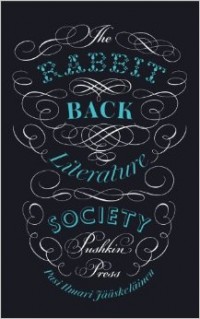
rabbit-back-literature-societyThe Rabbit Back Literature Society
by Pasi Ilmari Jääskeläinen
translated from Finnish by Lola M Rogers

This book was one of the staff recommendations at Mr B’s Reading Emporium and I was attracted to the title and the sinister tone of the blurb. I waited until it was suitably wintry outside (it is set in Finland, after all) and then settled in for something magical.

Ella Milana has recently moved back to her home town of Rabbit Back to teach literature and help her mother cope with Ella’s father’s decline into dementia. Rabbit Back is renowned throughout Finland, indeed the world, for being the home of acclaimed children’s author Laura White, who is not only a beloved bestseller herself, but also declared that she could take ten children from her home town and turn them into successful writers as well. To this end she formed the Rabbit Back Literature Society, to which she invited nine children who have grown up to become great writers. As Ella is both an adult and not a regular writer (she dabbles), she is rather taken aback to be chosen as the society’s tenth member.

“The essays blared through her consciousness…Jokes, banalities and metaphors assaulted her sensibilities, and the floodgates of language standards creaked as dubious sentence structures and hyphenation errors dribbled through their cracks. Every imperfect essay left a dent in Ella’s mind.”

This passport to greatness appears to have been curtailed as soon as it began when at a dinner party thrown at Laura White’s house, a key person disappears in a cloud of snow. But Ella is still a member of this writers’ society and she is determined to dig up all its secrets, big and small, real and imagined. Why are words changing in library books? Why is society member sci-fi writer Arne C Ahlqvist (real name Aura Jokinen) creeping around Ella’s house at night? And was there a previous tenth member of the society who has been written out of its history?

I love that when the first few strange things happen, including Ella’s invite to the society, she is too busy with her normal life to pay it all much heed. She has a job, difficult parents, her own preoccupations. This really highlighted for me how often in books characters jump to something new in their life with no regard for what they would otherwise have been doing.

“He just wanted to look at the garden, to watch it grow – that’s how he explained it to his wife, Marjatta, who had begun to think of herself as a widow and sometimes suffered from a terrible feeling of guilt because of it. Old age doesn’t always wait till you’re old, was her way of answering him. Every day seemed to break off another little piece of Paavo Emil Milana’s personality, and piece by piece he was less and less the Paavo Emil Milana she had married.”

The story hints at and creeps into several genres. The overall structure is that of the detective novel, but it’s not clear whether any crime has been committed. Similarly, there are strange hints of the supernatural in various forms – ghosts, faerie creatures, magic – but nothing is definite, nothing is explained. Could it all just be over-fired imaginations?

The imagination is certainly central to everything else in this novel. White has trained her writers to tap into their and each other’s deepest, most buried thoughts to fuel their writing. The whole town seems to believe in magical creatures, in dark shapes in the shadows become manifest. Even the dogs are behaving strangely. But there is also the beautiful possibility of imagination, the joy that books (and other writing – one of the society members writes for TV and another for film) bring.

“ ‘It was a lovely collapse,’ Saaristo said. ‘Like something out of an old melodrama. All that was missing were the smelling salts. It’s no wonder you fainted in this crowd. Free coffee and cake will get the masses out better than resurrection day.’ She looked around, smiled broadly, and said, ‘But if you want to find characters for a book, this is a good place to do it, as I’m sure you’ve noticed. I found bits of a serial killer’s mother, half of a hero’s lover, and three whole peripheral characters today. A nice haul.’ ”

As Ella learns the rituals of the secretive society and unearths its and the town’s secrets, there is always the potential for something awful to come to light, but what is hidden is more often sad in an everyday way, or at least everyday for the world – loneliness, infertility, the death of parents, the love affair that ended.

And yet somehow it isn’t a sad book, this tinge of sorrow underlines but doesn’t overwhelm the magical otherness, the sense of fun and adventure, the intrigue of mystery. There’s a black humour, a nod to the idea of the idyllic-seeming town harbouring dark secrets, but it’s so much stranger than that.

Lumikko ja yhdeksän muuta first published 2006 by Atena Kustannus.

This translation published 2013 by Pushkin Press.

Source: Mr B’s Reading Emporium.

Kate Gardner Reviews

Mid-winter reading round-up

January 11, 2015 4 Comments

Hands up: I finished reading two of these books weeks ago and have therefore forgotten almost everything about them. They all deserve full reviews but I’d have to reread the books for that to happen and, let’s face it, that’s not happening. So here are some woefully brief thoughts on the last few books that I’ve read. (Incidentally, my 2015 reading has started slowly. Goodreads tells me I am already behind. Stupid reading challenges.)

Dear LifeDear Life
by Alice Munro

Munro writes beautiful short stories about everyday life in Canada, often set in or starting from the mid-20th century, and even the more modern settings have a timeless quality to them. There was a bit of a theme of passing through, of the people who are important to you for a while and then move on, which is not an easy theme to create satisfying endings from, but this never bothered me. I really liked the story “Amundsen”, about a woman who goes to a remote village to teach at a school that’s part of a tuberculosis sanatorium. It’s somehow very ordinary and very strange at the same time.

“The building, the trees, the lake, could never again be the same to me as they were on that first day, when I was caught by their mystery and authority. On that day I had believed myself invisible. Now it seemed as if that was never true.”

First published in Great Britain 2012 by Chatto & Windus.

Source: Foyles, Bristol.

The Dead Lake
by Hamid Ismailov
translated from Russian by Andrew Bromfield

This strange short book started out with so much eerie promise but it got a little boring in middle. In fact, I put it down for a month and wasn’t sure if I would pick it up again, but I’m glad that I did. The language is beautiful and the story almost a fairy tale. It’s about Yerzhan who lives in a remote part of Kazakhstan where the Soviets test atomic weapons. As a young boy he fell in love with the girl next door and one day, to impress her, he dived into a forbidden (and almost certainly radioactive) lake. The consequences of this action are odd and fantastical, which is fitting for such an empty, unsettling landscape.

“Yerzhan stood there with his heart pumping hard, pounding its rhythm against the wall – or was that the heavy passenger express that pounded on the rails with a rhythm that pulsed through the ground? Whatever the cause of the pounding, Yerzhan just stood there nailed to the floor, more dead than alive. And once again that same implacable, visceral fear rose up from his trembling knees to his stomach, where it stopped like a hot, heavy, aching lump.”

Published 2014 by Peirene Press.

Source: Peirene gave this away as a free e-book to newsletter subscribers.

Rivers of London
by Ben Aaronovitch

This had been recommended to me by basically everyone and we accidentally ended up with two copies of it, so I’ve been meaning to read it for a while. It’s the story of Peter Grant, constable for the Met, who at the start of the book is at the end of his probation, waiting to be assigned to a department, so his whole career could hinge on how he handles guarding a crime scene in Covent Garden. Which would be easier if this particular murder case didn’t appear to involve ghosts and all manner of strangeness. This book is a lot of fun. It explores fantasy, magic, policing, class, race, history and death, doing so with great humour and plenty of action. There are already four sequels, which I know people rave about as much as this first book.

“Rush hour was almost in full flood when I got on the train, and the carriage was crowded just short of the transition between the willing suspension of personal space and packed in like sardines…I was sending out mixed signals, the suit and reassuring countenance of my face going one way, the fact that I’d obviously been in a fight recently and was mixed race going the other. It’s a myth that Londoners are oblivious to one another on the tube: we’re hyper-aware of each other and are constantly revising our what-if scenarios and counter strategies.”

Published 2011 by Gollancz.

Source: Heffers Bookshop, Cambridge.

Kate Gardner Reviews

A dam-burst of ideas, memories, impulses and thoughts

January 8, 2015January 8, 2015

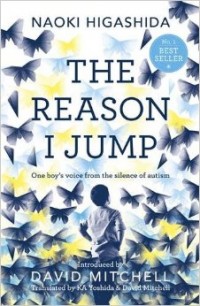
The Reason I JumpThe Reason I Jump: One boy’s voice from the silence of autism
by Naoki Higashida
translated from Japanese by K A Yoshida and David Mitchell

This was one of those random finds that make a great bookshop great. Not that it’s the best book ever, but it’s genuinely interesting and different and, despite being fairly new and translated by one of my favourite authors (plus his wife), I hadn’t heard of it. But it was on display in the non-fiction shelves and Mitchell’s name jumped out at me.

This is somewhere between a memoir and a factual study of autism. Higashida is autistic and at the time of writing was just 13 years old. He struggled with vocal communication, behaviour problems and even written communication, but had worked with his mother and a teacher to create an alphabet-grid system whereby he pointed at words or letters to be understood. (He did also learn to type on a computer and started a blog, so this book isn’t entirely miraculous.) With this book he found a way to explain his experience of autism that was fresh and new to parents and other adults who have regular contact with autistic children. It’s written in the form of questions and answers, with a few very short stories dropped in. There’s some lovely sections about how important nature is to Higashida, partly because it places no demands on him.

“Why do people with autism often cup their ears? Is it when there’s a lot of noise?

…The problem here is that you don’t understand how these noises affect us. It’s not quite that the noises grate on our nerves. It’s more to do with a fear that if we keep listening, we’ll lose all sense of where we are. At times like these, it feels as if the ground is shaking and the landscape around us starts coming to get us, and it’s absolutely terrifying. So cupping our ears is a measure we take to protect ourselves, and get back our grip on where we are.”

For many readers, Higashida’s words were a true breakthrough in their understanding of their own autistic child, and the book was a minor hit in his native Japan. One of those readers was Yoshida, and she immediately started to translate the book so that she could share it, initially with her husband and friends in Ireland, and then, once Mitchell had done some polishing and written an introduction, they published it to reach a much wider audience. There has apparently been some controversy about how much Mitchell polished, with some readers saying this doesn’t sound like a child’s writing. I must say I wholly disagree. Higashida sounds if anything surprisingly typical for his age – presumptive, repetitive and a little self-obsessed, thinking he’s learned to see the wider world but not really anywhere close to that yet.

I don’t mean to sound unkind. This is a very interesting and readable book about a condition that is incredibly difficult to understand. While nothing Higashida has to say was totally revelatory for me and he presumes to speak for all children with autism as if his own experience is universal, I’m really glad I have read it and can definitely see how valuable it could be to anyone who deals with autism. But let’s face it, Mitchell’s introduction is the best bit.

“Imagine a daily life in which your faculty of speech is taken away. Explaining you’re hungry or tired is now as beyond your powers as a chat with a friend… Now imagine that after you lose your ability to communicate, the editor-in-residence who orders your thoughts walks out without notice. The chances are that you never knew this mind-editor existed but, now that he or she has gone, you realize too late how they allowed your mind to function for all these years. A dam-burst of ideas, memories, impulses and thoughts is cascading over you, unstoppably.”

First published in Japanese in 2007.
This translation published 2013 by Sceptre.

Source: The Melton Bookshop.

Kate Gardner Reviews

Reality is always worth more than wishes

December 30, 2014

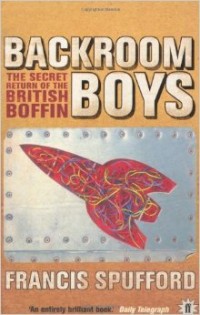
backroom boysBackroom Boys: the Secret Return of the British Boffin
by Francis Spufford

This was my final read for my 2014 Popular-Science Reading Challenge. It’s been recommended to me by multiple people, including Tim, so I thought I would save this for last. It’s about British engineering projects, large and small, of the 20th century.

This is a sort of love letter to British engineering, but a deprecating one with notes of doubt. Spufford looks at projects from the Black Arrow space rocket to the computer game Elite to the Human Genome Project. Sometimes, like that last example, the Brits formed part of an international effort, but it is very much the Brits that Spufford is writing about.

Spufford is playing up the idea of the unsung hero, the small project dwarfed by international (especially US) comparison, which isn’t actually always as true as he implies (but obviously in the case of, say, the space programme, it really is). A book about technology, especially one including ongoing projects, does risk feeling dated quickly, and in the 11 years since this was first published, things have changed. In fact, the paperback edition includes an author’s note at the end with updates that had already happened in the first year since publication.

“It was beginning to dawn on the engineers that they were watching a virtually perfect performance…Wishes were turning into facts faster than seemed wholly lucky…The party was long and loud, because the attempt to orbit Prospero had been the last thing between the rocketmen and the end of the programme, and this, the celebration, was the last of the last. When the sun came up the next morning over the desert, the hangover would encompass the whole of British rocketry.”

This is an interesting, entertaining book that brings to life largely forgotten (or possibly never known to begin with) stories. Spufford doesn’t just explain the science and technology well, he bubbles with enthusiasm, pouring praise on the men and women (but as he admits himself, mostly men) who made these projects happen. I was actually a little saddened when later chapters concentrated more on the policy and politics of making projects happen, not because that’s not a valid part of the story, but because it meant there was less of that almost childlike enthusiasm and adulation.

There’s a definite lean towards Cambridge-based projects. Spufford lives in Cambridge and, while I would not say any of his choices of subjects to cover are undeserving, it does seem a little more than coincidental that half of them are or were in Cambridge, and makes me wonder what alternative options he might have covered with a net cast more widely. Also, I was not always convinced by his sweeping statements, though I’m pretty sure he’s right on the details.

For instance, Spufford writes about Elite as if it’s the one and only example of a decent British computer game, as if this effort by two Cambridge students was the country’s one stab at a games industry and, while successful, was a one-off. This is so very far from true. In the major success league, by 2003 there had been four Grand Theft Auto games (DMA Design/Rockstar North), five Tomb Raider games (Core Design), Goldeneye 007 (Rare), Lemmings (DMA Design), Burnout (Criterion Games), Worms (Team17) and dozens more that I don’t know. So while Elite was clearly a major step forward, hugely influential on gaming as a whole and an interesting human story to boot, it is by no means a lone wolf in British engineering history. That said, it’s a particularly well written chapter, plus it was a lot of fun reading it while sat next to Tim playing the recent sequel Elite: Dangerous, and hearing from him what a big deal the original Elite was.

“That’s how making goes. It would be dispiriting for the maker if it weren’t that reality is always worth more than wishes. A real, constructed thing (however dented) beats a wish (however shiny) hands down; so working through the inevitable compromises, losing some of what you first thought of, is still a process of gain, is still therefore deeply pleasurable to the maker.”

Overall, Spufford is very readable and I’m glad that we already have one of his other books on our shelves.

First published 2003 by Faber and Faber.

Source: Borrowed from Tim

Challenges: This counts towards the 2014 Popular-Science Reading Challenge

Kate Gardner Reviews

You’re just a totalitarian angel

December 22, 2014

AmorousDiscourseSuburbsHellAn Amorous Discourse in the Suburbs of Hell
by Deborah Levy

This is a long poem (ish – it’s no Faerie Queen) in the form of a dialogue between a couple, “He” and “she”, alternating having their say in this argument/conversation. It’s different from anything else I’ve read, wonderfully surreal and packed with references to everything from Shakespeare to pop songs. I read it in one sitting and immediately wanted to read it again.

The poem works so well because it could be read in many ways. Is this an ordinary human couple living in suburbia? Or are they angels fallen to hell? Is one of them fallen and the other trying to save them? Is one human and one God? The many religious references (to the Bible, to Dante, to the language of faith) are woven in such a way that they could just possibly be the twee fondnesses of a couple in love, or they could be wholly serious.

Best of all, it’s funny. Genuinely, laugh-out-loud but also cleverly, funny. It’s profound and profane, full of meaning and simple, pure entertainment.

“i try to introduce you
to the way i see things
and all you want is a wife
a wife and a second-class stamp and a bath
a bath and a donut and a product to kill moths

“You’re just a totalitarian angel
Full of self-rapture
I thought you were a divine messenger
In fact you’re a glutton
With wings”

First published 1990 by Jonathan Cape.
This edition, with revisions, published 2014 by And Other Stories.

Source: I subscribe to the publisher.

Kate Gardner Reviews

Something from that moment needed to be kept

December 11, 2014December 9, 2014

all the days and nightsAll the Days and Nights
by Niven Govinden

This is a short, lyrical, even painterly novel about a dying artist. It’s in some ways the epitome of literary fiction, with a very simple storyline playing second fiddle to the style and language, but it didn’t feel at all pretentious or complex.

Anna Brown is a famous artist nearing death in her home in a small farming community not too far from New York City. She has her faithful housekeeper/cook/companion Vishni and her agent of sorts Ben for company in her final days, but her husband John – her muse and subject of most of her paintings – has gone missing, he just walked away. Anna addresses him, trying to imagine his journey and his state of mind, while also reminiscing on their life together. In the present she is painting her final work, turning her little household to turmoil as she forsakes oxygen tank and rest for her art.

I loved the language of this book, and the way it talked about art from so many perspectives – creating it, appreciating it, collecting it, displaying it. Anna doesn’t talk about death or dying but it’s clearly there in the forefront of her mind. She is obsessed with her art to the point of pushing people far beyond the bounds of most friendships, and her feelings for John are complicated by his being her muse as well as her husband. The story is sweet, moving, contemplative but never boring.

“You were bronzed and smooth, flaxen and happy; it was as if the last days of young manhood were making themselves known. I was blinded by the beauty of it, from the way you smiled to the trail of mosquito bites on your lower arm and the redness of your lips from all the beer…I wanted to shout at you…hold your pose because something from that moment needed to be kept. You were perfect. But I held my voice, because to explain it would be to kill your naturalness.”

Published October 2014 by The Friday Project.

Source: This book was kindly sent to me by the publisher in return for an honest review.

Kate Gardner Reviews

The torment was strange, it was all in her mind

December 9, 2014

brooklynBrooklyn
by Colm Tóibín

This is a lovely book, though I do have reservations. Eilis lives with her older sister Rose and their mother in 1950s Enniscorthy, an Irish town in which job opportunities are scarce. Their brothers have already moved to England to work. Rose has a steady job but Eilis, despite having a bookkeeping qualification, doesn’t, so when a priest offers to arrange a job and accommodation for her in Brooklyn it seems like there’s no choice but to agree.

Eilis is enigmatic – she lets life happen to her, lets others make decisions for her, but she doesn’t lack ambition or opinions of her own. At times she seems ineffectual or indecisive, at others strong and brave. I suppose she is young enough (20 or so?) that she’s still learning who she is and what she believes, even what she really feels. She’s had to grow up very suddenly, thrust from a protective home in a small town to a boarding house in one the world’s largest cities, and the decisions she is faced with are very different now. The social stigmas and etiquette are different, and yet in some ways the same – there’s snobbery and elitism everywhere, but Brooklyn has the addition of racial tensions.

Tóibín manages to explore a lot in not that many pages here – separation from family and ties to our childhood home, love and romance, migration and loneliness, the changing social position of women and job opportunities available to them – but it doesn’t in any way feel like an “issues” book. It’s a snapshot of a time and place that felt very real to me, but most of all I was swept up in Eilis’s story. One word of warning, though: do not read the blurb on the back cover – it reveals something from the last 20 pages of the book. Poor form, Penguin!

“It was like hell, she thought, because she could see no end to it, and to the feeling that came with it, but the torment was strange, it was all in her mind, it was like the arrival of night if you knew that you would never see anything in daylight again. She did not know what she was going to do.”

First published 2009 by Viking.

Source: Secondhand, not sure which bookshop.

Kate Gardner Reviews

Too far from the all-night click and shudder of the hot core

December 4, 2014

William Gibson_1984_NeuromancerNeuromancer
by William Gibson

I read this book because I had arranged to take Tim to an evening with William Gibson arranged by Toppings in Bath and, having read nothing by Gibson myself, thought I might as well start with his first and most famous novel, which is 30 years old this year. It was…educational?

Gibson’s language is wonderful, both lyrical and humorous and I often felt I could visualise scenes really clearly. However, the same can’t be said for clarity of plot. Through a lot of this book I felt that I didn’t know what was happening. After I had finished it and turned to the Internet for a little guidance, it turned out I had misunderstood some early scenes and that had thrown me, but actually I had followed the majority of the action. I just somehow didn’t feel that I had.

“Straylight reminded Case of deserted early morning shopping centers he’d known as a teenager, low-density places where the small hours brought a fitful stillness, a kind of numb expectancy, a tension that left you watching insects swarm around caged bulbs above the entrance of darkened shops. Fringe places, just past the borders of the Sprawl, too far from the all-night click and shudder of the hot core. There was that same sense of being surrounded by the sleeping inhabitants of a waking world he had no interest in visiting or knowing, of dull business temporarily suspended, of futility and repetition soon to wake again.”

The story follows Case, formerly a successful hacker in the Matrix, a kind of virtual reality, a “cyberspace” where computer data is visualised in various ways, from a pleasant beach scene to a complex maze. But at some point (before the novel begins? this bit I’m still not clear on) Case was caught stealing from an employer and a terrible punishment was wrought – a modification to his nervous system that left him unable to access the Matrix. So instead he wanders the back streets of Chiba City in Japan searching for a black market cure.

He is saved by a woman called Molly, a samurai who recruits him for a shadowy employer called Armitage, who offers to cure Case in return for a very big, dangerous job in cyberspace. He and Molly work together for Armitage but also begin to try to unravel exactly who Armitage is and what this job really is.

It’s clear from the start that this book was a major influence on the language of computing, computer games and SF films. But what’s interesting – and also no doubt part of why I got so confused about what was happening at times – is that there was a lot of terminology that’s now familiar to us all but in this book it’s not quite describing what I initially thought it was. For instance, “virtual reality” and “hacking” are words that I have clear preconceptions of but Gibson’s interpretation is wider and requires a bit of a brain shift.

Incidentally, at the Gibson talk we went to last week, he said that the only thing he felt he could predict about the future is that the division between reality and virtual reality will blur to the point that children born today won’t understand why us old folk insist on a distinction between the two. It’s clear that Gibson already thought that way when he was writing Neuromancer and it explains a lot about one of my confusions, which was that I wasn’t always sure whether a scene was happening in reality or virtual reality. But apparently the characters don’t think that way, so of course it wasn’t always distinct!

Plot confusion aside, I did enjoy this book. There are plenty of interesting, flawed characters, though none that you really get inside the head of psychologically speaking. Molly is pretty kickass, with inscrutable motivations, which I found refreshing. In fact, the whole novel felt very modern, certainly not 30 years old. I’m not sure if that’s the language or great foresight on Gibson’s part or if he’s actually managed to create something here that’s somehow timeless.

It’s also a very interesting look at addiction. Case gets physical pleasure from plugging himself into the Matrix and at the start of the novel is strung out on drugs in his attempt to achieve an equivalent high. When Armitage has Case cured of his nervous system damage, he also has Case’s pancreas altered so that no drug will have any effect on him. Initially Case is upset by this and showing signs of withdrawal, but once he gets back to cyberspace he no longer misses the drugs.

“The high wore away, the chromed skeleton corroding hourly, flesh growing solid, the drug-flesh replaced with the meat of his life. He couldn’t think. He liked that very much, to be conscious and unable to think. He seemed to become each thing he saw: a park bench, a cloud of white moths around an antique streetlight, a robot gardener striped diagonally with black and yellow.”

And despite my confusion at the time, I think the start of the novel in Chiba City is a very visceral, believable depiction of poor neighbourhoods rife with prostitution, drug-taking and other crime. It’s a dark, depressing place where everyone (especially Chase) is paranoid, but not everyone is miserable. In fact, the novel as a whole has great sense of place in all its various locations, perhaps rooted in Gibson’s early travel around the globe before he settled in Vancouver.

I just wish I’d known at any point what was actually happening.

First published 1984 by Victor Gollancz.

Source: Borrowed from Tim.

Kate Gardner Reviews

Graphic Novel Week: Mini reviews

November 29, 2014November 29, 2014

Reading in Winter Graphic Novel Week

To conclude this fantastic week of graphic novel celebration, organised by Kristilyn of Reading in Winter, I have written mini reviews of all the graphic novels I have read lately. I didn’t get through all of my reading list I set myself on Monday, but considering I was busy three evenings out of the five I don’t think I did too badly!

Transmetropolitan 1Transmetropolitan Vol 1: Back on the Street
by Warren Ellis (writer) and Darick Robertson (penciller)

Spider Jerusalem is a sweary, drug-addled, weapons-loving misanthropic journalist who retired to the mountains when fame started to make people actually like him. Now he’s running out of money and his publisher is threatening legal action if he doesn’t finally stump up the two books he’s contracted for, so he reluctantly returns to the one place where he knows he can write – the City. Ellis and Robertson depict a frightening future, a world that has got more extreme in every way. There is clearly a lot of Hunter S Thompson in Spider, but in a world where his brand of truth-telling is more badly needed than ever. Spider talks/coerces his way into a job writing a weekly column and as the words begin to flow, he becomes fractionally less awful as he has somewhere to channel his hatred, anger and misery. There’s great black humour in the words and the artwork – I definitely recommend paying attention to the details in every frame as there are so many stories being told here.

“I’ve shut off the mine-fields and the intelligent guns. For the first time in five years, there is nothing menacing in my garden. Five years of shooting at fans and neighbours, eating what I kill and bombing the unwary. Five years of being alone. I can’t begin to describe the ways I’ll miss the mountain…I could cry. I really could. Journalists do not cry. And I am a fucking journalist again.”

This collection published 1998 by DC Comics.

Source: Borrowed from Tim.

transmet 2Transmetropolitan Vol 2: Lust for Life
by Warren Ellis and Darick Robertson

In this volume, Spider Jerusalem gains a glamorous assistant called Channon who is both a fan and capable of handling his ridiculous habits, and starts finding himself a series of subjects for his column “I Hate It Here”. Often several pages in a row are, effectively, his column, calling attention to the poor and desperate of the city. He repeatedly breaks or bends the law not just to get his story, but also to exact small revenges on those he feels have failed the city in some way. There is one incredible and moving story about a woman called Mary who is revived from cryogenic sleep to find herself alone in a bewildering and inhospitable future. In another story, Spider visits a series of reservations created outside the city to preserve old cultures, where the desire for authenticity has stretched to removing the anti-cancer gene that humans have developed. It begins to be clearer in this volume how Spider comes to be so very fucked up. This is a truly fucked-up world and anyone who keeps their eyes open and dares to care is going to find their nature twist. It’s powerful, entertaining stuff.

“Mucus and soundbites. I remember this feeling now, from the last days before I went to the mountain. The sudden feeling that this place is Not On Your side. I’m hiding now. And writing. I can’t stop, even now. This goddamned city makes me write even when it wants me dead.”

This collection published 1998 by DC Comics.

Source: Borrowed from Tim.

Transmet 3Transmetropolitan Vol 3: Year of the Bastard
by Warren Ellis and Darick Robertson

Spider Jerusalem was made famous years ago by writing a bestselling book about a presidential election campaign so now he is desperately trying to ignore the approach of election time, while his editor and readers clamour for his opinion on it all. Inevitably he is sucked into following the election of an opposition candidate for the current president, known as the Beast. Spider is accompanied by his new assistant Yelena, in many ways the opposite of Channon – a brooding, resentful girl who disapproves of Spider in every way. But Spider is busy now figuring out what the two main candidates have to hide and which of them is capable of beating the hated Beast. Ellis is careful not to use words like Republican or Democrat but there is still plenty of applicable-to-real-life insightful political commentary here, phrased as always in Spider’s spleen-filled invective.

“Two days in this whirlwind have left me shipwrecked and abandoned. Even the stuff I’ve been shooting in order to, Holmes-like, keep my interest in the world alive is failing me now. I’ve played the game like a good little whore, snarled and cursed on cue…I’ll let myself sleep soon, and hope to hell the world doesn’t seem so goddamn fractured when I wake up. Having said that, I also hope I wake to find half this city committed suicide in my honour.”

This collection published 1999 by DC Comics.

Source: Borrowed from Tim.

transmet 4Transmetropolitan Vol 4: The New Scum
by Warren Ellis and Darick Robertson

It’s time to elect a new president – will it be the Smiler or the Beast? Spider Jerusalem interviews both candidates, savagely digging for the truth, for which man will be the lesser evil. There are glimpses too of the “New Scum” – the city’s poor for whom Spider has declared himself spokesperson – but this is largely another political volume. After the revelations of Year of the Bastard there is little hope that the outcome of the election will really change anything, so this is the bleakest volume yet. There is some light relief from Channon and Yelena bickering but overall I struggled a little to maintain the excitement that had had me reading eagerly through these books. Still gotta love Spider’s columns though.

“And there you have it, reader. The Beast believes in something, perverted and filthy as it is…I was so shocked that I almost forgot to plant the guerilla neurotransmitter gel…And that, Mr President, is why you’ve been hallucinating having sex with speed-crazed Barbary Apes suffering from irritable bowel syndrome for the last week. And now you know what it’s like to have you as president; what it’s like to be constantly fucked by someone who stinks of shit.”

This collection published 2000 by DC Comics.

Source: Borrowed from Tim.

transmet 5Transmetropolitan Vol 5: Lonely City
by Warren Ellis and Darick Robertson

Oh man. While volume 4 had me doubting this series, volume 5 has me convinced it is the greatest comic series I have read. Ellis really stepped it up a notch, I felt. Back on the city streets, Spider Jerusalem and his assistants stumble across a hate crime that doesn’t seem to be getting proper attention. When Spider calls the police out on it in his column, he unleashes a horrific series of events. Despite the futuristic setting and indeed the futuristic aspects of the crime itself, the rest of this storyline could terrifyingly easily happen in the real world today; arguably it has already happened over and over. I was chilled to the core and my fandom of the series fully reawakened. Also, this volume has an introduction by Patrick Stewart. Seriously. Cool.

“You went to all the trouble of conceiving me, and giving birth to me, and raising me and feeding me and clothing me and all. And yeah, whipping me from time to time, and making me live in a house that’s freezing fucking cold all the goddamn time. And you make me cry and things hurt so much and disappointments crush my heart every day and I can’t do half the things I want to do and sometimes I just want to scream. And what I’ve got to look forward to is my body breaking and something flipping off the switch in my head. I go through all this – and then there’s death? What is the motherfucking deal here?”

This collection published 2001 by DC Comics.

Source: Borrowed from Tim.

Ex_Machina,_the_First_Hundred_DaysEx Machina Vol. 1: The First Hundred Days
by Brian K Vaughan (writer) and Tony Harris (pencils)

Imagine The West Wing with superpowers, well, just one specific superpower really, but even so – amazing combo, right? Civil engineer Mitchell Hundred just became mayor of New York City, running on a campaign of independence, promising to unite left and right, but everyone knows he was really elected because he outed himself as the Great Machine, the first superhero, and his last super act before hanging up his hero’s suit was stopping the second plane from hitting the World Trade Center on September 11th. Now in true Jed Bartlett style, he must wrestle with the petty and ridiculous when he’d rather be tackling the big issues. But there’s the added difficulties of the NSA demanding he no longer use his special powers and a freak snow storm threatening to cripple the city. There are lots of great female characters, lots of interesting political machinations and I’m eager to see where this goes next.

“‘Ms Padmilla, I admire your tenacity, but I do have a press secretary.’

‘Yeah, one who refuses to divulge the origin of your psychic rapport with machinery.’

‘First of all, I’m not psychic. That’s just dumb. And secondly, you know damn well the NSA has ordered me not to comment on any “extra-normal abilities” I might have.’

…’Are you an alien?…What kind of pseudonym is Hundred anyway?’

‘For the last time, I am a thirteenth-generation American. My ancestors renamed themselves after Brandywine Hundred, the division of Delaware where they settled. And unless you can prove to me that Myles Standish – captain of the fucking Mayflower – was an alien, I’m done answering retarded questions about my planet of origin.’

…’Let’s roll…Ahh, shit! She’s gonna quote me on “retarded”, isn’t she?'”

This collection published 2005 by Vertigo Comics.

Source: Excelsior! comic book shop, Bristol.

serenity 4Serenity Vol. 4: Leaves on the Wind
by Zack Whedon (script) and Georges Jeanty (pencils)

This picks up where the film Serenity left off (the previous three comic volumes filled in back story, both before Firefly and between Firefly and the film). The tone is pitched perfectly, depicting the crew dealing with the emotional and practical fallout from the film’s events while also setting up a new story thread and new characters – good, bad and wavering inbetween. Not every character gets equal air time (frame time?) – for instance, I hope that future volumes give Kaylee and Simon more story – and I also felt that Kaylee’s dialogue played her as dumber than she ever came across in the TV series. However, overall I thoroughly enjoyed this volume, especially the gorgeous chapter page artwork by Dan Dos Santos.

“Life’s a funny thing. We cling to it so dear. The thought of losing it pushed down deep with all the other dirty little things we don’t like to see the light of day. Yet it is so easy to take a life. We’re so soft. So fragile…We’re built to live but we’re so easy to kill. Does that seem right to you?”

This collection published 2014 by Dark Horse Books.

Source: Excelsior! comic book shop, Bristol.

Kate Gardner Reviews

See how the light needs shadows

November 22, 2014

bone-clocks

The Bone Clocks
by David Mitchell

It’s almost two weeks since I finished this book, and the more I reflect on it the higher it ranks in my esteem. It’s definitely a book that rewards giving it some thinking time.

If you’ve read any of Mitchell’s first three books (Ghostwritten, number9dream and Cloud Atlas) then this new release will feel familiar, and not just because of the direct references to characters, places and things in those books. This has actually been true of all Mitchell’s books but never quite so clearly as here. He has been world-building for five novels and now he’s capitalising on it with a glorious plot that combines the best of all that has gone before and throws in some brand new magic.

“Empires die, like all of us dancers in the strobe-lit dark. See how the light needs shadows. Look: wrinkles spread like mildew over our peachy sheen; beat-by-beat-by-beat-by-beat-by-beat-by-beat, varicose veins worm through plucked calves; torsos and breasts fatten and sag…as last year’s song hurtles into next year’s song and the year after that, and the dancers’ hairstyles frost, wither and fall in irradiated tufts…”

As I mentioned in my write-up of David Mitchell’s talk at Bristol Festival of Ideas last week, it would be very easy to spoil this plot by saying too much, so I’m going to try very hard not to do that.

The Bone Clocks opens with teenager Holly Sykes having a really rubbish day. She starts off pretty annoying, as indeed most teenagers are, but as events continue to go badly for her, I realised I must have warmed to her because I really did care how things were going to turn out. It’s 1984 on the Kent—Essex border and though Holly mentions punk music and the miners strike, she doesn’t need to because the setting is so very alive. Holly’s parents own a pub and in reading about it I pictured all those small town pubs from my own childhood.

There are hints of something fantastical in the background, that this isn’t just a realistic story about a 15-year-old who’s had a massive fight with her mam, but Mitchell keeps these hints simmering slowly. It’s a tactic that for me paid off brilliantly, as it kept me reading even when the narrator switched to a whole new person and story that once again I needed to warm up to.

“Grey comes in through the cracks, birdsong too, and the sound of a lorry passing overheard, and a sharp pain from a knocked ankle, and I’m crouching on the concrete ground of an underpass, just a few yards from the exit. A breeze that smells of car-fumes washes over my face, and it’s over, my daymare, my vision, my whatever-it-was, is over.”

As always, Mitchell’s style is very readable and enjoyable. There’s plenty of humour to balance out the occasionally tough topics addressed. But key to what makes this such a good read is that every character is a rounded, believable person and though there are a few clear heroes and villains, even they can’t be relied on to be wholly good or bad.

Published 2014 by Sceptre.

Source: Waterstones.

Kate Gardner Reviews

Posts pagination

1 … 36 37 38 … 70

Archives

RSS Nose in a book

  • 2025 reading stats and top reads
  • December 2025 reading round-up
  • Book review: The Galaxy and the Ground Within by Becky Chambers

Me on the internets

  • @kate_in_a_book@mas.to (Mastodon)
  • Flickr/noseinabook
  • Instagram/kate_in_a_book
  • StoryGraph/kate_in_a_book

Categories

  • Blog
  • Reviews
  • Uncategorized
Proudly powered by WordPress | Theme: Dream by vsFish.