Nose in a book

Reviews and other ramblings

  • Home
  • Reviews archive
    • Book reviews
    • TV reviews
    • Theatre reviews
  • TBR
  • Challenges
    • The Classics Club
    • 2014 Popular-Science Reading Challenge
    • Cookery challenge
    • The Gilmore Girls Reading Challenge
    • 2013 TBR Pile Challenge
    • 2013 Translation Challenge
    • Crime and Punishment read-a-long
  • About
    • Cookie legal stuff
  • Home
  • Reviews archive
    • Book reviews
    • TV reviews
    • Theatre reviews
  • TBR
  • Challenges
    • The Classics Club
    • 2014 Popular-Science Reading Challenge
    • Cookery challenge
    • The Gilmore Girls Reading Challenge
    • 2013 TBR Pile Challenge
    • 2013 Translation Challenge
    • Crime and Punishment read-a-long
  • About
    • Cookie legal stuff

Category: Reviews

My father bleeds history

November 17, 2019November 17, 2019

Maus cover

The Complete Maus
by Art Spiegelman

I’m not sure what this says about my state of mind, but for some reason the celebrations surrounding the anniversary of the fall of the Berlin Wall last weekend made me pick up this book that famously covers some of the worst stories of the Holocaust. It’s a deeply upsetting book that I had to take breaks from to recover emotionally.

Art Spiegelman’s celebrated graphic novel alternates between telling the story of his father Vladek – a Polish Jew – from the 1930s to the late 1940s, and the story of Art’s own relationship with his father in the 1980s. It’s darkly sad and darkly funny. Oh – and all the people have animal heads. Jewish people are mice, Polish people are pigs, Germans are cats (later on, Americans are dogs and the French are frogs). It’s odd and it isn’t really ever explained, but the insinuations are clear.

Art and Vladek have a fractious relationship. Vladek is happy to tell his son details of his war-time experiences, but he also needs someone to vent to about getting old, about arguments with his second wife Mala. It’s uncomfortable to read at times.

Vladek narrates his history in broken English. And it’s a tough story, even in Holocaust terms. Vladek and his first wife (Art’s mother) Anja lived in south-west Poland, near Krakow. They went from owning a large successful business, to having their home and factories confiscated, to being moved to a series of ghettos and then work camps. Vladek was initially held as a political prisoner but was released back to the ghetto, primarily because political prisoners enjoyed some level of international protection.

Continue reading “My father bleeds history”

Kate Gardner Reviews

K-drama review: Descendants of the Sun

October 23, 2019
From left: Captain Yoo Si-jin, Dr Kang Mo-yeong, Sergeant Seo Dae-young and Lt Yoon Myung-ju.

I know, it’s barely two weeks since my last K-drama review and this show is 16 hours long. No wonder I haven’t read much. My excuses are twofold: I was a bit brain foggy and I found this series addictive. From the first episode of Descendants of the Sun (KBS 2016), I knew I was in trouble.

After the low stakes of Coffee Prince, this drama was much more serious, but still sweet. It opens with an impressive set piece in the DMZ between North and South Korea. After soldiers from both sides of the border fight with knives in a stand-off that the public can never be told about, the triumphant leader of the South Korean commandos removes the scarf covering his face to reveal our hero: Captain Yoo Si-jin (Song Joong-ki).

Our heroine has a slightly less violent introduction but is still instantly impressive. Dr Kang Mo-yeong (Song Hye-kyo) is a surgeon at a big hospital in Seoul. She’s great at her job but keeps getting overlooked for promotions because she doesn’t have connections. She doesn’t take any shit from patients but does get on well with her colleagues and is willing to suck up to her superiors so long as it doesn’t break her moral code.

Si-jin and his best bud Sergeant Seo Dae-young (Jin Goo) are on leave and enjoying a funfair when they foil a robbery. The thief, Kim Gi-bum (Kim Min-seok, who I know from Doctors and Hello, My Twenties) is taken to hospital, with Si-jin and Dae-young in pursuit when they realise he still has one of their phones. Dr Kang initially thinks they are hoodlums harassing her patient and refuses to let them near Gi-bum (who, for reasons that I could never figure out, has as his next-of-kin Dae-young’s on-off girlfriend Lt Yoon Myung-ju – a military doctor who trained with Dr Kang). But when Gi-bum tries to run away from the hospital, he runs into a real gang and ends up being saved by Si-jin and Dae-young in the pilot’s second excellent set piece.

Continue reading “K-drama review: Descendants of the Sun”

Kate Gardner Reviews

K-drama review: Coffee Prince

October 9, 2019

Coffee Prince advert

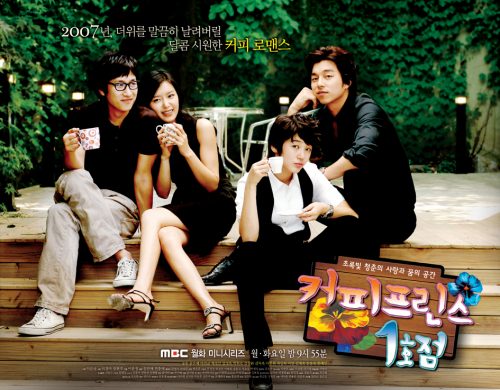
I haven’t written about the last few TV shows I’ve watched, but this one had some interesting quirks that I thought were worth a blog post. Coffee Prince (MBC 2007) was a successful enough show that it’s been remade in at least four other countries and the old cafe used for the main set was turned into a real coffee shop that’s a popular tourist attraction in Seoul.

The set-up is that our heroine, Go Eun-chan (played by Yoon Eun-hye), is a 24-year-old androgynous-looking woman who is often mistaken for a man and rarely bothers to correct people. She is the sole wage-earner in her family since her father died, and is determined to earn enough to send her younger sister Eun-sae to college, which means that she works several low-paying jobs. In the first episode, she meets the two men who will be rivals for her love, and of course they are cousins and close friends.

Choi Han-gyul (Gong Yoo) is the heir to a major food corporation and after spending a few years in America “dabbling” with being a toy designer, his grandmother is keen to get him suitably settled down. Her first aim is to find him a wife, so Han-gyul hires Eun-chan – who he thinks is a man – to play his boyfriend who breaks up every blind date. Eun-chan doesn’t like Han-gyul but she has just lost one of her jobs and needs the money.

Continue reading “K-drama review: Coffee Prince”

Kate Gardner Reviews

What exactly about the bag is Jewish?

October 3, 2019

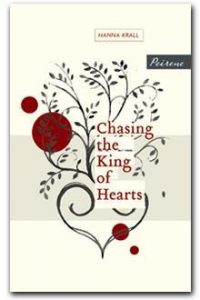
Chasing the King of HeartsChasing the King of Hearts
by Hanna Krall
translated from Polish by Philip Boehm

This is my Poland choice for the EU Reading Challenge, one of several I bought from Peirene Press. It’s a true story from World War Two, retold by a journalist who herself survived the war by hiding in a cupboard. Which sounds like quite a story itself, but possibly not one as eventful as that of Izolda.

Izolda Regensberg is a Jewish woman whose history took her from the ghetto in Warsaw, to working for the Underground, to various workcamps and even Auschwitz. But we know early on this book that she survived, thanks to interspersed chapters about her attempts to communicate with her Israeli grandchildren.

Language is key to this amazing story. Language and love. Izolda speaks Polish, Yiddish, Russian and French, and during the war learns German, which helps her to fake her identity, make friends and make money. But in her old age she can’t speak even a sentence of Hebrew and can only communicate with her granddaughters through her own children. It’s an interesting comment on the reduced capacity for new language as we get older, even in people who are polyglots.

Continue reading “What exactly about the bag is Jewish?”

Kate Gardner Reviews

All of us who survived on the street could not renounce the charm of the stories we told

September 22, 2019September 22, 2019

Dry SeasonDry Season
by Gabriela Babnik
translated from Slovene by Rawley Grau

This is a strange book, difficult to follow at times, but always lyrical and occasionally outstanding. It’s my Slovenia book for the EU Reading Challenge, written by a Slovene author and starring a Slovene main character, but actually set in Burkina Faso. It seems extra appropriate for this project as its publication was co-funded by the Creative Europe Programme of the European Union.

The book opens with two people in bed together in a hotel room in Ouagadougou. They are Ana – a 62-year-old artist here on holiday – and Ismael, a 27-year-old local who spent much of his life living on the street. It’s an unlikely pairing and one that doesn’t seem destined to last, but as the narrative alternates between their points of view, we discover things they have in common. In a way they are both running away from their daily lives, and as they gradually open up to each other, we learn that neither of them is quite what you expect.

Continue reading “All of us who survived on the street could not renounce the charm of the stories we told”

Kate Gardner Reviews

Our father refused to compromise, and live a life of silence in the face of oppression

September 12, 2019 2 Comments

burying the typewriter coverBurying the Typewriter: Childhood Under the Eye of the Secret Police
by Carmen Bugan

This is my Romania selection for the EU Reading Challenge, and it’s so far my only book in this challenge that was originally written in English. I remember adding this to my wishlist when it was first published. Past me was smart.

It’s a memoir of the author’s first 18 years, when she lived in Romania. She and her family left Romania in late 1989 under threat of death and this is Bugan’s story of how they reached that point. It’s very much told from her own point of view, as the oldest child of Ion Bugan, who was twice imprisoned for protesting Nicolae Ceaușescu’s regime.

The book opens with Carmen’s early childhood, which was idyllically happy. Though her father was an activist long before his marriage and her birth, and never stopped secretly protesting, she was oblivious for many years. As the 1970s turn into the 1980s, the warning signs appear (with of course decades of hindsight). When Carmen turns 11 she begins to pay attention to the radio programmes her parents listen to; to the food shortages and fights over rationing on the streets; to the arguments her parents have about moving near to the border and becoming self-sufficient.

Continue reading “Our father refused to compromise, and live a life of silence in the face of oppression”

Kate Gardner Reviews

The male and female together make the world

August 22, 2019August 22, 2019

One Part Woman coverOne Part Woman
by Perumal Murugan
translated from Tamil by Aniruddhan Vasudevan

This novel is set in early 20th century India, focusing on a couple who are farmers in a rural area, steeped in religion and superstition. So it is perhaps surprising to find that it is one of the most relatable stories I have read in a while.

Kali and Ponna have been married for 12 years. They love each other and their little corner of Tamil Nadu, but their inability to conceive a child has come to overwhelm everything else. Ponna is excluded from the community, and even family flinch if she touches a child. Kali is alternately mocked and advised to take a second wife. They’re not sure they even want a child, but it seems to be all that the rest of the world cares about.

Their simple lifestyle means that the exact date when this is set was unclear to me, though references to British rule give at least some clue. (There are mentions of certain politicians and events that apparently reveal to those with better historical knowledge than mine that this is the 1940s.) So fertility treatment is limited even for those who have money and access to doctors.

For Kali and Ponna there are no doctors to help. Their only recourse is religion. They endlessly pray, visit shrines and temples, perform rituals. They search their family histories for wrongs done by their ancestors that they can put right. They spend their meagre income on offerings to deities. Hundreds of deities.

Continue reading “The male and female together make the world”

Kate Gardner Reviews

K-drama review: Don’t Dare to Dream

August 14, 2019 7 Comments

Don't Dare to Dream poster

I loved this show so much. It’s not groundbreaking or original, but what it does, it does well. Don’t Dare to Dream, also known as Jealousy Incarnate (SBS 2016) is about TV news, family, love, jealousy and…cancer. It’s well acted, hits both light humour and real emotional moments in every episode and the credits feature cartoon aliens. It truly has everything.

Pyo Na-ri (played by Gong Hyo-jin) is a weather broadcaster who is frustrated by her TV station refusing to give her a permanent job and treating her as a general dogsbody, but can’t risk quitting as she needs to earn good money to support her younger brother Chi-yeol, who is still in high school. At work she is always professional, but at home she’s a bit of a mess, constantly behind on rent and shouting at Chi-yeol.

She jumps at an opportunity to work on a shoot with news reporter Lee Hwa-sin (Jo Jung-suk, who was the lead man in Oh My Ghost – another K-drama that I rate highly), who she used to have a crush on. She had hoped this was finally her chance with him, but instead meets another man who takes Hwa-sin’s place in her affections – businessman Go Jeung-won (played by Go Kyung-po, who I swear looks like Joseph Gordon-Levitt), who is Hwa-sin’s childhood best friend. Na-ri and Jeung-won begin dating, much to the despair of his mother, who is hoping to use his marriage as a business deal.

Continue reading “K-drama review: Don’t Dare to Dream”

Kate Gardner Reviews

Gladly will I oppose my body to his

August 11, 2019
The Mabinogion illustration by Alan Lee
The Mabinogion illustration by Alan Lee.

The Mabinogion
Translated from Middle Welsh by Lady Charlotte Guest

This was the first book I started for the EU Reading Challenge, but ended up being the 10th book I completed. Perhaps I should have searched out a more modern translation when I first started to struggle. These are ancient tales, widely considered the oldest surviving British literature in prose form. They were almost certainly oral tales for a century or more before their earliest known recording in 1350–1410. Lady Charlotte Guest translated the tales into both modern Welsh and English in the late 19th century. Which I thought made them an interesting inclusion on my EU list.

The 11 stories in this volume have different authors, all unknown, and in fact only the first four are strictly the Mabinogi. The rest are medieval romances; some early Arthurian knight tales; and the tale of Taliesin the bard. My particular edition of The Mabinogion includes full-page illustrations by Alan Lee, who is now better known for his Lord of the Rings illustrations. It is a beautiful object.

There is a bit of a theme in these tales of women with magical powers, many of whom have pretty awful fates. For instance, the first of the Mabinogi is “Pwyll, Prince of Dyfed” and tells the story of Pwyll’s attempts to romance Rhiannon, an Otherworld woman who runs rings around him rhetorically and literally (she’s pretty awesome), but eventually falls in love with Pwyll and marries him. However, when their son Pryderi disappears on the night of his birth, she is accused of matricide and imprisoned.

The story has a happy ending, but not before Rhiannon has spent years in prison. And she’s not the only wrongfully treated woman here. I can’t decide if this is fear of magic and witchcraft, or misogyny, or both. There’s plenty of magic, used for good and evil, but even when used for good it does tend to end badly.

Continue reading “Gladly will I oppose my body to his”

Kate Gardner Reviews

Dorama review: Mischievous Kiss – Love in Tokyo

August 7, 2019August 7, 2019

Mischievous Kiss Love in Tokyo poster

Mischievous Kiss – Love in Tokyo (Fuji TV 2013) seemed like it was almost a carbon copy of Good Morning Call to begin with. And I enjoyed Good Morning Call. But where that show stayed just the right side of irritating cliches, Mischievous Kiss rode those cliches all the way through two seasons. It’s really not great on the gender politics front, but so light and fluffy that I kept on watching, hoping for improvement. It is based on the Japanese manga Itazura Na Kiss written by Tada Kaoru.

This show depicted everything that annoys me about gender stereotypes in Japanese culture. The man is rich, intelligent, calm, collected, cold and cruel but apparently handsome enough for everyone to desire him. (Does that really happen with cold men in real life? In my experience the friendlier, chattier men get all the romantic attention, but then I don’t live in Japan.) The woman is poor, not at all clever, giggles and daydreams through her days, is popular and a good friend, pretty but not beautiful. And for some reason the woman is hopelessly in unrequited love with the man. Man treats woman with total contempt until another man expresses interest and then jealousy prompts realisation of actual feelings. But this doesn’t result in man actually treating woman well, no no no. It means he gives her just enough attention to string her along while continuing to be a total asshole.

The style of Mischievous Kiss is very camp, overwrought and comedic (which is perhaps why it took me most of season one to realise that those gender roles were not getting any better). The acting is laughably bad, as is the set-up.

Continue reading “Dorama review: Mischievous Kiss – Love in Tokyo”

Kate Gardner Reviews

Posts pagination

1 … 13 14 15 … 70

Archives

RSS Nose in a book

  • 2025 reading stats and top reads
  • December 2025 reading round-up
  • Book review: The Galaxy and the Ground Within by Becky Chambers

Me on the internets

  • @kate_in_a_book@mas.to (Mastodon)
  • Flickr/noseinabook
  • Instagram/kate_in_a_book
  • StoryGraph/kate_in_a_book

Categories

  • Blog
  • Reviews
  • Uncategorized
Proudly powered by WordPress | Theme: Dream by vsFish.