Nose in a book

Reviews and other ramblings

  • Home
  • Reviews archive
    • Book reviews
    • TV reviews
    • Theatre reviews
  • TBR
  • Challenges
    • The Classics Club
    • 2014 Popular-Science Reading Challenge
    • Cookery challenge
    • The Gilmore Girls Reading Challenge
    • 2013 TBR Pile Challenge
    • 2013 Translation Challenge
    • Crime and Punishment read-a-long
  • About
    • Cookie legal stuff
  • Home
  • Reviews archive
    • Book reviews
    • TV reviews
    • Theatre reviews
  • TBR
  • Challenges
    • The Classics Club
    • 2014 Popular-Science Reading Challenge
    • Cookery challenge
    • The Gilmore Girls Reading Challenge
    • 2013 TBR Pile Challenge
    • 2013 Translation Challenge
    • Crime and Punishment read-a-long
  • About
    • Cookie legal stuff

Author: Kate Gardner

I live in Bristol and I like to read books and share what I thought about them here. I read mostly general or literary fiction, with pretty much every genre making an appearance from time to time. I love to receive comments, whether you've read the same books or not!

Early summer reads in brief

June 19, 2014June 23, 2014 2 Comments

As you might gather from the sparcity of this blog this month, I’ve been busy. I’ve still been reading, but I’m very very behind on writing reviews, so here’s a few shorter thoughts on recent reads.

captain america

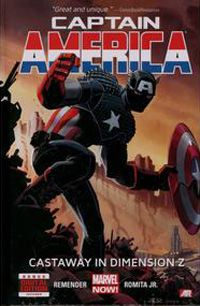
Captain America: Castaway in Dimension Z,
books 1 and 2
by Rick Remender and John Romita Jr

This relatively short storyline is a great example of how comics – superhero comics, at that – can be a really good medium through which to explore unusual or difficult ideas. Cap is doing his thing for the Avengers when he is kidnapped by the evil Dr Zola and taken to Dimension Z, and while he soon escapes his captors it seems that Dimension Z will not give him up so easily. Over time he gets caught up in the ongoing war between Zola’s bioengineered army and the phrox, who look monstrous but are willing to give Cap a home. Which all sounds a bit robots fight monsters grr argh, but while this book is distinctly masculine, it’s also very thoughtful. In fact, my main reservation was that Cap was perhaps too brooding and thoughtful. By far the majority of the text is his thoughts and for several pages I wondered whether he was going to speak at all. But overall I enjoyed it and the take on questions surrounding, among other things, war, parenthood, love, loyalty and belonging.

“Adrenaline surging—enough to jolt a dead man to a waltz. Need the help—so long as I don’t pass out. Pain—the shattered left hand screaming at me—it has no business maintaining a grip on a B-52 in a dead drop. Thank the adrenaline…His howl—agony…a reminder of what happens to a million people if you fail—millions of screams.”

Published 2013 by Marvel.

Source: Borrowed from Tim, who bought them at Excelsior! comic shop, Bristol.


Tales from the Secret Annexe
by Anne Frank
translated from Dutch by Susan Massotty

It pains me, after rediscovering the talent of Anne Frank earlier this year, to conclude that this collection of her essays and short stories is so far below the standard of her diary that it should probably never have been published. There are signs of her writing ability, certainly, and I don’t doubt that if she had lived she would have produced a collection after the war that would have shone with greatness. But this isn’t it; these are the writings of a child and it shows. Even her moving essays about hope and charity suffer from youthful naivety. The first part of the collection is especially odd, as it is a series of alternative accounts of events that are also included in Anne’s diary – essentially discarded early drafts. The book isn’t entirely without merit: it’s perfectly readable, provides a little extra depth to the picture of Anne for anyone who has read her diary, and the foreword is actually the best summary I have read of the Frank family’s war-time experience.

“Everyone is born equal; we all come into the world helpless and innocent. We all breathe the same air…Riches, power and fame last for only a few short years. Why do we cling so desperately to these fleeting things? Why can’t those who have more than enough for their own needs give the rest to their fellow human beings?”

Verhaaltjes, en gebeurtenissen uit het Achterhuis published 1982 by Bert Bakker.
This edition published 2010 by Halban.

Source: I bought it at Anne Frank House, Amsterdam.


Sex Criminals volume 1: One Weird Trick
by Matt Fraction and Chip Zdarsky

It really tells how much I enjoyed the first volume of Hawkeye by Matt Fraction that I was eager to check out his other current project despite a title that didn’t seem entirely aimed at me. However, it turns out that this is another fun, well written and stylishly presented series. The premise is that librarian Suzie stops time whenever she has an orgasm, an ability she discovered in her teens and has quietly enjoyed since, while getting on with her otherwise normal life. Until she meets Jon, who not only shares her ability, but has ideas about what they could do with it. Her library is closing due to lack of money, they can stop time – it seems like robbing the bank will be an easy solution. But when is life ever easy? Although this comic is undeniably explicit and R-rated, it’s actually much less explicit than some Alan Moore stuff I’ve read and, importantly, far more honest about sex. As Suzie and Jon get to know each other we learn about their teen years, discovering masturbation and other sexual acts, which is a subject that, while not quite taboo, is usually dealt with extremely lightly. This comic combines a good level of honesty and humour with a bit of action adventure thrown in.

Published 2014 by Image Comics.

Source: Borrowed from Tim, who bought it from comiXology.

Kate Gardner Reviews

Germaine Greer on the environment

June 14, 2014

Germaine Greer

White Beech: the Rainforest Years
@Bristol, 12 June

The packed audience for Germaine Greer’s talk at Bristol Festival of Ideas were mostly women, as you might expect, but for once the topic at hand was not feminism but the environment and conservation. Greer was introducing her new book White Beech: the Rainforest Years by giving some background to what might seem like a surprising episode of her life.

In 2001 Greer bought an abandoned farm in Australia with the sole intention of returning the land to the sub-tropical rainforest it once had been, a small area of which remained. She had very clear ideas about how and why she wanted to do this and had spent some time choosing the right piece of land, but where did this unusual idea come from?

Greer spoke eloquently and passionately about her lifelong love for nature and her growing realisation, as she got older, that she preferred “real” nature to anything artificially managed. She spoke about the difference between the artistic notion of “landscape” and the Aboriginal term “country”, which encompasses not only land and vegetation but also sky above and creatures living there. (I say “creatures” deliberately because as president of the charity Bug Life, Greer tends to be more concerned with insects, crustaceans and the like rather than birds or mammals). While landscaped land can be pretty or picturesque, Greer finds real beauty in wilder nature. She also finds that natural plants in their natural habitat tend to make sense and work together, creating more biodiversity than anything artificial manages.

Which led her to begin educating herself about natural vegetation versus introduced species. She has become pretty knowledgeable on this subject about both the UK and Australia. The UK’s long history of landscaped gardens and parks hasn’t done our native species any favours. There are now more monkey puzzle trees in the UK than in their native Chile but the very British larch tree is struggling.

Greer is nothing if not opinionated and while her passion and her project are both wonderful, there are points on which she seems wilfully naïve. For instance, she is very against captive breeding programmes for endangered animals and says that we should instead declare their habitats protected areas and leave them to regenerate. It would be a wonderful world if that were possible but look at the number of protected reserves around the world that have failed to protect animals from poachers or illegal tree felling or other damaging human activity. Humans are just not that easy to control.

Greer also says that her hope with this project is to start a trend, to encourage others to do as she has. Which is all very well for her to say but most of us don’t have the time or the money for such a huge project, or even a smaller version of it. She employs a staff of botanists on her bit of Australian rainforest and made sure we all knew that she pays them a decent wage (apparently paid work is a bit of a rarity for botanists these days). I’m glad for them but perhaps this section of the talk would be better saved for audiences of the very rich, rather than having multiple questions from the audience about what the average person can do be dismissed out of hand. Not a lot, was the largely disguised answer. This is a rich person’s solution.

However, Greer’s eagerness to do what she considers to be the right thing and her pleasure in the success she has had so far on her own project shone through. She describes the experience as “fun, surprising, joyful, unalloyed, exciting and dramatic”.

Kate Gardner Blog

London Road: a Musical

June 11, 2014

Bristol Old Vic Studio, 11 June
Bristol Old Vic Theatre School

Bristol Old Vic Theatre School
(Copyright: Graham Burke)

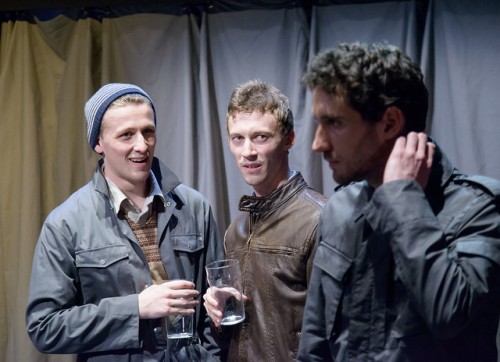
Describing this production too briefly would probably put off most people. It’s a musical based on the real-life murders of five prostitutes in the London Road area of Ipswich in 2006 – that’s fine, if a bit dark. But it’s also verbatim theatre – all the words are taken from interviews that writer Alecky Blythe conducted with residents of London Road and are performed as precise copies of the original voices – the intonation, pauses, repetitions, accents, ums and ahs are all learned by the actors. And then a level of stylisation is added in the form of songs and song-like sections that perhaps most closely resemble poetry.

All of which could have added up to something unwatchable in the wrong hands. But this is more than just watchable, it’s actually pretty good, though the verbatim dialogue does take some getting used to. Key to this is the excellent script. Blythe took what were presumably many many hours of many interviews and cut together a story of a community both haunted and hopeful, with plenty of those small humorous moments that real life serves up. But a good script is nothing without a good cast, and here Bristol Old Vic Theatre School really delivers.

Bristol Old Vic Theatre School
(Copyright: Graham Burke)

Once again the Studio Theatre was used to good effect, with the stage area and audience chairs arranged at the start as if for something like a town hall meeting. The cast milled about a tea trolley making cups of instant coffee and settled around a cheap folding table and a noticeboard covered with flyers. As the live orchestra on the balcony started up and hush fell over the small but eclectic audience, we learned that this was a Neighbourhood Watch meeting, that the London Road residents want to wrestle something good out of the horror they have lived through.

The cast all play multiple roles, fleshing out the story to include visiting journalists, police, prostitutes and other townsfolk, but they have clear principal characters who make up the Neighbourhood Watch committee – concerned citizens who obviously had plenty to say to Blythe and were trying to be positive for the future. This positive spin shines through the story, though it’s hard not to wonder what the tone might have been if a different set of people had opened up to Blythe.

With so many changes in character with just a subtle adjustment of costume or props, it’s perhaps little wonder that there was an occasional slip into comic overacting. And I couldn’t help but be irritated to spot that the first photographer depicted carried both a Canon camera and a Nikon, which is really not realistic. But that’s a pernickity detail that my being a bit of a photography geek taught me! More importantly, the “real words” added a certain something to the show – it felt more realistic than the average scripted drama despite all the repetition and singing.

Bristol Old Vic Theatre School
(Copyright: Graham Burke)

Though it is very much an ensemble cast, I’d like to give special mention to Bethan Nash who was excellent both in her main role as Julie, organiser of the local “In bloom” gardening competition, but even more excellent in the short scene of an interview with three prostitutes, which ended with Nash appearing near tears despite having said very little. That scene was exceptional and I don’t wonder that it is the one section of Blythe’s original recording that was selected to be played toward the end of the show.

For all my praise, this is an odd show that probably won’t be to everyone’s taste, but if you’re willing or even eager to experience something a bit different, I would encourage you to try it.

Disclaimer: Tickets were kindly supplied to me by the theatre in return for an honest review.

Kate Gardner Reviews

Scratch a geologist and, under their skin, you’ll find a romantic

June 2, 2014

Snowball Earth

Snowball Earth: the Story of the Great Global Catastrophe That Spawned Life as we Know it
by Gabrielle Walker

I picked up this book because Walker came highly recommended, not because of the subject matter. In fact, the one aspect of the book I had been interested in (the biology angle) was squeezed largely into one chapter. It turns out that this is a book about geology, which I have very little knowledge of or interest in, yet I found it hugely readable and genuinely enjoyable.

I will attempt to explain the premise briefly. The Earth is about 4.5 billion years old. The first lifeforms – single-celled slime, often called the “primordial ooze” – emerged about 3.7 billion years ago. The first multi-cellular creatures – the ancestors that led to complex beings such as us humans – didn’t show up until 600 million years ago. Scientists had long been puzzled as why it took so long for evolution to really get started and whether there had been some kind of trigger. In the late 20th century geologists finally found what looks like the answer – the Snowball Earth.

“Stretch your arms out wide to encompass all the time on Earth. Let’s say that time runs from left to right, so Earth was born at the tip of the middle finger on your left hand. Slime arose just before your left elbow and ruled for the remaining length of your left arm, across to the right, past your right shoulder, your right elbow, on down your forearm, and eventually ceded somewhere around your right wrist. For sheer Earth-gripping longevity nothing else comes close. The dinosaurs reigned for barely a finger’s length. And a judicious swipe of a nail file on the middle finger of your right hand would wipe out the whole of human history.”

But what is the Snowball Earth? The idea is that sometime around 650 million years ago the Earth froze completely over, even at the equator, for a few million years. There’s a lot of geological evidence pointing to this having happened, possibly multiple times in quick (geologically speaking) succession, and it is the theory that best answers a lot of questions raised by odd rock formations and other geological anomalies. However, it’s also a controversial idea that has taken a lot of time and accumulated evidence to reach the state of semi-approval it currently has.

It really is to Walker’s credit that she has made a book about looking at rocks so very appealing to me. I think this is partly because she puts the emphasis firmly on the people and personalities involved. This book is as much about Paul Hoffman, a professor of geology at Harvard, as it is about anything else. Walker depicts him as quite the character, difficult and brilliant, with long-standing rivalries and a long string of we-used-to-be-friends, but her picture is still a warm one.

“There’s something about holding a geological hammer that makes you want to hit rocks. Weigh one in your hand, and you’ll find yourself itching to whack something with it. Still, to carve a hand sample into just the right shape for your pocket requires considerable skill. Paul is very, very good at it. If his geology career went awry, he could make a living as an ornamental rock chipper.”

The way Walker describes the piecing together of the Snowball Earth theory is very enlightening as regards the scientific process, elucidating where ideas come from and how they develop, sometimes painfully slowly. She lets the story unfold as it really did – in fits and starts – with only the occasional backpedal to clarify. This can be frustrating at times when suddenly a new character comes into play and has to be introduced but it also cannily introduces suspense: How is this new person connected to everything else? And how will they affect Paul’s story?

“Relationships among geologists are intense. By its nature, geology involves travelling with your colleagues to remote places…living on top of one another and away from other people for weeks on end…Their personalities become magnified. They bond or they break.”

Walker’s explanations of the actual science are largely excellent, though she does occasionally simplify a little too far – who doesn’t know at the basic level what DNA is? But I came away from this book really feeling that I understood it all and curious about what further developments have been made in this area since the book was published 11 years ago.

There are some beautiful descriptions both of the remote locations the geologists travel to to find the right rock formations and of geology itself. Walker paints a romantic view of geology, showing love for the subject and affection for all the people involved in the tale. Perhaps it’s this warmth that drew me in. I’m certainly intrigued to read more of her works and see if she can make other unlikely subjects come alive for me in the same way.

“Scratch a geologist and, under their skin, almost invariably, you’ll find a romantic. They will often be gruff about the landscape they work in. They are usually matter of fact about the rocks and how they interconnect. But try asking why they’ve chosen to spend their lives working on this particular place or on that particular terrain, and that’s when the stories start to slip out.”

Published 2003 by Bloomsbury.

Source: Borrowed from the library.

Challenges: This counts towards the 2014 Popular Science Reading Challenge.

Kate Gardner Reviews

May reading round-up

May 31, 2014
Woman Reading by Kuroda Seiki
(Kuroda Seiki, c. 1890)

My May reading is looking very female-author heavy, which I’m happy with. And includes not one but three popular-science books! Take that complete-failure-that-was-me-in-March. However, my reading has also been heavily borrowed from friends/the library, so my TBR has not shrunk at all. One day I will achieve my aim of owning fewer than 100 unread books. One day.

We’ve had lots of weekend fun this month, distracting me from my books, plus we’re back in redecorating mode (we’re currently at the stage where everything looks much worse than when we started so no I will not post any photos just yet) so frankly I’m pleased to have read anything at all. Amazing how I manage to find the time to read when I’m actually enjoying every book I pick up and struggle to fit in reading when the books are a little bit disappointing. Can’t imagine what the lesson there is!

Books

The Immortal Life of Henrietta Lacks by Rebecca Skloot (review here)

The Luminaries by Eleanor Catton (review here)

Saga volume 3 by Brian K Vaughan and Fiona Staples

Breasts by Florence Williams (review here)

Orlando by Virginia Woolf (review here)

Snowball Earth by Gabrielle Walker

Short stories

“Shakespeare’s memory” by Jorge Luis Borges (New Yorker Fiction podcast)

“Where the Cluetts are” by Jack Finney (Selected Shorts podcast)

“Lederhosen” by Haruki Murakami (Selected Shorts podcast)

“Outlaw” by Amy Berg (Empower: Fight Like a Girl! anthology)

“Healthy happy hailie!” by Cherry Chevapravatdumrong (Empower: Fight Like a Girl! anthology)

“Hallelujah” by Akela Cooper (Empower: Fight Like a Girl! anthology)

“Three minutes” by Liz Edwards (Empower: Fight Like a Girl! anthology)

“INT. WOLF—NIGHT” by Jane Espenson (Empower: Fight Like a Girl! anthology)

“XAYMACA” by Shalisha Francis & Nadine Knight (Empower: Fight Like a Girl! anthology)

“Collapse” by Lisa Klink (Empower: Fight Like a Girl! anthology)

“Suzie homemaker/apocalypse ass kicker” by Pang-Ni Landrum (Empower: Fight Like a Girl! anthology)

“Positive symptoms” by Lauren LeFranc (Empower: Fight Like a Girl! anthology)

“Dangerous stars” by Kam Miller (Empower: Fight Like a Girl! anthology)

“Recording angel” by Ian McDonald (Lightspeed magazine, issue 13, June 2011)

“The treatment” by Daniel Menaker (Selected Shorts podcast)

“Palais de Justice” by Mark Helprin (Selected Shorts podcast)
 
 
Hope you had a great May and here’s hoping for more happy reading times in June!

Kate Gardner Blog

Memory is the seamstress, and a capricious one at that

May 29, 2014 2 Comments

Orlando

Orlando
by Virginia Woolf

This is an odd book. Having read some Woolf before and knowing roughly what the storyline was I thought I knew what to expect, but it wasn’t really what I got. I ended up greatly enjoying it but though I found it clever and witty from the start, it took me a while – more than half the book – to actually like it.

How to explain the story? Orlando is born the son and heir to an aristocratic English family and becomes beloved courtier to Queen Elizabeth I and then King James I until his heart is broken by a Russian beauty, after which he sulks his way through the civil war and Restoration and then travels to Turkey to be the British Ambassador there to King Charles II, is made a duke, then falls asleep for a week and wakes up a woman, upon which she continues to have adventures up until the present day (or rather the present when the novel was written, back in 1928).

Notice the hinky timeline there? Orlando’s ability to live through centuries with minimal ageing (the narrative clearly states Orlando is 30 when he turns into a she about a third of the way through the novel, despite about a century having passed since the book’s opening scene, in which a 16-year-old Orlando alternates swordplay with writing poetry) isn’t directly addressed until quite late on, and it took me a little while to notice the historical clues to this fantastical thread. The switch in Orlando’s gender, on the other hand, is very directly dealt with, with comments on Orlando’s gender from page one.

“Orlando stared; trembled; turned hot; turned cold; longed to hurl himself through the summer air; to crush acorns beneath his feet…Whom had he loved, what had he loved, he asked himself in a tumult of emotion, until now?…Love had meant to him nothing but sawdust and cinders…as he looked the thickness of his blood melted; the ice turned to wine in his veins…he dived in deep water; he saw the flower of danger growing in a crevice…”

I can see how many an essay could be based on this book, there are so many interesting themes and details, from gender identity and sexuality, to Orlando’s attempts to be a patron of poets and a poet him/herself, to Woolf’s view of the changes in society over the centuries covered, and so much more besides. (It’s also apparently a fictionalised biography of Vita Sackville-West, with whom Woolf had an affair and to whom the novel is dedicated, but I don’t know enough about the real-life history to have spotted this within the text myself.)

What struck me most was the tone of the book. It’s very satirical, almost brashly so, and this I felt kept me at a distance from the story, which was in stark contrast to my experience of Woolf’s other works. This meant I never got a handle on Orlando as a person but I did (eventually) grow to love the style and rhythm of the story.

“Once the disease of reading has laid hold upon the system it weakens it so that it falls easy prey to that other scourge which dwells in the inkpot and festers in the quill. The wretch takes to writing. And while this is bad enough in a poor man…the plight of a rich man, who has houses and cattle, maid-servants, asses and linen, and yet writes books, is pitiable in the extreme.”

There’s certainly no shortage of great lines. I had to stop using sticky notes to mark great quotes and start using a pencil, because there were so many but also because I found myself wanting to add little comments. I just wish I’d found a harder pencil as I’m having to squint a bit to read my faint scribbles!

While the genres the book satirises – picaresque adventure, historical biography, overblown romance – are as old as the novel, and while this is not written in Woolf’s familiar Modernist style, there are nevertheless modern touches. Woolf breaks the fourth wall by not only speaking direct to the reader and discussing the art of writing biography but even referencing specific page numbers (which are presumably carefully changed in every new edition) in a non-fiction fashion. And though for the most part the style is straight-faced biography, occasionally it turns abstract, nonlinear, in sections that are not exactly stream of consciousness but certainly owe their origin to Woolf’s mastery of that mode. Through Orlando’s own attempts to become a writer, Woolf pulls apart the literary style of every age since the Elizabethan but also mocks the literary critics of every age for preferring anything old over anything new.

“Memory is the seamstress, and a capricious one at that. Memory runs her needle in and out, up and down, hither and thither. We know not what comes next, or what follows after. Thus, the most ordinary movement in the world, such as sitting down at a table and pulling the inkstand towards one, may agitate a thousand odd, disconnected fragments, now bright, now dim, hanging and bobbing and dipping and flaunting, like the underlinen of a family of fourteen on a line in a gale of wind.”

I think I liked the last part of the book best because it became more self-aware, discussing Orlando’s reactions to the changing times rather than time just passing unnoticed as it seemed to in the first part of the book. The satire gets particularly savage in the 19th century, perhaps exposing Woolf’s own prejudices, but this results in some of the book’s most delicious lines.

“Thus the British Empire came into existence; and thus – for there is no stopping damp; it gets into the inkpot as it gets into the woodwork – sentences swelled, adjectives multiplied, lyrics became epics, and little trifles that had been essays a column long were now encyclopaedias in ten or twenty volumes.”

All of which did appeal to me, but I was still left wishing this had been more like Woolf’s other works. Perhaps (and I seem to find myself saying/writing this far too often) this is another book I need to re-read to fully appreciate. I definitely think I would get more from studying it – from having someone draw out the little details and historical background that I know I missed. Maybe I’ll search out a study guide before I pick it up again!

First published 1928 by the Hogarth Press.

Source: I bought this as part of a set of Penguin Red Classics several years ago, I think from a catalogue so probably the Book People?

Kate Gardner Reviews

Sunday Salon: Books and school

May 25, 2014 4 Comments

The Sunday Salon

I was going to do one of my “what I’ve been up to lately” posts today but then Michael Gove’s comments about the new GCSE curriculum were all over Twitter and I had to respond. I know that what Gove said (or is quoted as saying) does not accurately reflect the content of the new GCSE curriculum, it was just his own bizarre prejudices and ideas, but the man is the education secretary and sadly his words have consequence. So this is a riposte to him, not necessarily the curriculum.

I went to secondary school already loving books. Whether that was something innate in me or the influence of my parents and some or all of my primary school teachers I don’t know. But that’s why I survived five years of indifferent teaching of English lit and came out the other end as a lover of books. I would not be surprised if a lot of my former classmates don’t read as adults. We were not inspired to.

I should add for the record that my secondary school did have some great teachers – in history, maths and French I was very well served. And English language was handled well – I learned to debate, to write in different forms, especially creatively. But that cornerstone of education – reading books – was not handled in a way that inspired.

It can’t have all been about the choice of books. Because we did read some great books – Goodnight Mister Tom, Romeo and Juliet, Uncle Tom’s Cabin – but I can remember six books or plays that I studied in five years. That’s pretty poor. Is that the way the books were taught or the choice of books? I don’t know but I suspect it’s both.

Again, I was already a lover of books. My home was filled with books and I was encouraged to visit the library for more. My parents read and would recommend titles to me. I was given books and book vouchers for birthdays and Christmas. I was lucky. Many people don’t have that luck. For far too many children school represents all of their access to books, and that makes the books that are chosen to be taught – and the way they are taught – really really important.

At GCSE I studied A View from the Bridge, The Merchant of Venice, To Kill a Mockingbird, big cat poetry (including “Tyger, tyger, burning bright” and something about a caged animal in a zoo)…and that’s almost all I can tell you. There might have been a couple more novels, I’m not sure. I remember basically nothing about the first or last items on that list. We didn’t see A View from the Bridge or The Merchant of Venice performed, even on film. We did watch the film of To Kill a Mockingbird. In fact I remember the assignment was to compare and contrast book and film. Which was interesting and different but didn’t really touch on any of the key themes of that amazing book. I was convinced until I studied Shakespeare again at university that The Merchant of Venice was the dullest of all his plays.

Even at 15/16 it broke my heart that my English teacher was not inspiring me or my class, that I was not in love with each and every one of the books we studied. I know some people say that they learned to hate every book they studied at school but I maintain that’s not a natural outcome, it’s a result of the teacher and the choice of book. I would see friends in another English class with a different teacher filled with enthusiasm about their texts. I don’t know what limits were placed on the curriculum for my school in the 1990s and maybe my perception of that other class was wrong – perhaps all English teaching was constrained back then in just the way people fear it’s about to be again.

The thing I take from this is that teaching is hard and putting ill-thought-through reactionary limits on the books that can be taught to children at that crucial age is unhelpful. Declaring that all the books must be British is ridiculous – teenagers need to learn about the rest of the world too, if only to learn that it’s not all that different from the life we know, even when at first glance it’s completely different. And limiting the curriculum to pre-1900 is more than just ridiculous. When are we most sneering about boring old stuff? When do we most need to feel a connection to a world that is increasingly scary and full of big life-changing decisions? And yet when are we most receptive to big new ideas? This is when we should be exposed to science fiction, foreign fiction, the politics of gender, race and, well, politics in general.

So what saved my love of reading? I left that school and went elsewhere for my A-levels. It was a great decision because it led me to a great teacher. Linda picked a varied reading list for us but equally importantly she overflowed with enthusiasm for those books. (In fact, sometimes we mocked her a little for her exuberance but we loved her for it really.)

Frankenstein
My A-level copy of Frankenstein. Click to enlarge if you want to read my notes!

Not only can I tell you what books I read for A-level but I still have my copies of all of them and I can remember what they were about and what they taught me. We went to see both plays we studied – Shakespeare’s Measure for Measure and David Hare’s Murmuring Judges – performed on stage (Linda had made sure this would be possible before picking them for us), which showed me that sometimes humour needs to be spoken aloud to be funny. Penelope Lively’s memoir Oleander Jacaranda made me yearn to go to Egypt, even though I knew I would, like Lively, never know what it was to be Egyptian. (In fact, my first foreign holiday that I paid for and arranged by myself was indeed to Egypt.) Mary Shelley’s Frankenstein filled my passionate heart with dramatic images of snowy mountains and Arctic tundra and also, in Shelley, gave me a heroine to admire. Chinua Achebe’s Things Fall Apart showed me a completely alien yet still relatable way of life and taught me to question colonialism and Christianity. But in some ways Henry James’s Washington Square was the real turnaround. I did not like that book, I found it tedious, but Linda still taught me to appreciate it. She used it to teach us about irony and sarcasm, and about the changing role of women in society.

I owe Linda so much. If I had continued with those teachers and book lists I’d had at secondary school I probably wouldn’t have studied English at university. I might not have continued to love reading at all (though I think – hope – that that’s unlikely). Reading is a huge and joyous part of my life still now, 17 years after I left that school, 15 years after Linda hugged me goodbye on A-level results day.

So I want to say thank you to the teachers who are putting their all into encouraging children to not only read, but to enjoy reading, to appreciate books. And to those teachers who aren’t inspired or inspiring? Please don’t give up or become complacent. Please keep trying. What you do is SO important. And definitely ignore that Mr Gove. He’s an idiot. But you knew that.

Kate Gardner Blog

We love breasts, yet we can’t quite take them seriously

May 22, 2014 2 Comments

Breasts

Breasts: a Natural and Unnatural History
by Florence Williams

Continuing with the popular-science self-education, I picked up this book because descriptions made Williams sound a lot like Mary Roach, whose book I enjoyed. And this was much in the same vein, even with some of the same reservations.

It’s an eye-catching title, right? I quite enjoyed watching people’s reactions when I was reading this book at the pub, or when we had guests round and it was sat casually on the arm of the sofa. This book also started a fun game where for a week, Tim got to ask me every evening “What have you learned about breasts today?” and I was able to give genuine answers!

“We love breasts, yet we can’t quite take them seriously. We name them affectionately, but with a hint of insult. Breasts embarrass us…For such an enormously popular feature of the human race…it’s remarkable how little we actually know about their basic biology…Not even the experts among us are certain.”

I did learn some good facts, especially in the early chapters. This book starts strong, with a fun-fact-filled overview and then a plunge into what we know about breasts and evolution. Apparently there’s quite the division between scientists about whether breasts (and by that I mean human breasts, because we are the only animal to have breasts throughout adulthood, not just while lactating) evolved because men find them sexually attractive (and primarily mated with the women with breasts) or because it confers multiple advantages for feeding babies and for women’s health in general. Williams clearly leans toward the latter explanation and I was pretty thoroughly persuaded to her side.

“Modern life has…taken a strange and confounding toll on our breasts. For one thing, they are bigger than ever…We are sprouting them at younger and younger ages. We are filling them with saline and silicone and transplanted stem cells to change their shape. Most of us are not using them to nurture infants anymore, but when we do, our breast milk contains industrial additives.”

Williams shows a sense of humour but she doesn’t treat her subject lightly, for the most part. However, she does show her own bias a little too clearly. For instance, in the section on breast implants, she is clearly bemused by the whole idea and a little mocking. But at least some of the increase in implant surgery is down to the rise in breast cancer, which she devotes multiple chapters to later in the book. It seems to me that this subject merited a little more seriousness – perhaps a few more conversations with women about why they had the surgery.

“Double-D breasts on skinny women are not all that common in nature. (Barbie’s proportions are naturally found in one out of one hundred thousand women, according to researchers from the University of South Australia; Ken’s bod, by contrast, is found in one in fifty men.) Big, fake breasts have so thoroughly saturated mainstream entertainment and media that they’ve created a new standard by which boys judge girls and girls judge themselves.”

In fact, this was a bit of a running theme. For such a human subject, Williams failed to humanise the issues but instead tended to get clinical. I appreciated that there was plenty of real science explained very well, but I don’t think this is an entirely medical subject and yet Williams devotes more than half the book to what seem to be her pet topics – breast cancer and breast feeding. Yes, these are clearly important aspects of a book about breasts but I can think of plenty of areas left unexplored or only lightly touched upon. For instance, anthropology – what are the historical and geographical differences in social attitudes to breasts? (I would guess Williams shied away from this kind of discussion because it tends to centre around the sexual aspect of breasts, which she was distancing herself from.)

It’s not an overly clinical book. In fact, it is written engagingly and warmly. Williams happily uses herself and her pre-teen daughter as examples, from getting themselves tested for toxins before and after a sort of plastic detox (lots of chemicals used in lots of household plastics and flame retardants end up in breast milk, but only because our modern bodies are swimming in them) to detailing their family history of ages at child-bearing (which has a complicated relationship to chances of getting breast cancer). This adds a personal flavour while she also gives the stats and other wider details.

“In [macaque] society, daughters learn from hanging around their mothers longer and more often, and thinner milk means they stay close for more frequent feedings. The sons, by contrast, might be ‘tricked’ by the [relatively] fattier milk into feeling sated and therefore not feeding as often. It’s not a bad thing for the sons; they have more time to play and explore, skills they’ll need down the road when they leave the group.”

More than anything, this book owes a debt to Rachel Carson’s Silent Spring (which I haven’t read and clearly really shoould), which Williams freely acknowledges. She worries about the effects of environmental toxins more than anything else and is fairly persuasive on this topic. She certainly made me glad I don’t live in the US! (Europe has much stronger regulations regarding chemicals, both on general sale and in household uses.) There is a bit of a US-centric angle, with plenty of specific studies from elsewhere but the general statistics are all US and almost always quoted without comparison. (There’s one place where she compares US stats with Canada and it’s a stark difference, which I found fascinating. Why? No suggestion is given, frustratingly.)

I preferred the opening chapters on evolution and puberty more than the later stuff but this was overall an interesting book on a subject we don’t tend to talk about, despite the importance of breasts in our lives. I strongly feel we need, as a society, to get over the sexualised view of women’s bodies and this book has a strong contribution to make to that.

Published 2012 by W W Norton.

Source: Borrowed from the library.

Challenges: This counts toward the 2014 Popular-Science Reading Challenge.

Kate Gardner Reviews

There is no truth except in relation

May 14, 2014 2 Comments

The Luminaries

The Luminaries
by Eleanor Catton

I’m a bit bemused why this won the Booker Prize. It’s not by any means a bad book, but less than a week after finishing it I’m finding it’s not really stayed with me, and nothing about it felt particularly standout. Except perhaps its size. That’s pretty noticeable.

This is a historical mystery novel with a broad cast of characters (and you know there’s a lot of people to keep track of when a book begins with a character list) who inhabit the New Zealand coastal town of Hokitika during the 1860s. The story opens with the arrival of Mr Walter Moody, come to make his fortune on the nearby goldfields. On his first night in town he stumbles on a secret meeting of 12 men who are trying to get to the bottom of a series of mysterious events that occurred two weeks previously: a prostitute attempted suicide (or did she?), a wealthy (and well-liked) man vanished and a drunken hermit was found dead with a fortune hidden in his home. Moody finds that by chance he has some information that may be pertinent to the gathered men, so they all tell their stories in turn. Or rather their snippets of the same story, because it becomes clear that they are each part of a large jigsaw puzzle that must be reassembled.

“Unconfirmed suspicion tends, over time, to become wilful, fallacious, and prey to the vicissitudes of mood – it acquires all the qualities of common superstition – and the men of the Crown Hotel, whose nexus of allegiance is stitched, after all, in the bright thread of time and motion, have, like all men, no immunity to influence.”

That’s part one, which is 360 pages long – partly because every new character is described in great detail, or at least their physical appearance and temperament are. But that length also comes from the same story effectively being told multiple times from different perspectives, with different details added or assumptions made that are later proved wrong. It’s an interesting way to tell a story, if sometimes confusing, and I think I was a little disappointed that the rest of the novel didn’t follow quite the same style.

From part two the story moves more conventionally forward and then eventually backward in time, much like a detective novel, following the characters trying to unravel the mysteries and then going back to reveal what actually happened. It’s no surprise that all of the odd events are linked together, but figuring out how and why is genuinely intriguing and enjoyable enough to keep me reading without feeling burdened by the book’s 832 pages (except for the occasional sore arm from holding all that size and weight – this is definitely a good argument for the e-book).

“[This] only showed, Moody thought, that a man ought never to trust another man’s evaluation of a third man’s disposition. For human temperament was a volatile compound of perception and circumstance.”

So if it wasn’t the book’s size or the plot that left me unsatisfied, what was it? One thing is that I didn’t really get the book’s main narrative device – the plural narrative voice (as in, the story is told by “we”, not that different narrators take turns). I wasn’t sure who these voices were supposed to be, though I did get a sense they were somehow linked to star signs and astrology, which also pop up at the start of each section. It’s a shame because I quite like the idea of a chorus, like in an old play, but it just didn’t quite work for me. Possibly because I was put off by the astrology references. This is a personal prejudice, but I did think that the astrology didn’t strongly relate to the rest of the story and felt out of place. (It does actually come up as a plot point that’s probably meant to be really important, but I felt could easily have been dropped without affecting the rest of the story at all, so that’s not really key at all, is it?)

“When we looked upon Man, we sought to fix him: we mourned his failures and measured his gifts…But there is no truth except in relation, and heavenly relation is composed of wheels in motion, tilting axes, turning dials; it is a clockwork orchestration that alters every minute, never repeating, never still. We are no longer sheltered in a cloistered reminiscence of the past. We now look outward, through the phantasm of our own convictions.”

I did like the little summary at the start of each chapter, which reminded me a lot of Henry Fielding’s Tom Jones, including the tongue-in-cheek sense of humour with which they are written. And I liked the variety of people, both in terms of nationalities and personalities. But that very plurality also meant that there was no psychological insight into any people or events. It’s a personal preference, I know, but I like to get under someone’s skin in my reading, rather than be held at arm’s length.

Have you read this? What did you think of it?

Published 2013 by Granta.
Winner of the 2013 Man Booker Prize.

Source: Borrowed from a friend.

Kate Gardner Reviews

I can’t get mad at science

May 9, 2014 4 Comments

The Immortal Life of Henrietta Lacks

The Immortal Life of Henrietta Lacks
by Rebecca Skloot

I remember hearing about this book when I first came out and thinking “That sounds interesting” and moving on. It got serious fanfare in the US but I think over here it was a quieter success and now I’ve read it I wonder why it wasn’t a bigger deal here as well, because it’s an amazing book.

I mean, I get it really. It’s an American story by an American author dealing with some specifically American issues – segregation and civil rights, medical care and insurance, education of the poor. But it’s also a universal story. I mean, Henrietta Lacks’ cells are at the heart of biological and medical research all over the world.

“[I’ve wondered] what she’d think about cells from her cervix living on forever – bought, sold, packaged, and shipped by the trillions to laboratories around the world. I’ve tried to imagine how she’d feel knowing that her cells went up in the first space missions…or that they helped with some of the most important advances in medicine…I’m pretty sure that she – like most of us – would be shocked to hear that there are trillions more of her cells growing in laboratories now than there ever were in her body.”
– Rebecca Skloot

I should explain. Henrietta Lacks was a very poor black woman who died of aggressive cervical cancer in 1951, aged just 31. She was being treated at Johns Hopkins Hospital in Baltimore, where a Dr Gey was particularly interested in cervical cancer, as he was studying its two different known forms, so he was taking tissue samples of every cervical tumour he came across. He also happened to be trying to grow human cells in the lab but couldn’t seem to keep any alive, so any tissue samples he collected were also passed to his assistant for that purpose. Lacks’ cancer cells, labelled HeLa after her, didn’t die but instead multiplied. And they kept on multiplying day after day, something which was unprecedented in human tissue.

This was huge news scientifically speaking. Lab-grown human cells gave scientists an intermediary between animal testing and live human subjects. Suddenly they could infect real human cells with diseases and see how they reacted. They could test medicines and biological theories. Specific chromosomes were identified for the first time using HeLa cells. The polio vaccine was developed, as were IVF and chemotherapy. Many huge breakthroughs in science can be traced back to Henrietta Lacks. So it’s strange and jarring to read that she died so poor she didn’t even have a gravestone (until, that is, a year or so after this book was published when Skloot had prompted enough people to remember Lacks that the money was finally raised and a memorial service held). In fact, Henrietta Lacks wasn’t even asked permission for her tissue sample to be used in research. And her family didn’t know about HeLa cells until two decades after her death, when they found out from a journalist.

“John Hopkin [sic] didn’t give us no information about anything. That was the bad part. Not the sad part, but the bad part.”
– Sonny Lacks

“It’s not fair! She’s the most important person in the world and her family living in poverty. If our mother so important to science, why can’t we get health insurance?”
– Lawrence Lacks

It’s an often sad story, and it would be easy to be judgemental about the money made by pharmaceutical companies from HeLa while many of the Lacks family can’t afford basic healthcare or decent education. But that would be an oversimplification and Skloot is a better writer than that. Dr Gey freely sent samples of HeLa cells to fellow researchers all over the world, so his only profit was his continued career. And there were very few laws surrounding medical ethics in the 1950s; it was common to take human tissues without consent, or perform tests on patients without explaining why.

Skloot combines three different stories here: the life of Henrietta Lacks and her family; the scientific impact of HeLa, including the development of ethics laws and lab procedures; and her own investigations, which lasted more than a decade and had their roots in her biology degree course, in which Henrietta Lacks merited just one sentence in one lecture. Skloot really did have to be dogged in her pursuit of the truth. The Lacks family had not been treated well by previous journalists and took a lot of persuading to co-operate.

“Truth be told, I can’t get mad at science, because it help people live, and I’d be a mess without it. I’m a walking drugstore! I can’t say nuthin bad about science, but I won’t lie, I would like some health insurance so I don’t got to pay all that money every month for drugs my mother cells probably helped make.”
– Deborah Lacks

She manages all three strands brilliantly, with wit and insight. I learned a lot about the science of HeLa cells, about medical ethics (and the historical lack of them), about the Lacks family. Skloot depicts it all honestly, warts and all. The Lacks family history is a colourful one that includes slavery, STDs, domestic violence, drugs, prison and many a family feud. And the scientific story, while largely a positive one, also includes some disturbing moments.

This is an important story that needed to be told but Skloot wasn’t the first to try. The difference is that she was the first to do it well. This is a gripping, entertaining read and deserves all praise and success that comes its way. When I did a little further reading on Skloot’s website I discovered that with the profits from this book she set up the Henrietta Lacks Foundation, which provides grants for medical and educational expenses to those in need, particularly members of the Lacks family. I think I have developed a small crush on her.

Published 2010 by Macmillan.

Source: Borrowed from the library.

Challenges: This counts towards the 2014 Popular-Science Reading Challenge.

Kate Gardner Reviews

Posts pagination

1 … 71 72 73 … 123

Archives

RSS Nose in a book

  • 2025 reading stats and top reads
  • December 2025 reading round-up
  • Book review: The Galaxy and the Ground Within by Becky Chambers

Me on the internets

  • @kate_in_a_book@mas.to (Mastodon)
  • Flickr/noseinabook
  • Instagram/kate_in_a_book
  • StoryGraph/kate_in_a_book

Categories

  • Blog
  • Reviews
  • Uncategorized
Proudly powered by WordPress | Theme: Dream by vsFish.