Nose in a book

Reviews and other ramblings

  • Home
  • Reviews archive
    • Book reviews
    • TV reviews
    • Theatre reviews
  • TBR
  • Challenges
    • The Classics Club
    • 2014 Popular-Science Reading Challenge
    • Cookery challenge
    • The Gilmore Girls Reading Challenge
    • 2013 TBR Pile Challenge
    • 2013 Translation Challenge
    • Crime and Punishment read-a-long
  • About
    • Cookie legal stuff
  • Home
  • Reviews archive
    • Book reviews
    • TV reviews
    • Theatre reviews
  • TBR
  • Challenges
    • The Classics Club
    • 2014 Popular-Science Reading Challenge
    • Cookery challenge
    • The Gilmore Girls Reading Challenge
    • 2013 TBR Pile Challenge
    • 2013 Translation Challenge
    • Crime and Punishment read-a-long
  • About
    • Cookie legal stuff

Author: Kate Gardner

I live in Bristol and I like to read books and share what I thought about them here. I read mostly general or literary fiction, with pretty much every genre making an appearance from time to time. I love to receive comments, whether you've read the same books or not!

Was her memory meaningless? Her experience insubstantial?

October 19, 2014October 19, 2014

seconds-bryan-lee-omalley

Seconds
by Bryan Lee O’Malley

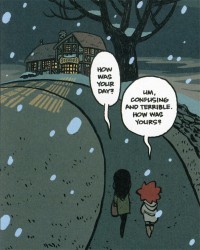
This is a sweet, funny graphic novel from the author and artist behind Scott Pilgrim, very much in the same vein. It blends real life with fantastical elements and has a strong female lead. What’s not to love?

Katie is the head chef at a restaurant called Seconds, but her dream is to own her very own restaurant. She has started to make her dream come true but it isn’t going smoothly. Her ex-boyfriend Max keeps turning up at Seconds, she’s having an affair with the man she’s supposed to be training up to replace her, and the builders at her new restaurant keep calling with bad news. When she causes an accident through negligence Katie knows something has to change…and somehow it does.

“Katie disappeared into the pantry. It was pretty pathetic. She sat there heaving and trying to make herself cry. The saddest thing was that she couldn’t have a moment away from herself. And then, through a crack in the floorboards, she saw—something.”

This has elements of a classic folk or fairy tale, including the idea that being able to put right mistakes won’t necessarily result in everything turning out perfectly. It also has a lovely strand about female friendship, as Katie alleviates her loneliness by getting to know her waitress Hazel. In familiar Bryan Lee O’Malley fashion, there are no clear right answers and Tim and I argued about the ending, before agreeing to accept that it isn’t the ending.

“Katie’s heart wouldn’t stop racing. Was her memory meaningless? Her experience insubstantial? Was she losing her grip on reality? Was she even awake?”

The art style is simple and atmospheric, with some beautiful set pieces. For instance, one double page is given over to a top-down view of the Seconds building, like a floor plan occupied by people and furniture. It reminded me of a page from one of the Usborne Puzzle Adventure series, with subtle jokes and hidden clues to the story to come – and I mean that as a compliment; I loved my Usborne Puzzle Adventures and still have several of them in my library!

Katie is an imperfect, relatable lead character. She’s strong and confident when she needs to be, fragile and heartbroken in hidden moments. She makes mistakes and she tries to put them right. She’s a bitch on a bad day and beloved by all on a good day. She doesn’t want to be alone but she doesn’t want to give up her dreams for a boyfriend. And she talks back to the narrator, which I found hilarious.

So now the only question is: will Edgar Wright please make a film of this? It would be really really great.

Published 2014 by Ballantine Books/SelfMadeHero.

Source: Excelsior! comic shop, Bristol.

Kate Gardner Reviews

The broken branch was a symbol of my too-much

October 16, 2014 2 Comments

clever girl

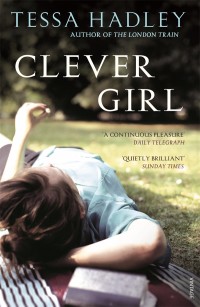
Clever Girl
by Tessa Hadley

I bought this book for two reasons – it’s set in Bristol and it was a staff recommendation at the very lovely Mr B’s Reading Emporium in Bath. Why buy one of the hundreds of books on my wishlist when I can pick up something new and random?

Stella tells us her life story, from working-class single-parent 1950s origins, to gaining a stepfather and moving to a fancy new estate and fancy new school in the 1960s. Stella is smart and suddenly she has the opportunity to do something with her abilities. But a life that could have been predictable is made unpredictable by choices she makes when she is 17.

“He broke off a whole branch of wet, scented apple blossom and gave it to me. It was a criminal thing; bees were still dangling, desirous, around the flowers’ stamen and stigma and their bulges of ovary which would never now grow into apples. The broken branch was a symbol of my too-much; it seemed more lordly not to refuse such bounty if offered. What it was impossible to have without harm was also most to be desired.”

For a lot of the book, Stella is a window into the youth cultures of the time, from the late 1960s on through the 70s and 80s. She is attracted to the political and the alternative, but somehow the book is never about politics itself, only about political ideologies. Stella is never wholly happy or satisfied or confident in herself, which makes her a sympathetic, if occasionally frustrating, character. She certainly doesn’t let her lack of direction stop her from living a varied and interesting life.

“I tried to prolong this happiness, or find a code I could store it in, so that it meant something even when I wasn’t feeling it. I imagined it as resembling the filmy skin of a bubble enclosing its sphere of ordinary air; impermanent yet also, for as long as it existed, flexible and resilient – real, a revelation.”

In some ways, this book could have been set anywhere, or at least in any British city outside London, but on the other hand, Bristol does have a certain mix of people and neighbourhoods that allows Stella to see and meet all sorts without ever living anywhere else. For those familiar with Bristol, you can nod along when Hadley mentions a specific area, knowing what relevance it has, but Hadley gives enough information for non-Bristolians to get it too (e.g. Totterdown in the 1970s = working class; Totterdown in the 2000s = working and middle class, arty types and professionals – I can attest to this one!). I don’t know any other city as well as Bristol but I can firmly believe in this story happening here. I can believe in people getting lost in politics/drugs/ideals while all around them friends and family plod on with boring ordinary lives.

“The land’s fabric seemed dragged down and tearing under the sheer weight of the built environment, which never ended and could surely never be undone and wasn’t even thriving: the monster machine was stalling, it had poisoned itself and now it had fallen into enemy hands.”

Stella’s story is very readable and absorbing, with some gorgeous language, but somehow not quite what I hoped for. She’s smart and loves books, which is usually a winner for me, but the story doesn’t linger on her bookishness, lingering instead on the men in her life, who are admittedly key, but for a character who calls herself feminist I struggled with how much she is defined by her role or by her man and not by her self.

Published 2013 by Jonathan Cape.

Source: Mr B’s Reading Emporium, Bath.

Kate Gardner Reviews

Holiday in France: books, books, books

October 12, 2014 1 Comment

As I’ve mentioned, on holiday last month I didn’t get much reading done, but being a booklover that in no way diminished my desire to buy more books. It’s not a problem, it’s just who I am. Anyway, my book acquisitiveness was largely kept in check by us staying in the middle of nowhere without any bookshops accessible. However, I did have two major temptations.

Untitled The bluest sky

Like their British counterparts, most French supermarkets have a book section stuffed with bestsellers, both French and international. This is not the place to find English-language books so the temptation here came down to my confidence in my French reading ability. Once upon a time my French was pretty good. I worked for a summer in Burgundy as an au pair and then when I came home I got a couple of jobs in a row that needed a little French and German. However, that was 14 years ago and I really haven’t kept my hand in. Every time we went to a supermarket on holiday I had a quick browse of the books and tried to decide whether I wanted the new Amélie Nothomb book in French. But the one time I was seriously honestly tempted was when I found an older Amélie Nothomb book, Stupeurs et Tremblements, which I own and have read in English and I figured I could refer to the translation whenever I struggled with it in French. After a lot of dithering, though, I decided that sounded more like work than fun.

The second temptation was harder to resist. Tim’s parents took us to an English tea room and bookshop. We enjoyed tea and scones and browsed the books. It was an interesting selection, clearly influenced by the reading tastes of the local English-speaking ex-pats. I skipped right past the large military history section but there was plenty to excite my bibliophilia in the fiction section. What prevented me from leaving with an armful of books, or even just one, is that I didn’t have any steer as to what to buy. I didn’t see any authors I already love or books already on my wishlist; there were no staff recommendations; I didn’t even see books I have heard praised in the numerous blogs I follow, podcasts I listen to or newspapers and magazines I read. Is this what it’s like for less bookish people every time they walk into a bookshop? A feeling of vague directionless desire? Weird.

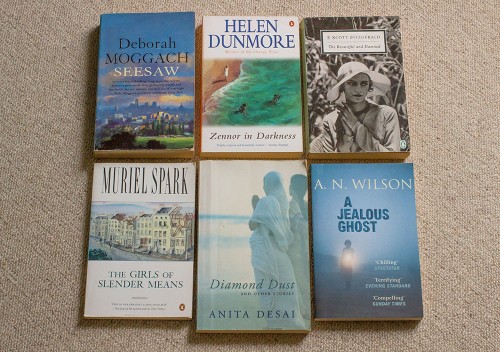
At this point I should come clean. What made it easier to resist both of these temptations was that when we arrived at Tim’s parents’ house, his mum told me that she is thinning out her vast book collection and that I should help myself to as many as I liked of the ones she was discarding. In fact, she was even going to make it easier for me by picking out books she thought I would like. And that is the best kind of recommendation: from someone who has not only read and enjoyed a book, but also overlaps your reading taste and knows where that overlap is. Really, it’s amazing I only picked out six books!

france-books-web

Maybe one day I’ll get that TBR down to a small bookcase, rather than overflowing a large one, but I can’t imagine ever not going out and looking for new books!

Kate Gardner Blog

I wish you to gasp not only at what you read

October 11, 2014

Pale Fire

Pale Fire
by Vladimir Nabokov

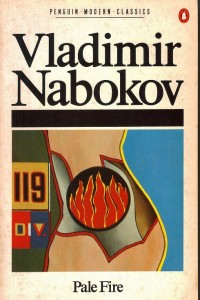
I need to let you know from the start that this is one crazy crazy book. The structure, the plot and the characters are complex to the point of inscrutable. This is truly experimental literary fiction.

How to describe this book? The poet and academic John Shade has been murdered and this is his last poem, introduced and analysed by a neighbour and colleague of the poet, Charles Kinbote. Kinbote is clearly crazy, but the question is exactly how crazy.

Kinbote’s “commentary” mostly ignores the actual poem and rambles on about the last king of Zembla, the country he has emigrated from to the small New England college where he met Shade. The story of this king is one of wild adventure, preposterous even, and Kinbote is clearly obsessed with it. He had told this story to Shade in the hope that the great poet would write a great poem about it, but that’s not what this final poem is and Kinbote’s disappointment is palpable.

“What if we awake one day, all of us, and find ourselves utterly unable to read? I wish you to gasp not only at what you read but at the miracle of its being readable (so I used to tell my students)…I can do what only a true artist can do – pounce upon the forgotten butterfly of revelation, wean myself abruptly from the habit of things, see the web of the world, and the warp and weft of that web.”

The whole conceit, and Kinbote himself, are often frustrating, occasionally tedious and frankly wholly ridiculous and yet at times it becomes almost, almost, believable. Kinbote’s obsessive nature has attached itself to his learned neighbour and he has clearly read the situation wrong time and time again, convincing himself that he became Shade’s dearest friend on the basis of flimsy evidence. It’s not a new story, but it’s nevertheless an interesting one and it’s being told in a very new way.

Thankfully, the scholarly frame of the novel is not entirely po-faced. This is a comedy, packed full of satire, poking fun at poets and scholars and literary criticism. Kinbote is somehow both subtly ambiguous and a broad comic character. The language is laughably over-the-top academic and delights in putting together pleasing sounds and amazing, if unwieldy, sentences.

“The heating system was a farce, depending as it did on registers in the floor wherefrom the tepid exhalations of a throbbing and groaning basement furnace were transmitted to the rooms with the faintness of a moribund’s last breath. By occluding the temperatures upstairs I attempted to give more energy to the register in the living room but its climate proved to be incurably vitiated by there being by there being nothing between it and the arctic regions save a sleezy front door without a vestige of a vestibule.”

It’s a clever balancing act and I would be thoroughly impressed by a book that made me laugh out loud despite such an outlandish structure if I hadn’t found other sections painfully tedious. This is a short book but it took me a long time to read, partly because I kept putting it down and declaring “This is batshit insane.” Which it is.

“The coming of summer presented a problem in optics: the encroaching foliage did not always see eye to eye with me: it confused a green monocle with an opaque occludent, and the idea of protection with that of obstruction.”

I must admit, this is one of those books I’m a little bit proud of having got through. Which perhaps undersells it. Many people consider this a masterpiece and I certainly see that there’s plenty to admire but I don’t think Nabokov will ever be a favourite of mine.

First published 1962 by G B Putnam’s Sons.

Source: Secondhand, probably from the Oxfam Bookshop on Park Street, Bristol.

Kate Gardner Reviews

My Perfect Mind by Told by an Idiot

October 7, 2014

A quick post to say that my review of the play My Perfect Mind from Told by an Idiot theatre company at Bristol’s Tobacco Factory Theatre last week has been posted over at Theatre Writers Bristol. It was a very entertaining and very different night at the theatre. Thanks to Theatre Writers Bristol for arranging the tickets for me.

Kate Gardner Blog

Summer reads in brief

October 5, 2014

Well, it’s sure not summer anymore, but in my defence it still felt like summer until last week when I finished the last of these books, so I figure that counts!

The Quiet War

The Quiet War
by Paul McAuley

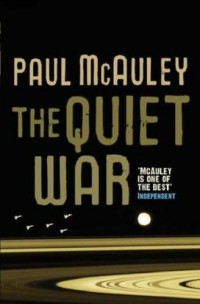
I’d been intending for a while to read one of McAuley’s novels, having really liked short stories of his I had come across, and this was Tim’s recommendation. It’s a book about war, and the politics leading up to war, which isn’t my favourite subject matter, but I tried to put that to one side. The book is set in a future post global warming with human settlements throughout the solar system. These “Outers” make surgical changes to themselves to suit the very different environments in which they live and are also supporters of science for science’s sake. The Earthlings, meanwhile, have turned to science to regenerate their planet but heavily restrict the science that can be done. There is ongoing tension that many believe is inevitably going to become war. War is prodded along by surreptitious activities on both sides. Chapters alternate between following various key characters in this space opera, though the reasons why they are key is clearer in some cases than others. There are beautiful descriptions of moving through space – McAuley manages to combine poetic language with scientific accuracy (or believability in the case of science/tech we don’t currently have). I loved the characters, even those who were thoroughly nasty. However, I did find the gradual build-up of political tensions in the first half of the book a little too slow.

“Jupiter’s fat disc dominated the black sky. Stars were flung with careless extravagance everywhere else, thousands of them, hard untwinkling lights of every colour.”

Published 2008 by Gollancz.

Source: Borrowed from Tim.

Paintwork
by Tim Maughan

I picked up this book about a thousand years ago at BristolCon, where I bought it from the author after hearing him speak in one of the sessions and thinking he sounded interesting. It was a good call and this is by some way the best self-published work I’ve yet read. It’s made up of three linked short stories set in a future where virtual reality software and gaming are the centre of the economy. Not being much of a gamer myself, this isn’t an obvious appeal for me but I found it really enjoyable. Maughan paints a believable but very different vision of the future. The book starts in Bristol, very much rooted in the local graffiti culture, and works outward from there.

“He skulked around the city in the early hours, darting under robotic surveillance cameras with a ninja-like bandanna over his face and a clanking knapsack full of car-repair spray cans on his back, his hands stained with multicoloured rainbows.”

Published 2011 by Tim Maughan Books.

Source: Bought direct from the author at BristolCon.

Improper Stories
by Saki

This collection of short stories are both separate and linked, as there are some recurring characters and clear recurring themes. They’re comic pieces set in upper class England in the very early 20th century and are very much comedy of manners a la P G Wodehouse or Dorothy Parker. The action tends to be slight; really it’s all about the drawing room conversations, about the character who shocks or outwits the rest. The opening story is about two children on a train whose governess is trying and failing to entertain them with moral tales. A stranger in their carriage shuts them up with a silly and morally outrageous tale, delighting the children and shocking the governess. That’s the whole story, and a typical example. I found them very funny to begin with but to be honest, the same joke over and over wore a little thin, even spacing out reading them to one or two per week.

“Her letter of thanks for the gift of a tiger-claw brooch was a model of repressed emotions. The luncheon-party she declined; there are limits beyond which repressed emotions become dangerous.”

Originally published between 1904 and 1914.
This collection published 2010 by Daunt Books.

Source: Amazon.

Kate Gardner Reviews

Book competition: the winners

October 3, 2014

Sensation

The results are in! I pulled names out of a hat used random.org and can now reveal the three winners of a copy each of Sensation by Thalma Lobel:

Jo Jones
Georgina Allen
Jeanette Kemp

Congratulations! I’ve dropped you all an e-mail, so look out for that.

Thank you to everyone who entered. If you missed the competition and are curious what on earth this is all about, check out my review of the book here.

Kate Gardner Blog

September reading round-up

September 30, 2014September 30, 2014
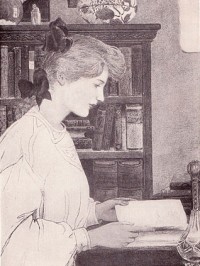
A young girl reading, by M Anchor (c. 1890)

We have had a lovely, if busy, September. We started the month on holiday, which is a pretty good start to anything! I didn’t get much reading done there, but when I came home I started whizzing through books. I still haven’t posted about the second half of our holiday because I haven’t finished going through my photos still, but I’ll get there eventually. I think my next free evening is in about a fortnight…

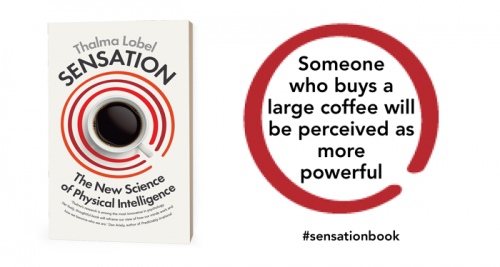
What I did find time for this month was a giveaway of a new popular-science book called Sensation: the New Science of Physical Intelligence by Thalma Lobel, which you can still enter until midnight tomorrow. It’s a really interesting look at a new area of psychology, though I have a few caveats.

And finally, tomorrow sees the release of the For Books’ Sake poetry collection Furies, which should be a fantastic read as well as raising money for the charity Rape Crisis England & Wales. Check it out.

Books
The Golden Notebook by Doris Lessing (My review)

The Quiet War by Paul McAuley

Z: a Novel of Zelda Fitzgerald by Therese Anne Fowler (My review)

The End of Your Life Book Club by Will Schwalbe (My review)

Sensation: the New Science of Physical Intelligence by Thalma Lobel (My review)

Improper Stories by Saki

Short stories
“The assassination of Margaret Thatcher – August 6th 1983” by Hilary Mantel (available online)

“In dreams begin responsibilities” by Delmore Shwartz (Selected Shorts podcast)

“The lover of horses” by Tess Gallagher (Selected Shorts podcast)


Here’s to a wonderful October all round.

Kate Gardner Blog

We are unconsciously influenced in the most amazing ways

September 26, 2014October 1, 2014

Sensation

Sensation: the New Science of Physical Intelligence
by Thalma Lobel

I have very mixed feelings about this book. I will try to sort them out during this review, but apologies if it just comes off as a confused mess of thoughts!

Lobel is a psychologist who is interested in how our senses affect the way we think and links that to the way that we think metaphorically – a new area of psychology called “embodied cognition”. Sounds a bit complicated? Here are some examples to show how straightforward an idea it is: holding something warm makes us friendlier; the colour red makes us anxious; the smell of fish makes us feel suspicion. Yes, really.

The examples explored in the book vary quite a lot. Some of them seemed obvious to me (we equate weight and value, for instance), while others were surprising (touching something cold or hard makes us act more sternly). For me, Lobel certainly achieved her stated goal, which is to make readers question whether their senses are affecting their judgement. Am I agreeing to take on extra work because I’m holding a warm cup of tea? Am I choosing not to give money to that homeless person because they’re wearing black? Is that person genuinely good at their job or is it just that they’re tall?

“We are constantly exposed to environmental stimuli and cues…We experience much of our world quite consciously through our senses. But without noticing it, we are also unconsciously influenced in the most amazing ways by the physical experiences our senses convey. “

Which is all very interesting, and Lobel quotes a lot of studies rather than just making assertions. The training instilled in me by Ben Goldacre’s Bad Science blog meant I couldn’t help noticing that they’re mostly very small studies, but then it is a fairly new area of research and Lobel is careful to say when further studies back up the findings or when they are still needed.

Often, I found that a subject was obvious from one direction – that we think heavy things have more gravitas than light things, for example – but what was really interesting was when this was studied from the opposite direction. We estimate weights as heavier when they are somehow linked to a more serious subject (for instance a book deemed “important” compared with one that is supposedly random). We estimate heights as taller when the person is in a position of power. We perceive people as being nicer if they have a sweet tooth.

Despite the endless examples, Lobel has a very readable style. She is clearly excited by the science and manages to pass on her enthusiasm. She includes examples from books, films and TV as well as anecdotes from her own life to illustrate aspects of embodied cognition, which didn’t always hit the mark for me, but added personality and, coupled with her own involvement in this area of research, gave the book a personal touch.

“I had always thought of my grandfather as tall…In reality…he was on the shorter side of average. The pictures in my hands showed [this] but even then I checked with my mother to verify what my eyes were seeing. Even after learning that the grandfather I had always thought of as being tall was actually short, I still see him in my memory as towering over the rest of the family.”

My one problem with the book is possibly a problem I have with psychology in general – I don’t just want to know how behaviour is affected by sensory input, I want to why and this is only occasionally touched on. Lobel gets a bit defensive in an early chapter about psychology being considered a “soft science” but I can’t help observing that, compared with the other popular-science books I’ve read, this one was lacking that dogged search for the underlying truth, and I missed that.

I also want to know if these findings are universal or if they’re language-based. My guess would be that the link between red and danger and sex is universal, but the link between the smell of fish and feeling suspicion isn’t. But I want someone to tell me whether I’m right and why! Some of my questions were at least broached in the final chapter, but for the most part the answer was that more studies are needed, which I suppose is fair, but unsatisfactory.

It’s honestly a fascinating book and it has made me more aware of my sensory surroundings and how they might affect me.

Published 2014 by Icon Books.

Source: This book was kindly sent to me by the publisher in return for an honest review.

Challenges: This counts towards the 2014 Popular-Science Reading Challenge.

Sensation

Kate Gardner Reviews

WIN a copy of Sensation by Thalma Lobel

September 25, 2014October 1, 2014 28 Comments

This competition is now closed.

Sensation

Icon Books have kindly offered me three copies of fascinating new book Sensation by Thalma Lobel to give away to you, my lovely readers. Here’s the publisher’s blurb:

With Sensation, the world’s leading expert on the new science of physical intelligence, Thalma Lobel, brings us the first ever popular psychology book on “embodied cognition”: how the body profoundly affects our thoughts, emotions and decisions about everything from the people we like to the ways we work.

By sharing fascinating new findings – like how clean smells promote moral behaviour and sports teams in black jerseys are given more penalties than teams in other colours – Thalma Lobel reveals how shockingly impressionable we are to sensory input from the world around us.

Sensation is the first book to show how vulnerable we are to the unconscious influence of our senses over our minds.

Sensation

To WIN a copy of this book, just leave a comment before the end of Wednesday 1 October, and then I will pick out three random winners.

If you want to find out what I thought of Sensation, keep an eye on the blog for my review, coming shortly.

Kate Gardner Blog

Posts pagination

1 … 68 69 70 … 124

Archives

RSS Nose in a book

  • February 2026 reading round-up
  • Book review: The Stories of English by David Crystal
  • Book review: Monkey Grip by Helen Garner

Me on the internets

  • @kate_in_a_book@mas.to (Mastodon)
  • Flickr/noseinabook
  • Instagram/kate_in_a_book
  • StoryGraph/kate_in_a_book

Categories

  • Blog
  • Reviews
  • Uncategorized
Proudly powered by WordPress | Theme: Dream by vsFish.