Nose in a book

Reviews and other ramblings

  • Home
  • Reviews archive
    • Book reviews
    • TV reviews
    • Theatre reviews
  • TBR
  • Challenges
    • The Classics Club
    • 2014 Popular-Science Reading Challenge
    • Cookery challenge
    • The Gilmore Girls Reading Challenge
    • 2013 TBR Pile Challenge
    • 2013 Translation Challenge
    • Crime and Punishment read-a-long
  • About
    • Cookie legal stuff
  • Home
  • Reviews archive
    • Book reviews
    • TV reviews
    • Theatre reviews
  • TBR
  • Challenges
    • The Classics Club
    • 2014 Popular-Science Reading Challenge
    • Cookery challenge
    • The Gilmore Girls Reading Challenge
    • 2013 TBR Pile Challenge
    • 2013 Translation Challenge
    • Crime and Punishment read-a-long
  • About
    • Cookie legal stuff

Author: Kate Gardner

I live in Bristol and I like to read books and share what I thought about them here. I read mostly general or literary fiction, with pretty much every genre making an appearance from time to time. I love to receive comments, whether you've read the same books or not!

Jokes, banalities and metaphors assaulted her sensibilities

January 20, 2015January 19, 2015

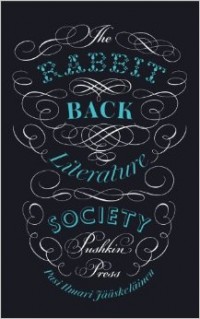
rabbit-back-literature-societyThe Rabbit Back Literature Society
by Pasi Ilmari Jääskeläinen
translated from Finnish by Lola M Rogers

This book was one of the staff recommendations at Mr B’s Reading Emporium and I was attracted to the title and the sinister tone of the blurb. I waited until it was suitably wintry outside (it is set in Finland, after all) and then settled in for something magical.

Ella Milana has recently moved back to her home town of Rabbit Back to teach literature and help her mother cope with Ella’s father’s decline into dementia. Rabbit Back is renowned throughout Finland, indeed the world, for being the home of acclaimed children’s author Laura White, who is not only a beloved bestseller herself, but also declared that she could take ten children from her home town and turn them into successful writers as well. To this end she formed the Rabbit Back Literature Society, to which she invited nine children who have grown up to become great writers. As Ella is both an adult and not a regular writer (she dabbles), she is rather taken aback to be chosen as the society’s tenth member.

“The essays blared through her consciousness…Jokes, banalities and metaphors assaulted her sensibilities, and the floodgates of language standards creaked as dubious sentence structures and hyphenation errors dribbled through their cracks. Every imperfect essay left a dent in Ella’s mind.”

This passport to greatness appears to have been curtailed as soon as it began when at a dinner party thrown at Laura White’s house, a key person disappears in a cloud of snow. But Ella is still a member of this writers’ society and she is determined to dig up all its secrets, big and small, real and imagined. Why are words changing in library books? Why is society member sci-fi writer Arne C Ahlqvist (real name Aura Jokinen) creeping around Ella’s house at night? And was there a previous tenth member of the society who has been written out of its history?

I love that when the first few strange things happen, including Ella’s invite to the society, she is too busy with her normal life to pay it all much heed. She has a job, difficult parents, her own preoccupations. This really highlighted for me how often in books characters jump to something new in their life with no regard for what they would otherwise have been doing.

“He just wanted to look at the garden, to watch it grow – that’s how he explained it to his wife, Marjatta, who had begun to think of herself as a widow and sometimes suffered from a terrible feeling of guilt because of it. Old age doesn’t always wait till you’re old, was her way of answering him. Every day seemed to break off another little piece of Paavo Emil Milana’s personality, and piece by piece he was less and less the Paavo Emil Milana she had married.”

The story hints at and creeps into several genres. The overall structure is that of the detective novel, but it’s not clear whether any crime has been committed. Similarly, there are strange hints of the supernatural in various forms – ghosts, faerie creatures, magic – but nothing is definite, nothing is explained. Could it all just be over-fired imaginations?

The imagination is certainly central to everything else in this novel. White has trained her writers to tap into their and each other’s deepest, most buried thoughts to fuel their writing. The whole town seems to believe in magical creatures, in dark shapes in the shadows become manifest. Even the dogs are behaving strangely. But there is also the beautiful possibility of imagination, the joy that books (and other writing – one of the society members writes for TV and another for film) bring.

“ ‘It was a lovely collapse,’ Saaristo said. ‘Like something out of an old melodrama. All that was missing were the smelling salts. It’s no wonder you fainted in this crowd. Free coffee and cake will get the masses out better than resurrection day.’ She looked around, smiled broadly, and said, ‘But if you want to find characters for a book, this is a good place to do it, as I’m sure you’ve noticed. I found bits of a serial killer’s mother, half of a hero’s lover, and three whole peripheral characters today. A nice haul.’ ”

As Ella learns the rituals of the secretive society and unearths its and the town’s secrets, there is always the potential for something awful to come to light, but what is hidden is more often sad in an everyday way, or at least everyday for the world – loneliness, infertility, the death of parents, the love affair that ended.

And yet somehow it isn’t a sad book, this tinge of sorrow underlines but doesn’t overwhelm the magical otherness, the sense of fun and adventure, the intrigue of mystery. There’s a black humour, a nod to the idea of the idyllic-seeming town harbouring dark secrets, but it’s so much stranger than that.

Lumikko ja yhdeksän muuta first published 2006 by Atena Kustannus.

This translation published 2013 by Pushkin Press.

Source: Mr B’s Reading Emporium.

Kate Gardner Reviews

Sunday Salon: Noted quotes

January 18, 2015 3 Comments

The Sunday SalonWhen I was a teenager I used to write down favourite quotes and stick them on my bedroom wall and mirror. I had dozens of them by the time I left for university. I remember there were a lot of Oscar Wilde aphorisms, because they seem immensely clever and worldly when you first discover them, but there were also some lines of poetry, beautiful combinations of words that spoke to me.

These days when I read, I don’t take note of the same kind of things I did back then. When I pick out quotes for my reviews, I’m choosing lines that demonstrate the style of the book. They might well be clever and/or beautiful, but not in the same way as those words on my old wall. Teenage me was searching for words to live by: inspiration, hope, advice, wisdom. Older me looks for a more abstract beauty in words, a sense of originality, ultimately something I truly admire.

Those teenage quotes are still with me, as in I remember most of them, though I expect the actual scraps of paper are long gone and if not, I’m pretty sure the ink will have faded to almost nothing. But though the quotes I pick out these days are arguably better, chosen for purer reasons, I never remember them. Even as I’m closing the final pages of a book in which I have underlined dozens of passages that I loved, I won’t remember any of them.

This might be partly a comment on my failing memory, or on how much more information I have crammed into my brain in the years since I was a teenager, but I find it a little sad I don’t retain nuggets of literature in that way anymore. Perhaps I need to read more poetry, as the rhythms lend themselves to being memorised. I love the idea of being able to quote whole poems (something else I did as a teenager – why yes I was tad pretentious) but worry what other information I’d be squeezing out.

Do you remember good quotes from books you read? Do you keep note of quotes you like?

Kate Gardner Blog

Mid-winter reading round-up

January 11, 2015 4 Comments

Hands up: I finished reading two of these books weeks ago and have therefore forgotten almost everything about them. They all deserve full reviews but I’d have to reread the books for that to happen and, let’s face it, that’s not happening. So here are some woefully brief thoughts on the last few books that I’ve read. (Incidentally, my 2015 reading has started slowly. Goodreads tells me I am already behind. Stupid reading challenges.)

Dear LifeDear Life
by Alice Munro

Munro writes beautiful short stories about everyday life in Canada, often set in or starting from the mid-20th century, and even the more modern settings have a timeless quality to them. There was a bit of a theme of passing through, of the people who are important to you for a while and then move on, which is not an easy theme to create satisfying endings from, but this never bothered me. I really liked the story “Amundsen”, about a woman who goes to a remote village to teach at a school that’s part of a tuberculosis sanatorium. It’s somehow very ordinary and very strange at the same time.

“The building, the trees, the lake, could never again be the same to me as they were on that first day, when I was caught by their mystery and authority. On that day I had believed myself invisible. Now it seemed as if that was never true.”

First published in Great Britain 2012 by Chatto & Windus.

Source: Foyles, Bristol.

The Dead Lake
by Hamid Ismailov
translated from Russian by Andrew Bromfield

This strange short book started out with so much eerie promise but it got a little boring in middle. In fact, I put it down for a month and wasn’t sure if I would pick it up again, but I’m glad that I did. The language is beautiful and the story almost a fairy tale. It’s about Yerzhan who lives in a remote part of Kazakhstan where the Soviets test atomic weapons. As a young boy he fell in love with the girl next door and one day, to impress her, he dived into a forbidden (and almost certainly radioactive) lake. The consequences of this action are odd and fantastical, which is fitting for such an empty, unsettling landscape.

“Yerzhan stood there with his heart pumping hard, pounding its rhythm against the wall – or was that the heavy passenger express that pounded on the rails with a rhythm that pulsed through the ground? Whatever the cause of the pounding, Yerzhan just stood there nailed to the floor, more dead than alive. And once again that same implacable, visceral fear rose up from his trembling knees to his stomach, where it stopped like a hot, heavy, aching lump.”

Published 2014 by Peirene Press.

Source: Peirene gave this away as a free e-book to newsletter subscribers.

Rivers of London
by Ben Aaronovitch

This had been recommended to me by basically everyone and we accidentally ended up with two copies of it, so I’ve been meaning to read it for a while. It’s the story of Peter Grant, constable for the Met, who at the start of the book is at the end of his probation, waiting to be assigned to a department, so his whole career could hinge on how he handles guarding a crime scene in Covent Garden. Which would be easier if this particular murder case didn’t appear to involve ghosts and all manner of strangeness. This book is a lot of fun. It explores fantasy, magic, policing, class, race, history and death, doing so with great humour and plenty of action. There are already four sequels, which I know people rave about as much as this first book.

“Rush hour was almost in full flood when I got on the train, and the carriage was crowded just short of the transition between the willing suspension of personal space and packed in like sardines…I was sending out mixed signals, the suit and reassuring countenance of my face going one way, the fact that I’d obviously been in a fight recently and was mixed race going the other. It’s a myth that Londoners are oblivious to one another on the tube: we’re hyper-aware of each other and are constantly revising our what-if scenarios and counter strategies.”

Published 2011 by Gollancz.

Source: Heffers Bookshop, Cambridge.

Kate Gardner Reviews

A dam-burst of ideas, memories, impulses and thoughts

January 8, 2015January 8, 2015

The Reason I JumpThe Reason I Jump: One boy’s voice from the silence of autism
by Naoki Higashida
translated from Japanese by K A Yoshida and David Mitchell

This was one of those random finds that make a great bookshop great. Not that it’s the best book ever, but it’s genuinely interesting and different and, despite being fairly new and translated by one of my favourite authors (plus his wife), I hadn’t heard of it. But it was on display in the non-fiction shelves and Mitchell’s name jumped out at me.

This is somewhere between a memoir and a factual study of autism. Higashida is autistic and at the time of writing was just 13 years old. He struggled with vocal communication, behaviour problems and even written communication, but had worked with his mother and a teacher to create an alphabet-grid system whereby he pointed at words or letters to be understood. (He did also learn to type on a computer and started a blog, so this book isn’t entirely miraculous.) With this book he found a way to explain his experience of autism that was fresh and new to parents and other adults who have regular contact with autistic children. It’s written in the form of questions and answers, with a few very short stories dropped in. There’s some lovely sections about how important nature is to Higashida, partly because it places no demands on him.

“Why do people with autism often cup their ears? Is it when there’s a lot of noise?

…The problem here is that you don’t understand how these noises affect us. It’s not quite that the noises grate on our nerves. It’s more to do with a fear that if we keep listening, we’ll lose all sense of where we are. At times like these, it feels as if the ground is shaking and the landscape around us starts coming to get us, and it’s absolutely terrifying. So cupping our ears is a measure we take to protect ourselves, and get back our grip on where we are.”

For many readers, Higashida’s words were a true breakthrough in their understanding of their own autistic child, and the book was a minor hit in his native Japan. One of those readers was Yoshida, and she immediately started to translate the book so that she could share it, initially with her husband and friends in Ireland, and then, once Mitchell had done some polishing and written an introduction, they published it to reach a much wider audience. There has apparently been some controversy about how much Mitchell polished, with some readers saying this doesn’t sound like a child’s writing. I must say I wholly disagree. Higashida sounds if anything surprisingly typical for his age – presumptive, repetitive and a little self-obsessed, thinking he’s learned to see the wider world but not really anywhere close to that yet.

I don’t mean to sound unkind. This is a very interesting and readable book about a condition that is incredibly difficult to understand. While nothing Higashida has to say was totally revelatory for me and he presumes to speak for all children with autism as if his own experience is universal, I’m really glad I have read it and can definitely see how valuable it could be to anyone who deals with autism. But let’s face it, Mitchell’s introduction is the best bit.

“Imagine a daily life in which your faculty of speech is taken away. Explaining you’re hungry or tired is now as beyond your powers as a chat with a friend… Now imagine that after you lose your ability to communicate, the editor-in-residence who orders your thoughts walks out without notice. The chances are that you never knew this mind-editor existed but, now that he or she has gone, you realize too late how they allowed your mind to function for all these years. A dam-burst of ideas, memories, impulses and thoughts is cascading over you, unstoppably.”

First published in Japanese in 2007.
This translation published 2013 by Sceptre.

Source: The Melton Bookshop.

Kate Gardner Reviews

Happy New Year

January 4, 2015 7 Comments

How were your Christmas and New Years, folks? I didn’t do very much reading, considering I had two whole weeks off work, but I did do plenty of relaxing, catching up with friends and family, and even some useful stuff. Not bad for someone who’s been gorging on cold and flu drugs for a week and a half. But then I love Christmas and birthdays (which I also had one of this week) so maybe I’ve been running on a bit of a high.

More relevant to this blog than my sinuses or holiday cheer is all the many lovely books I have gained in the past fortnight. Not that I need more, but they’re still the best present ever. I can’t wait to break into these piles of deliciousness (actually, I’ve already read two of them, but one’s a joke book so that doesn’t really count).

christmas-books-2014

Christmas presents:

We Need New Names by NoViolet Bulawayo
Books, Baguettes and Bedbugs by Jeremy Mercer
Slouching Towards Bethlehem by Joan Didion
The Siege by Helen Dunmore
The Gospel of Loki by Joanne M Harris
Paris Was Yesterday by Janet Flanner
The Little Prince by Antoine de Saint-Exupéry
I am the Beggar of the World edited by Eliza Grimwald and Seamus Murphy
F in Exams by Richard Benson (joke book that made me cry with laughter)
Plenty by Yotam Ottolenghi (recipe book of great great beauty)

birthday-books-2015

Birthday presents:

Maps and Legends: Reading and Writing Along the Borderlands by Michael Chabon
Bitter Greens by Kate Forsyth
My Brilliant Friend by Elena Ferrante
Veronica Mars: The Thousand Dollar Tan Line by Rob Thomas and Jennifer Graham

bought-books-2014

And as if that wasn’t enough, I treated myself (thoroughly encouraged by Tim, I might add) to not one but three forays into tiny but brilliant bookshops – the Melton Bookshop, the Forest Bookshop and Durdham Down Bookshop, all of which deserve blog posts dedicated to them that I will eventually get round to. I restricted myself to one or two books from each because I do have some guilt about the TBR being at its biggest point ever since I started keeping track, but I also want to support every great bookshop I pass. My purchases were:

The Reason I Jump by Naoki Higashida (which I read within 48 hours of buying it; I’ll review it soon)
The Maltese Falcon by Dashiell Hammett (book club for February, so it’s a totally sensible purchase)
The Prisoner of Heaven by Carlos Ruiz Zafón (because Cemetery of Forgotten Books!)
I Know Why the Caged Bird Sings by Maya Angelou (I think I read this years ago but didn’t own a copy so while I was picking up the next volume, I figured I should start a matching set)
Gather Together in My Name by Maya Angelou (look: it’s so pretty!)

Kate Gardner Blog

2014 round-up

December 31, 2014December 31, 2014 2 Comments

Oh Christmas Tree

As I cough and splutter my way through New Year’s Eve, I would like to come up with some pithy, wise things to say about the year that’s ending, but mostly I’m counting down the time until I can take more Sudafed, so apologies if this a bit rambly.

This year I read 71 books. I set myself three challenges, of which I completed two. Honestly, I am fine with that. I read some great books this year. My favourites have been:

The Invention of Wings by Sue Monk Kidd
The Immortal Life of Henrietta Lacks by Rebecca Skloot
Sworn Virgin by Elvira Dones
Transmetropolitan, Vol. 5: Lonely City by Warren Ellis and Darick Robertson
An Amorous Discourse in the Suburbs of Hell by Deborah Levy

Looking at that list, I’m pleased with how varied it is. There’s lit fic, popular science, translated fiction, a graphic novel and poetry. Completely unplanned, I swear!

Just practising

On the non-reading front, I’ve also had some fun new experiences this year. I went to Amsterdam (and instantly fell in love with it), saw Cirque du Soleil live (which was a total surprise planned by Tim – best surprise ever!), successfully grew chillis (in fairness a friend did the difficult first part and gave me the seedling, but I’m still happy I didn’t just kill it) and I knitted stuff (Tim’s mum taught me to knit at the end of 2013 but I didn’t knit any actual things until this year and I’m super proud of myself still every time). Oh, and we finally finished watching Battlestar Galactica, which may not sound like much of an achievement but we bought the box set five and a half years ago, so I’m totally counting it. It’s a great show, I don’t know why we took so long!

Right now, I think it’s time for another cup of tea and one of my new Christmas books (which I’ll post pictures of another time). Happy New Year everyone!

Kate Gardner Blog

Reality is always worth more than wishes

December 30, 2014

backroom boysBackroom Boys: the Secret Return of the British Boffin
by Francis Spufford

This was my final read for my 2014 Popular-Science Reading Challenge. It’s been recommended to me by multiple people, including Tim, so I thought I would save this for last. It’s about British engineering projects, large and small, of the 20th century.

This is a sort of love letter to British engineering, but a deprecating one with notes of doubt. Spufford looks at projects from the Black Arrow space rocket to the computer game Elite to the Human Genome Project. Sometimes, like that last example, the Brits formed part of an international effort, but it is very much the Brits that Spufford is writing about.

Spufford is playing up the idea of the unsung hero, the small project dwarfed by international (especially US) comparison, which isn’t actually always as true as he implies (but obviously in the case of, say, the space programme, it really is). A book about technology, especially one including ongoing projects, does risk feeling dated quickly, and in the 11 years since this was first published, things have changed. In fact, the paperback edition includes an author’s note at the end with updates that had already happened in the first year since publication.

“It was beginning to dawn on the engineers that they were watching a virtually perfect performance…Wishes were turning into facts faster than seemed wholly lucky…The party was long and loud, because the attempt to orbit Prospero had been the last thing between the rocketmen and the end of the programme, and this, the celebration, was the last of the last. When the sun came up the next morning over the desert, the hangover would encompass the whole of British rocketry.”

This is an interesting, entertaining book that brings to life largely forgotten (or possibly never known to begin with) stories. Spufford doesn’t just explain the science and technology well, he bubbles with enthusiasm, pouring praise on the men and women (but as he admits himself, mostly men) who made these projects happen. I was actually a little saddened when later chapters concentrated more on the policy and politics of making projects happen, not because that’s not a valid part of the story, but because it meant there was less of that almost childlike enthusiasm and adulation.

There’s a definite lean towards Cambridge-based projects. Spufford lives in Cambridge and, while I would not say any of his choices of subjects to cover are undeserving, it does seem a little more than coincidental that half of them are or were in Cambridge, and makes me wonder what alternative options he might have covered with a net cast more widely. Also, I was not always convinced by his sweeping statements, though I’m pretty sure he’s right on the details.

For instance, Spufford writes about Elite as if it’s the one and only example of a decent British computer game, as if this effort by two Cambridge students was the country’s one stab at a games industry and, while successful, was a one-off. This is so very far from true. In the major success league, by 2003 there had been four Grand Theft Auto games (DMA Design/Rockstar North), five Tomb Raider games (Core Design), Goldeneye 007 (Rare), Lemmings (DMA Design), Burnout (Criterion Games), Worms (Team17) and dozens more that I don’t know. So while Elite was clearly a major step forward, hugely influential on gaming as a whole and an interesting human story to boot, it is by no means a lone wolf in British engineering history. That said, it’s a particularly well written chapter, plus it was a lot of fun reading it while sat next to Tim playing the recent sequel Elite: Dangerous, and hearing from him what a big deal the original Elite was.

“That’s how making goes. It would be dispiriting for the maker if it weren’t that reality is always worth more than wishes. A real, constructed thing (however dented) beats a wish (however shiny) hands down; so working through the inevitable compromises, losing some of what you first thought of, is still a process of gain, is still therefore deeply pleasurable to the maker.”

Overall, Spufford is very readable and I’m glad that we already have one of his other books on our shelves.

First published 2003 by Faber and Faber.

Source: Borrowed from Tim

Challenges: This counts towards the 2014 Popular-Science Reading Challenge

Kate Gardner Reviews

Merry Christmas

December 23, 2014 2 Comments

Christmas reading plans

Merry Christmas folks!

As I have two whole glorious weeks off work, I have ambitiously set aside the above pile of books to work my way through, though I will no doubt get distracted by shiny new Christmas present books at some point. We do have lots of people to visit and sensible house stuff to do, so I’m not sure how much reading time I’ll actually get, but here’s hoping!

Happy holidays and happy reading everyone.

Kate Gardner Blog

You’re just a totalitarian angel

December 22, 2014

AmorousDiscourseSuburbsHellAn Amorous Discourse in the Suburbs of Hell
by Deborah Levy

This is a long poem (ish – it’s no Faerie Queen) in the form of a dialogue between a couple, “He” and “she”, alternating having their say in this argument/conversation. It’s different from anything else I’ve read, wonderfully surreal and packed with references to everything from Shakespeare to pop songs. I read it in one sitting and immediately wanted to read it again.

The poem works so well because it could be read in many ways. Is this an ordinary human couple living in suburbia? Or are they angels fallen to hell? Is one of them fallen and the other trying to save them? Is one human and one God? The many religious references (to the Bible, to Dante, to the language of faith) are woven in such a way that they could just possibly be the twee fondnesses of a couple in love, or they could be wholly serious.

Best of all, it’s funny. Genuinely, laugh-out-loud but also cleverly, funny. It’s profound and profane, full of meaning and simple, pure entertainment.

“i try to introduce you
to the way i see things
and all you want is a wife
a wife and a second-class stamp and a bath
a bath and a donut and a product to kill moths

“You’re just a totalitarian angel
Full of self-rapture
I thought you were a divine messenger
In fact you’re a glutton
With wings”

First published 1990 by Jonathan Cape.
This edition, with revisions, published 2014 by And Other Stories.

Source: I subscribe to the publisher.

Kate Gardner Reviews

Sunday Salon: Christmassy book thoughts

December 14, 2014December 14, 2014 4 Comments

The Sunday SalonIt’s the last weekend before the Christmas holiday starts in the Nose in a book household, so I was expecting to be madly Christmas shopping or present wrapping, but I seem to have already bought everything I can until certain family members respond to my questions, so instead the weekend has been spent hanging out with friends, reading and binge-watching a TV box set that I’m not going to name because we’re about five episodes from the end and I really don’t want it spoiled for me!

One thing I did spot while doing my Christmas shopping was this rather lovely charitable giving project from Blackwells bookshops: the Giving Tree, donating books to less fortunate children. If I can get to a Blackwells in person I’d love to help pick out a book myself but if I can’t I’ll entrust the choice to their booksellers who, let’s face it, know what they’re doing.

It’s a timely reminder that not everyone is in the fortunate position I’m in where I have more books than I can read in a year already piled up invitingly. And I keep buying more for myself! Though I try not to do too much of that around Christmas, this week I did receive my first book from my Peirene Press subscription, which I bought as a present to myself last month. Because I just couldn’t keep resisting these beauties.

peirene

And last week I also received this rather fun advance reading copy of a book being published early next year, along with a kit for knitting a square of a blanket that I can only assume will be gigantic if every reviewer does that part as well. As an enthusiastic amateur knitter how could I not join in this project? They judged me well when they sent that invite! Keep an eye out early next year for my knitting and my review.

a to z of me and you proof

Kate Gardner Blog

Posts pagination

1 … 65 66 67 … 123

Archives

RSS Nose in a book

  • 2025 reading stats and top reads
  • December 2025 reading round-up
  • Book review: The Galaxy and the Ground Within by Becky Chambers

Me on the internets

  • @kate_in_a_book@mas.to (Mastodon)
  • Flickr/noseinabook
  • Instagram/kate_in_a_book
  • StoryGraph/kate_in_a_book

Categories

  • Blog
  • Reviews
  • Uncategorized
Proudly powered by WordPress | Theme: Dream by vsFish.