Book review: Passing by Nella Larsen
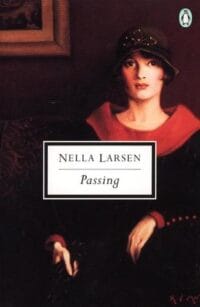 I probably hold on to more of the books I read than I will ever realistically reread, but there are some I know I will come back to. Like Passing by Nella Larsen, which I recently read for the second time in 14 months. It was chosen by my book club (with my encouragement) and I’m pleased to find I loved it second time around (as did all but one of the book club).
In this 1929 novella, two Black women reconnect years after having been children together. Irene and Clare bump into each other in a whites-only restaurant in Chicago. They’re both passing, but for Irene it’s a brief convenience to drink a cool drink on a dusty summer’s day. Clare is living her whole life passing for white – including being married to a racist white man who has no idea she’s Black.
Irene is married to a Black man who is a doctor and fund raises for civil rights. They’re prominent members of society in Harlem. She doesn’t approve of Clare’s life choices – even more so when Clare starts coming to socialise in Harlem when her husband is away.
“Did that woman, could that woman, somehow know that here before her very eyes on the roof of the Drayton sat a Negro? Absurd! Impossible! White people were so stupid about such things, for all that they usually asserted that they were able to tell; and by the most ridiculous means, finger-nails, palms of hands, shapes of ears, teeth, and other such silly rot…Nevertheless, Irene felt, in turn, anger, scorn, and fear slide over her. It wasn’t that she was ashamed of being a Negro, or even of having it declared. It was the idea of being ejected from any place, even in the polite and tactful way in which the Drayton would probably do it, that disturbed her.”
It’s a dangerous path for them to rekindle their friendship and spend significant time together. But the nature of that danger is not quite what it at first seems. The tension rises to a dramatic denouement, which I thought was well earned.
Clare and Irene are complex characters. Irene lives in fear that her husband will either leave or take their whole family away to Brazil. He is unhappy – possibly depressed – and unfulfilled. Irene refuses to try to understand, insisting they must maintain their high standard of life by keeping everything as it is. Theirs seems to be a passionless marriage, conducted in brisk conversations about their social engagements. So Irene invests her love and energy in their two sons.
Clare has a sad backstory. She was always looked down on by her peers at school and rumours about her abounded since her teens. She doesn’t have a strong bond with her daughter or husband. But she exudes a joy for life, a passion even, that makes Irene nervous. Everything we know about Clare is from Irene’s perspective, so we don’t get to hear inner thoughts. But we still see a lot in her body language and the things she says.
“Irene’s lips trembled almost uncontrollably, but she made a desperate effort to fight back her disastrous desire to laugh again … she turned an oblique look on Clare and encountered her peculiar eyes fixed on her with an expression so dark and deep and unfathomable that she had for a short moment the sensation of gazing into the eyes of some creature utterly strange and apart. A faint sense of danger brushed her, like the breath of cold fog.”
The social mores and motivations are often subtle. Larsen’s prose is sparse and many details are inferred rather than spelled out. I’m definitely glad to have a Penguin Classics edition with lots of explanatory notes. There’s a lot of irony and theatricality in the dialogue, which made me think of studying Henry James at A-level.
In fact, I learned from the introduction in my edition, by Thadious M Davis, that Larsen was heavily influenced by Modernist writers as well as the early figures in the Harlem Renaissance – a group she became part of for a few years. Larsen gained some renown and admiration for her psychological insight and the more complex problems of race and gender that her novels tackled.
Sadly Larsen only ever wrote two novels. In 1930 she was given a Guggenheim Fellowship, intended to fund her writing. Shortly afterward, a short story of hers was publicly accused of plagiarism. She still travelled to Europe as planned and worked on a novel but it was never published. Her marriage (to physicist Elmer Imes) broke down and shortly after she returned to the US they divorced. She took up her earlier career of nursing and disappeared from society.
You can see aspects of her life story in Passing. Larsen had a white Danish mother and a Black father from the Danish Virgin Islands who left when she was a baby. Her mother remarried a white man and they had another child. This meant that Nella was the only Black member of the family – and she could not pass. In the first two decades of 20th century USA this could not have been the easiest situation.
Knowing that, Clare’s longing to be among her fellow Black people, denied first by her family circumstances and then her marriage, could easily be Larsen’s own feelings from earlier in her life. But also, Irene’s need to conform to the expectations of Harlem society, her fear of standing out, could reflect Larsen’s experience of her years in Harlem.
Apparently Larsen’s first novel, Quicksand, was more directly autobiographical. Which I am definitely curious about. And I wonder if it’s possible to find her short stories now.
First published 1929 by Knopf. This edition with introduction and notes published 1997.
Source: I bought this secondhand in Paris on our 2024 holiday. It was either The Abbey Bookshop or San Francisco Books. I do love how many bookshops there still are in Paris – at least in the Latin Quarter. On that trip I also visited The Red Wheelbarrow and peered through the window for ages at La Libre Pensee wondering if my French was good enough for a radical pamphlet or two.