Book review: Utopia Avenue by David Mitchell
Like many people I discovered David Mitchell through his bestselling novel Cloud Atlas. I went back and read his first two books and declared myself a big fan. I bought his next few books as hardbacks on release and loved them. But then after 2014 I for some reason didn’t pick up his next two novels – until now.
Looking back at my notes from the talk Mitchell gave in Bristol in 2014, he said he was writing “a book largely set in 1960s London and New York, due for publication in 2016”. Well that surely has to be Utopia Avenue, which was finally published in 2020. And which I finally read last month.
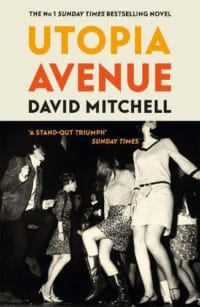
This is a novel about a fictional band called Utopia Avenue in 1960s London (mostly). They’re a cross-genre hybrid formed by a visionary manager, Levon Frankland, bringing together musicians he’s individually impressed by. Which at first seems like a plan so misguidedly hopeful it can’t possibly work. As these five strangers gradually become a team, life throws curveballs that could end the dream before it’s begun.
Each chapter centres around the writing of a particular song, told from the perspective of the song’s writer. All the band members and their manager get a turn – though two of the band do the majority of the writing and therefore get more chapters. It’s an interesting way to tell the story, though I did occasionally want more from the perspectives that were largely missing.
The band composition is pretty varied. Dean Moss is a blues bassist without a band, estranged from his family. In the first few pages of the novel he’s evicted from his flat and loses his part-time job at a coffee shop. So when he bumps into Levon who offers him a bed for the night in return for his opinion on a new act playing that night, Dean can hardly say no. Dean is a working class kid who spouts homophobic slurs and is quick to use his fists to resolve a disagreement.
Levon introduces Dean to drummer Griff and guitarist/vocalist Jasper de Zoet. Griff is a Northern lad who’s mostly played in jazz bands, touring with some of the greats. Jasper is a posh half-Dutch guy who is almost certainly neurodivergent and a guitar virtuoso in the vein of Jimi Hendrix.
“Many an anonymous Soho doorway, Jasper is learning, is a portal to another time and place. Club Zed is a jazzer’s hangout as well as a Polish one, and it houses a fine Steinway grand as well as an eight-piece Ludwig drum-kit on which Elf and Griff are playing while Dean wrings howls from his harmonica. The audience of two consists of Levon and Pavel, Club Zed’s owner. They smoke cheroots.”
The final band member is Elf Holloway, a folk singer-songwriter who has already achieved some small fame but just broke up with her boyfriend/musical partner and is heartbroken. She has a warm, loving middle-class family nearby who support her choice of career – for now.
And then there’s Levon, a Canadian who spent years working in New York City’s music scene before moving to London. He’s 20 years older than these bright young things he’s now managing, and careful to keep his life separate from theirs while always having their back. He’s also gay – another reason to hold himself separate in the 1960s. Which all the band members quickly figure out and none are bothered by – even Dean, suggesting the slurs are mostly bluster.
For a good chunk of the novel, Utopia Avenue are an unknown/little-known band touring small venues and figuring out what works for them. They have three song writers with very different styles and need to decide if this is a positive or negative thing. Especially when they get a record deal and have to choose which songs to record and release as singles. Dean’s insecurity about being working class, and Elf’s insecurity about being the only woman, feed into arguments that felt very real. Plus they all have their romances and/or family stuff to deal with outside the band.
All of that worked brilliantly for me. And I liked the cameos from real-life people of the time – David Bowie on the steps of the music publisher talking about his forthcoming first single; the band going to see Pink Floyd play in grungy little clubs; Levon meeting Francis Bacon at a discreet gay bar. I’m sure there were dozens of references to real people and places I missed.
“ ‘Nina Simone at Ronnie Scott’s,’ says Elf… ‘I was 17. My parents would never have let me go into Soho alone, but Imogen and a boy from church chaperoned me into Satan’s Lair. I’d been sneaking off to the Folk Barge at Richmond since I was 15 but Nina Simone was in a higher league. Way higher. She floated across Ronnie Scott’s like Cleopatra on her barge. A black orchid dress. Pearls the size of pebbles. She sat down and announced “I am Nina Simone” as if daring you to contradict her.’ ”
The one thing that didn’t quite work for me is something I knew was almost certainly coming – when the narrative took a slightly sci-fi/magical realism turn. All Mitchell’s novels have this to a greater or lesser extent. And this book is clearly part of Mitchell’s wider semi-fantastical world. As well as having a half-Dutch character called De Zoet, there are references to the Cloud Atlas Sextet by Robert Frobischer and later a Dr Marinus. But the particular way this novel veers into fantasy (which I won’t spoil here as it happens quite late on) just didn’t feel right. It seemed convoluted and didn’t quite fit with the rest of the novel. Unlike with, say, The Bone Clocks – another mostly realistic novel by Mitchell where the touch of SFF felt like a touch of brilliance.
Perhaps that’s why Mitchell took four years longer than planned to release this novel, and even maybe why he hasn’t published another in the six years since. Tying all his novels into one giant fantastical world must get ever more complicated with each book he adds to the pile. I don’t think any author owes their audience any kind of regularity of when their books come out or what style of books they are. So I just want to say to Mitchell: if your next book needs to be in a fresh new universe with no references to anything that came before it, that’s okay. We’ll understand.
I will go back and read the one Mitchell book I skipped: Slade House. Which he described in 2014 as a short novel, but I see now it’s 240 pages, which I consider full length. Certainly shorter than most of Mitchell’s books, including Utopia Avenue. It’s a story set in the world of The Bone Clocks, so perhaps I should reread that before I pick it up. In fact, maybe I should reread all his books from the start. And that is how it takes me 12 years to get round to reading a book I’m really excited about.
Published 2020 by Hodder & Stoughton.
Source: present from family.