Book review: The Stories of English by David Crystal
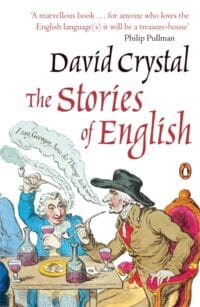
Way back when Tim and I were first dating, we bonded over our interest in English language and he recommended I read David Crystal. Crystal is a linguist who has been studying and writing books about the English language since 1964. He lectured for decades at the University of Reading, which is where both Tim and I went, though sadly he was not there during our time. Crystal is rightly beloved as someone who is incredibly knowledgable, does important original research, and is able to make his field completely fascinating to the lay reader.
So I read a few of Crystal’s books 20-odd years ago, loved them and yet somehow his bestseller The Stories of English sat on my TBR for, well, 20 years. I finally picked it up last year and was reminded how great Crystal is. I was constantly quoting bits to Tim and our friends. That said, this book is denser than I remember the other Crystal books I’ve read having been and it took me a few months to get through.
This book is about the development of the English language, from the origins of Old English in the 5th century CE to the effects of the Internet on modern English. Crystal’s thesis is that this is not one single story, but many overlapping stories. And there is not, and never was, one single English language – it has always been multifarious. Which is a thesis I can get behind.
From the very start, Crystal questions the neatness of the common received narrative. Before the arrival of Germanic tribes – beginning with Angles, Saxons and Jutes – the Britons spoke various Celtic languages. With a small, highly scattered population, there would have been huge regional differences in dialect already. The Germanic tribes invaded/settled in small pockets of Britain, bringing their own regionally different forms of Old German. But Britons were already trading with Germanic and Frankish people before that, swapping words as well as goods. And because no language stays static, the language brought by Germanic people to Britain in the 5th century would have been very different to the language spoken by Germanic people who arrived from the same region a century later.
Crystal also acknowledges that there are still puzzles to which we don’t know the answer. Starting with the mystery of Celtic. Why did the Anglo-Saxons not end up speaking the local Celtic languages? They arrived in relatively small numbers and other similar migrations in Europe around this time tended to conclude in the invaders adopting the indigenous language. But even the oldest records we have in Old English have remarkably few words of Celtic origin. There are certainly some anthropological theories that Crystal presents, but unless archaeology makes some astonishing new finds it is unlikely we will ever know.
Old German was followed by Old Danish and Old Norse, with Latin an ever-increasing influence. Old French too started to show up in Old English long before the Norman invasion of 1066. Crystal painstakingly shows the receipts at every step, quoting original sources, providing word lists, being completely clear how sure we can be of any statement he makes according to how much evidence we have. Which means this a dense read, requiring the reader’s full attention. And yet I never found it boring or too textbook-like.
The main narrative is dotted with interludes and boxouts examining case studies. These might look at the language of a certain domain (e.g. law or the church); specific manuscripts of importance; specific dialects; or the origins of a certain aspect of modern English. A particularly interesting interlude looks at the second-person pronoun, and how the distinction between thou and you was collapsed into one word (aside from in some regional dialects). But again it wasn’t a straight line from two words to one. “Thou” continued to be used in poetry and plays long after it disappeared from factual writing. In Shakespeare’s plays, for example, the use of “thou” tells the audience about the character who is speaking – either their relative rank or that they are a “regional” character.
Crystal is very entertaining when it comes to the grammarians. As he points out, there wasn’t one single phase of self-appointed arbiters of “correct” use of English; there were centuries of it. From the 17th century to the 20th century, waves of books were published declaring the rules to follow. The earliest of these tended to bundle language and grammar with etiquette. After all, behaving politely included speaking politely, which meant using language that was clear and widely understood.
In 1795 Lindley Murray published his English Grammar, originally for use at a local girls’ school. Though widely criticized and satirized, schools loved his book and school grammar textbooks continued to closely follow Murray right through to the late 20th century, despite the wider world of language experts having quickly rejected many of his “rules”. Which explains why so many older Brits – and people raised in English-speaking former colonies – continue to insist that, for example, infinitives must never be split. Apparently English is not the only language that suffered this prescriptivism – it was common across Western Europe. And while the establishment of a standard English has its uses, language variety is essential.
“This is the real harm that the prescriptivism of the mid 18th century did to English. It prevented the next 10 generations from appreciating the richness of their language’s expressive capabilities, and inculcated an inferiority complex about everyday usage which crushed the linguistic confidence of millions. We have begun to emerge, at the beginning of the 21st century, from this linguistic black hole.”
Crystal concludes with 10 sociolinguistic principles, starting with:
“1. Language change is normal and unstoppable, reflecting the normal and unstoppable processes of social change.
2. Language variation is normal and universal, reflecting the normal and universal diversity of cultural and social groups.”
I really recommend this book to anyone interested in language history and development. And I will look out for more recent Crystal books.
Published 2004 by Penguin Books.
Source: Almost certainly a present from Tim.