TV review: The Durrells
Soon after we moved to Bristol, I stumbled across three of the books from the Alexandria Quartet by Lawrence Durrell in beautiful matching Faber editions. Tim bought me the missing fourth book and in 2012 I embarked on reading this complex tale of love, politics, friendship and betrayal in Egypt written in the 1950s. I loved them. I loved the language, the settings, the obfuscation of multiple layers of narration. Ever since, I have intended to read more by Durrell and learn more about him.
A couple of years ago I became aware there was a TV show called The Durrells (ITV, 2016–2019) and wondered if it could be about the same man. Well – yes and no. I’m three seasons in, so I’m enjoying it. But what have I really learned?
Lawrence Durrell was the eldest of four children (technically five, but one sister died very young) born in India to British parents. When their father died, Lawrence was already in the UK at boarding school. His mother Louisa decided to move to the UK with her three younger children. After an unhappy few years, all five of them moved to Corfu in 1935. (Right now, in a cold wet January, it is easy to sympathise with the idea to leave Britain for sunnier climes.)
Those facts seem to be agreed on by all sources and by the TV show. But this is a fictionalised TV series based on the “Corfu Trilogy” memoirs of the youngest sibling, Gerald Durrell, which are themselves widely acknowledged to be fictionalised to some extent. In particular, they gloss over Louisa’s alcoholism, poke fun at Gerald’s older siblings and completely omit Lawrence’s first wife Nancy, who also moved to Corfu. Lawrence and Gerald’s surviving sister Margo wrote a memoir that apparently heavily contradicts Gerald’s account. And Lawrence also contradicted Gerald’s version of their tale in interviews he gave. Gerald’s widow acted as a producer and adviser for the TV series, but she met and married him long after the 1930s.
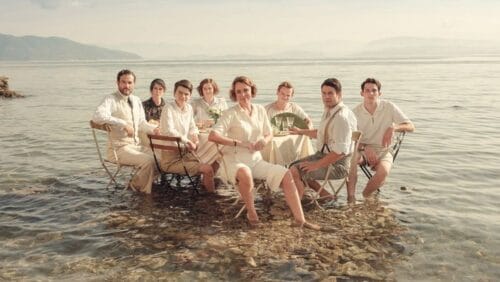
So – this is not a TV show from which to learn the reality of who the Durrell family were or what their daily life was like in Corfu for those four years. That is merely its loose inspiration. What it is, is a fairly light, glossy period drama about upper middle class Brits muddling through life in rural Greece. They’re depicted as eccentric socialists, trying to both integrate with the locals and be part of the international ex-pat community on Corfu. They largely fail at the former and somewhat succeed at the latter, but their eccentricity keeps most people at arms length.
I tend to find myself both liking and disliking the people in this show. Louisa (and here I can only talk about the character in the TV show, not the real person) only knows about three words of Greek and has been a lax parent to both Gerald and her second son Leslie, but she is well-intentioned and very modern in some ways. She barely bats an eyelid at learning a friend is gay, encourages Margo to find a career rather than a husband, gives her children talks about safe sex. She’s come from a well-to-do family with many servants – so life in Corfu with only a part-time housekeeper to help out and continual money troubles is a big change for her to adapt to.
Lawrence, or Larry, as everyone calls him, is already grandly calling himself a writer from episode one despite not having published any novels yet. He is always bashing away at his typewriter and saying outlandish things about sex in front of the family to get a rise out of them (which never works). But the show acknowledges he is a great writer and his writing is a major source of income for the family.
Leslie is initially the hardest character to like – and articles I’ve read suggest he was considered to be the “problem child” of the family. He (the character) is obsessed with guns and girls. Both of which get him into trouble. By series three he has started to redeem himself but you can see that he probably disagrees politically with the rest of the family. I certainly don’t think he would have been invited to wild parties by Henry Miller, as Larry is, for example.
Margo is at first quite annoying – boy obsessed, uninterested in finding a job and comically bad at them when she does try working. Almost an airhead. But she is the first of the Durrells we see speaking more than a polite word or two in Greek, and when she finds a job she is interested in she proves to be pretty smart and capable. The series is a little too keen on giving her storylines about having spots, or other skin problems, leaning into her appearance being what she cares about most. But then again, she was 16 when they moved to Corfu, and at 16 this is what girls are told to care about.
Gerald is very much the baby of the family, only 10 when the story starts. Despite picking up Greek reasonably early, he isn’t sent to school in Corfu. Instead, Louisa employs a series of tutors, with minimal success. His only real interest is nature – encouraged by a new friend the family meet in Corfu, Theo. The real Theodore Stephanides was indeed a British-Greek polymath who spent half a day a week with Gerald in Corfu, inspiring him to become the naturalist, zookeeper and conservationist he was in later life. Gerald is a bit of a brat, endlessly bringing home animals for his “zoo” with minimal interest in how the family will afford to keep them – or how being kept in a cage/pen might affect the animals. I don’t know if the TV series’ writer Simon Nye was trying to correct the record from books that self-aggrandised, and maybe over-corrected, but by series three I have grown to (mostly) like all the other characters and intensely dislike Gerald.
Aside from Theo, the main Greek characters (again, based on real people) are Spiros – a local taxi driver who helps the Durrells find a house and generally acts as their dogsbody/interpreter – and Lugaretzia, their maid/housekeeper. Spiros is good looking and good natured to an almost unrealistic degree. Lugaretzia is older, grumpy and seems a terrible fit for this family but somehow they all rub along together.
I repeat, this is a light comedic TV series. It does not interrogate the wealth divide in Greece in the 1930s or the effect of wealthy foreign people moving there. International politics is mentioned but not the focus. It occasionally falls foul of mocking the rural poor for lacking what we would today consider basic common knowledge. But it does also mock the clueless Brits for not knowing how to live somewhere that is hot, religious, home to different insect life, etc. And the setting is so very beautiful. Sometimes I will admit I tune out the characters and just enjoy the stunning scenery.
So I haven’t really learned much more about Lawrence Durrell. But Greece has jumped higher on the list of places I want to go. And in the meantime I might just pick up that Lawrence Durrell novel that’s sat on my TBR for a couple of years now.