Nose in a book

Reviews and other ramblings

  • Home
  • Reviews archive
    • Book reviews
    • TV reviews
    • Theatre reviews
  • TBR
  • Challenges
    • The Classics Club
    • 2014 Popular-Science Reading Challenge
    • Cookery challenge
    • The Gilmore Girls Reading Challenge
    • 2013 TBR Pile Challenge
    • 2013 Translation Challenge
    • Crime and Punishment read-a-long
  • About
    • Cookie legal stuff
  • Home
  • Reviews archive
    • Book reviews
    • TV reviews
    • Theatre reviews
  • TBR
  • Challenges
    • The Classics Club
    • 2014 Popular-Science Reading Challenge
    • Cookery challenge
    • The Gilmore Girls Reading Challenge
    • 2013 TBR Pile Challenge
    • 2013 Translation Challenge
    • Crime and Punishment read-a-long
  • About
    • Cookie legal stuff

Month: April 2012

You’re gonna get screwed but good in this town

April 6, 2012April 28, 2012

Tales of the City
by Armistead Maupin

After hearing this book praised left, right and centre since I started book blogging I figured I had to give it a go. And what a joy it is!

This is the first in what has turned out to be a very long-running series about a large cast of characters in San Francisco. In this book (I don’t know if this is true of any of the rest) the focus is on a boarding house on Russian Hill run by the inimitable Anna Madrigal (who grows her own weed and claims to have been raised in a whorehouse), and in particular her tenant Mary Ann Singleton. Mary Ann has newly arrived in the city from Cleveland and her sweet naivety is in for a shock. Or several shocks.

According to something I heard on Radio 4 (I think it was on A Good Read) the editors of the San Francisco Chronicle, in which this started life as a serial, kept a tally of straight versus gay sex scenes because there was a concern about it being “too gay”. Which tells you a little about the book. It is outrageous and wickedly funny but also intelligent and insightful. The characters lean very slightly into the larger-than-life category but they are not stereotypical or predictable. It really is an achievement that so much silliness can be so lovable.

There are dozens of storylines at work, only a couple of which are wrapped up by the end of the novel. The characters are introduced separately but their lives quickly overlap to the point where I was hard-pressed to remember who knew who from where. I’ll just have to read it again!

The extra character is, of course, the city of San Francisco. Maupin lovingly describes its streets and views and bars and people with all the little details of someone who calls it home. It is very much a tale of 1978, with an undercurrent of the politics and social nuances of the time. I was (perhaps naively) surprised by how much of the “pretentious” of middle-class life today (organic food, over-earnest attempts to appear not racist or homophobic, caring about global warming) was considered pretentious back then too. It is satirical but somehow firmly on the side of the people it satirises. Both prudish innocent (Mary Ann) and sexaholic (most everyone else) are celebrated in their own way.

I can see why it has been called a literary soap opera and it is indeed both those things. It isn’t literary in floweriness but rather in insight and cleverly spare language that gives you just enough, while finding room for some fantastic little jokes with words and meanings. So that’s six more books to add to the wishlist then, I guess!

First published in 1978 in the San Francisco Chronicle.
Published in book form in 1980 by Corgi Books.

Kate Gardner Reviews

Life might have been totally different

April 3, 2012April 28, 2012 3 Comments

1Q84
by Haruki Murakami

It’s my own fault. I was really excited about this book. I built it up in my head. I believed the “magnum opus” hype. I was bound to be let down.

1Q84

I really like Murakami. He’s not my favourite writer but I have loved some of his books and really liked several more, so the prospect of a three-volume masterpiece by him sounded wonderful. Unfortunately it turned out to be my least favourite of his works so far. In fact, at times it had me angry enough to want to throw the book across the room and I nearly gave up on it multiple times. But I soldiered on because this is after all Murakami and there is an intriguing storyline that is not wrapped up until the last page. And I had to know.

So that’s it’s great strength: the story. It’s a very Murakami story, an idea that starts gradually, slowly forming, giving you room to guess what’s going on. It’s weird in a surreal sort of way but it has an internal logic that allows you to see the directions it might go in.

Because it takes most of book 1 (300+ pages) for the basic concept to become clear, I don’t want to say too much about what happens. The chapters alternate between the stories of Tengo and Aomame. Tengo is part-time teacher, part-time writer, who allows himself to be persuaded by an editor friend to rewrite someone else’s entry in a creative writing competition, a story called Air Chrysalis. The situation goes from a bit unethical to downright dangerous when it turns out that there is a lot more to Air Chrysalis than meets the eye.

Aomame is a fitness instructor and also an assassin. But not the ruthless kind who will kill anyone for the right price. She has just one client and kills one particular breed of very bad men. So what links her to Tengo? Well, that would be saying too much, but from the start it is clear that they have a lot in common. They are both about 30 years old, living in Tokyo, with no strong emotional ties to anyone. They have almost clinical attitudes to their sex lives. They are particular about cleanliness and eating well. And because they would clearly get on well, it was wonderful slowly learning about how they were linked, seeing their stories draw together. But.

For one thing, I think 1Q84 is far longer than it needs to be. Murakami has a reputation as a sparse writer but here there is lots of repetition, lots of restating facts – a lot of bulk could have been shed. After the initial teasing out of a detail or plot point it then gets overstated and too obvious. This was to the detriment of the more surreal, magical elements because it made them seem at times clumsy and over-thought.

But I also had issues with some of the major themes in the book. First up: sex. I have no problem with sex scenes, but here I frequently got the feeling that typical male fantasies were being depicted for no good reason. Aomame is straight and at one point turns down an offer of sex with a woman, yet Murakami has her linger on the memory of a teenage lesbian dalliance with a close friend more than once. For no reason that I could fathom, when she remembers two good female friends from her past she thinks about their breasts. And not in a jealous way but in a sexual way. It’s very strange.

Then there’s the parents thing. There are no good parent–child relationships in this book. Tengo is horribly self-centred in his attitude to his father. Both Tengo and Aomame chose to move out from their parents at the earliest possible opportunity, but neither describes anything particularly terrible to explain why. Aomame’s parents were religious, Tengo’s father a distant workaholic, and perhaps with some further details those would have indeed been in some way abusive situations, but for all the very many words, I was never able to see what had been so wrong with either childhood.

Which brings us to the last problem: religion. Oh my word does Murakami have an axe to grind here. I should point out that I am an atheist, I am no fan of organised religion and recognise that it has been the source of a lot of bad stuff. But it has its positive side too and in most cases is probably best described as benign. 1Q84 gives no stock to such nuances. ALL RELIGION BAD could sum its attitude up. Basically, you have a cult that somehow grew out of a non-religious hippy commune and became a child-raping place of evil. And all other religious sects, churches or organisations mentioned are spoken of as if they are just as bad. As if they all brainwash, make children miserable, expect unreasonable things of their followers. Some of the statements I read made me slam the book shut and shout out angrily. At one point there was so much of this nonsense I didn’t know how I could possibly read on, but thankfully the narrative moved past it. (Although this is also a problem because I felt it was very ambiguous whether the nasty child-rape situation had been resolved or not.)

It started well and it ended well. The anger I felt in book 2 never resurfaced, although the boredom with some of the “waiting” sections did. I kept on reading because I wanted to know more, but I could not honestly say I enjoyed the read. This was translated by Murakami regulars Jay Rubin and Philip Gabriel so the style should have been familiar but it genuinely felt poorly edited in places and there were no moments when the writing stood out as beautiful or moving. Tengo and Aomame were typical Murakami characters in that they felt real but at a distance, slightly cold fish, so I could never be in their shoes truly living the story.

It saddens me that I cannot recommend this book and am even a little bit put off reading Murakami at all for a while. But I know other people have loved it so remember this is just my opinion. Others are available.

First published in Japanese in 2009 and 2010 by Shinchosa Publishing.
This translation published 2011 by Harvill Secker.

See also: discussions on Tony’s Reading List and In Spring it is the Dawn

Kate Gardner Reviews

Holiday snaps

April 1, 2012 3 Comments

Last week Tim and I went on holiday to Pembrokeshire with some good friends and it was perfect. We had seaside, a pretty cottage to stay in, log fires, lots of board games to play and the random heatwave meant we had sunshine too, despite it being March.

The beaches were almost empty.
Untitled

I revisited a place that had a profound effect on me when I was younger (17, I think. I read Frankenstein for my A level English while sat on the cliffs outside).
Untitled

I fell in love with the fossa, an animal I had never even heard of before.
Untitled

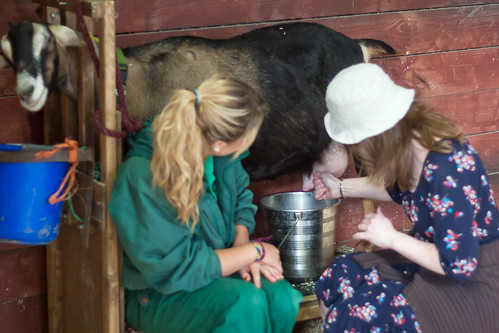
And I milked a goat. It only stood in the bucket once, despite my hideously long nails.
Kate milks a goat

The rest of my photos were on film so they will follow soon. Keep an eye out on my Flickr photostream.

Kate Gardner Blog

Posts pagination

1 2

Archives

RSS Nose in a book

  • Book review: Interstellar Megachef by Lavanya Lakshminarayan
  • May 2026 reading round-up
  • Book review: Passing by Nella Larsen

Me on the internets

  • @kate_in_a_book@mas.to (Mastodon)
  • Flickr/noseinabook
  • Instagram/kate_in_a_book
  • StoryGraph/kate_in_a_book

Categories

  • Blog
  • Reviews
  • Uncategorized
Proudly powered by WordPress | Theme: Dream by vsFish.