Nose in a book

Reviews and other ramblings

  • Home
  • Reviews archive
    • Book reviews
    • TV reviews
    • Theatre reviews
  • TBR
  • Challenges
    • The Classics Club
    • 2014 Popular-Science Reading Challenge
    • Cookery challenge
    • The Gilmore Girls Reading Challenge
    • 2013 TBR Pile Challenge
    • 2013 Translation Challenge
    • Crime and Punishment read-a-long
  • About
    • Cookie legal stuff
  • Home
  • Reviews archive
    • Book reviews
    • TV reviews
    • Theatre reviews
  • TBR
  • Challenges
    • The Classics Club
    • 2014 Popular-Science Reading Challenge
    • Cookery challenge
    • The Gilmore Girls Reading Challenge
    • 2013 TBR Pile Challenge
    • 2013 Translation Challenge
    • Crime and Punishment read-a-long
  • About
    • Cookie legal stuff

Month: September 2011

Something new every time

September 6, 2011

We like to go to the zoo. Specifically, Bristol Zoo, which just happens to be our local one. Handy that. It’s a particularly good one in terms of conservation and breeding programmes and all that. The enclosures are big enough and full of enough foliage and whatnot that the animals can pretty effectively hide from view, which some of them do more often than not (no aye ayes for us on the last 2 or 3 visits) but somehow we still managed to take almost 1000 photos there at the weekend. Yup. 1000. Of which I have so far identified about 20 good ones.

While we like to think we know our zoo pretty well and can find our way around and show visitors hidden treats, there is always something new to see/do/learn. This time we saw lion cubs, learned about gorillas and fed lorikeets. Which was all very cool.
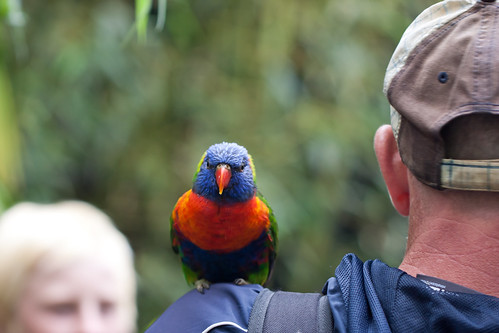
The lorikeets know that visitors are bringing them food so they land all over you, eager to be closest when you reveal the pot of nectar. It’s a bizarre feeling, birds’ feet on your bare arm. The keeper shooed off the bird that landed on my Mum’s head. Sadly I didn’t get a photo of that because we foolishly all fed the birds at the same time. So my photos are of complete strangers feeding the lorikeets.
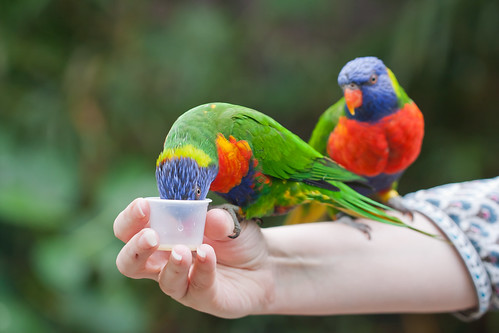
They are very pretty and reasonably gentle if slightly frantic birds. My best photos of the day were taken in the Bug House but I figured they might freak some of my readers out, seeing as it freaked me out a little editing them. Zooming in on a locust’s head to check if the eye or the mouth is in focus – it’s making the hairs rise on the back of my neck just thinking about it!

I’m gradually adding the selected photographic highlights to my Flickr photostream so if you’re interested and ready to be slightly unnerved by/speed quickly past the insect macros, take a peek.

Kate Gardner Blog

The fun of the fair

September 4, 2011March 11, 2012 2 Comments

Nights at the Circus
by Angela Carter

This is one of those modern classics that keeps popping up in discussions on Radio 4, with nothing but praise directed its way, so I thought it was about time I gave it a go.

It is a beautiful, crazy book. Right from the start, Carter keeps us guessing: is anyone telling the truth? Is this the part fantasy/fairy tale that it seems to be or is it a story about some rather clever, even fantastic, people in “real” life?

The story switches between three narrators, sometimes third person, sometimes first, but always appearing to be one of their perspectives. First there’s Jack Walser, an American investigative journalist who, at the start of the novel, is in London to interview a woman who he thinks must be pulling some kind of trick on the British public. That woman is our second narrator, Sophie Fevvers, a six foot plus blonde with wings – yes, wings – who takes advantage of this strange growth by performing as a trapeze artist. She gladly tells Walser her story, or a version of it, with help from her rather less welcoming foster mother Lizzie, who seems to have tricks up her sleeve, has a way with words that belies her coarse cockney accent and is our third narrator/perspective.

Walser quickly falls for Fevvers, as she prefers to be known, to the extent that he signs himself up to join the circus that she is about to go on tour with; and so begins a cacophony of adventure and misadventure.

The story is set in 1899 so the circus is that old-fashioned kind that combined freak show, performing animals, and heavy superstition and tradition. This sometimes got hard to stomach. I have in my time campaigned for circuses to be animal-free and, frankly, this novel offers strong evidence in that campaign’s favour. However, it’s all part of the surreal menagerie that now includes Fevvers – part woman, part swan. And the chimps are completely brilliant.

Carter toys with her readers throughout, mixing reality with lore and perception so that it is never clear what the characters believe to be true and what actually is true:

“[They] did not live alone. There was a bear, a black one, not yet a year old, still almost a cub. This bear was part pet, part familiar; he was both a real, furry and beloved bear and, at the same time, a transcendental kind of meta-bear, a minor deity and also a partial ancestor because the forest-dwellers extended considerable procreational generosity towards the other species of the woods and there were bears in plenty on the male side of the tribal line.”

For all its rollicking, good humoured, wonderfully written storytelling, it did take me a while to get through this book. Mostly I think that was the language. This isn’t simple, accessible language. This is complex, crafted, allusion-heavy prose, with borrowings from the folklore and mythology of several European countries. I thought it was magnificent, but there was no rushing through it.

I also – and I hate to admit that this made a difference – took a while to warm to any of the main characters. Fevvers and Lizzie deliberately keep themselves at a distance, though they can talk for hours on end (and do so), so you’re always aware that they’re holding something back, even without the big mystery of Fevvers’ wings. And Walser starts out as a pure journalist, not letting his own character or history get anywhere near the story that he is unravelling, so it is a long time before his personality begins to show through.

In all, this is a magical, funny, adventure-filled read encompassing all sorts of colourful outsiders – prostitutes, freaks, clowns, murderers and more besides. The story travels from London to Siberia and evocatively captures each location as well as the daily lives of its huge cast of characters. Carter created something extraordinary here and I will definitely have to read more of her work.

First published 1984.
Winner of the James Tait Black Memorial Prize.

Kate Gardner Reviews

Non-fiction in fiction’s guise

September 1, 2011March 11, 2012 1 Comment

War is Boring
story by David Axe, artwork by Matt Bors

I am starting to acquire a collection of this “graphic novel style journalism” and I’m really liking it thus far. If anyone has any recommendations for more titles, let me know!

That said, this is not my favourite of the bunch. It’s a slim volume by war correspondent Axe and flits quickly through Chad, Iraq, Lebanon, East Timor, Afghanistan and Somalia, with really only a few short scenes in each place. Which is the point of the book but still not what I was expecting. I suppose I was hoping for a little more background behind each war; in fact I say “more” but in some cases we learn no more than “it’s a war zone”.

But I’m being unfair. Axe’s actual journalism about all these places was published elsewhere. This is not that. This book is about the effect of war on him, on his way of seeing the world. Or perhaps it’s not about war itself but solely about him and the type of person he is. You see, from the start his maxim is “War is boring, peace is much worse” and despite coming perilously close to bullets, explosions, rockets and deadly knives, this view of things doesn’t change.

While he calls himself a war junkie, Axe doesn’t seem to get a thrill from war, it’s just that a direct attempt on his life is the only thing that makes him feel alive. I can’t really understand that but then I’ve never experienced it; I suspect my whole world view would change.

I do empathise with Axe’s aim, which is to bring world conflicts and the people affected by them to wider attention. He genuinely cares and is deeply upset by what he sees when he travels to these places. His website, warisboring.com is part webcomic, part blog from the warzones that he continues to travel to and, with all the space of the internet, it seems to get deeper into the minutiae of each conflict visited, or even just Axe’s experience of each. There are photographs of soldiers in action and straight journalistic accounts alongside the panels of the comic and this combination works better, for me, than the comic alone.

As with previous examples of this genre, the artwork is excellent – detailed and illuminating without showing a lot of graphic violence. And the depiction of Axe himself is self-deprecating and self-aware and more likeable than not. Maybe he has since struck a better balance in life, but the book ends with a frighteningly bleak statement about the awfulness of humanity and the senselessness of violence that made me want to tell him to go see some beautiful things in-between wars – but then, I’m an optimist.

First published August 2010 by Penguin Books.

Kate Gardner Reviews

Posts pagination

1 2

Archives

RSS Nose in a book

  • Book review: Interstellar Megachef by Lavanya Lakshminarayan
  • May 2026 reading round-up
  • Book review: Passing by Nella Larsen

Me on the internets

  • @kate_in_a_book@mas.to (Mastodon)
  • Flickr/noseinabook
  • Instagram/kate_in_a_book
  • StoryGraph/kate_in_a_book

Categories

  • Blog
  • Reviews
  • Uncategorized
Proudly powered by WordPress | Theme: Dream by vsFish.